Prufrock's Wargaming Blog

Prufrock's Wargaming Blog

Thursday, June 12, 2014

Review of Labyrinth: the War on Terror 2001-?

I was lucky enough to be able to take advantage of GMT Games' recent 50% off sale and, having watched a few documentaries on the Royal Marines in Afghanistan, thought I'd like to try a game from the COIN series just to see what the system is like (and what the fuss is about).  A Distant Plain was sold out, so I went for Labyrinth: The War on Terror, 2001-? as it seemed to be in the same ball park.

To be fair and open, historical moderns is not really my thing. I enjoy hypothetical Cold-War-goes-hot stuff, but actual recent or ongoing conflicts feel raw to me and I find it a little uncomfortable thinking about gaming them. 

It was therefore with slight wariness that I approached Labyrinth, which takes as its subject the post-9/11 war on terrorism. Please keep this in mind while reading this review.

Anyway, let's take a look at the game itself.

The first thing you notice is that it is played on a beautiful, hard-mounted map. The featured countries are classed as either Muslim or non-Muslim, and they are tracked differently depending upon which category they fall into. Muslim countries have governance (Islamic rule, poor, fair or good) and stance vis-a-vis the US (ally, neutral or adversary) noted, while non-Muslim countries have a counter for posture (hard/soft), indicating whether or not they support the use of force against extremism.

Countries may also harbour terrorist cells, US troops, or a combination of the two.

The game board, clearly enough...
To win the game the US must keep its prestige high and use 'war of ideas' plays to ensure good governance in Muslim states. The Jihadist player must try to keep funding levels high, reduce US prestige - and therefore its ability to influence other nations - and look to foment Islamic rule in Muslim states or set off a WMD in the US itself.

The game revolves around card play, with each card being able to be used as an event or as an operations play. Sometimes, if the card is an enemy event, you might have to play it as both an operation for you and an event for the enemy, so how best to use the cards dominates decision-making.

US operations options include 'war of ideas' in which the US gets, under certain conditions, to roll to improve the governance or stance of a Muslim country.  The lower US prestige, and the greater the difference between US posture (hard/soft) and the posture of the rest of the non-Muslim world, the smaller the chance of this roll succeeding.

The US may also attempt a 'war of ideas' operation to get a non-Muslim country to change its posture from hard to soft, or vice versa.  Again, this depends on a die roll.

The US may opt to use an operations turn to disrupt terrorist cells, foil a terrorist plot, or deploy troops. Troops can generally only be deployed to allied Muslim nations, but the US does have a game-changer option: regime change, whereby the US may order regime change against any country under Islamic rule. This immediately changes the governance of the country to poor ally and brings a significant troop commitment while the US attempts, over time, to end Jihadist resistance and bring the governance level up to good.

The US player has a sort of firefighter role - he or she must look to keep prestige high, maintain alliances, disrupt terrorist cells, use force where needed, promote good governance in Muslim nations, uncover plots and, above all, prevent a WMD attack on US soil.

Naturally enough, the Jihadist player also has a number of options. These include being able to recruit terrorist cells in certain areas, send cells to other nations, set up plots and use either of two different types of jihad to disrupt governance in Muslim countries in an attempt to bring these states closer to or under Islamic rule.

The US is powerful, but can't do everything at once, so the Jihadist player must try to stretch the US as much as possible, lower its prestige, and make it difficult to respond to every threat.

The game also includes solitaire rules (a key feature for me - most of my play is solo), which see the Jihadist side played by an automated system. Apparently there are plans to bring out rules to automate the US side which will be made available through a future edition of GMT Games's house magazine, C3i.

We've been talking so far about operations, but as one of the prime uses of cards is for events, I'd better mention them as well. In fact, it's with these events that things get really interesting (and tricky). There are 120 event cards, and over a turn each player must use the eight or nine cards in his or her hand judiciously. Some events are more useful than others at certain times, or require conditions to be right, or are at their best used before or after the play of other particular events. Learning the card deck is probably the most important thing if you want to become a competitive player of these types of games.

Sample cards showing events, who they favour, and operations value (OpV # in box)

Now, in most card-driven games, this is where things start to get less appealing for me. I don't really want to have to learn a card deck and associated optimal plays to be able to do all right in a game. If I want to play cards, I'll play a traditional card game. But the way that Labyrinth approaches card play seems fresh and does not result in the sense of frustration that I've had with some other games in the genre. I've been happy just to play through the cards as they come, hand by hand, and haven't felt that I'm missing anything on a macro level by not knowing optimal plays.

That said, I'm still ambivalent about the game itself. As I said before, I'm not very comfortable with modern conflicts - especially ongoing ones - and that is a major difficulty for me. It's nothing I didn't know already however, so I'm not going to hold that against the game.

I find that the game mechanisms are clever, but the treatment (necessarily, of course) is at times simplistic and does not go into deeper causes or ramifications, and therefore any understanding that may be generated is, to me, undercut by the feeling that the game is presented from the US side of the divide. As a way to understand a US narrative of an approach to fighting extremism it may be a reasonable approximation, but as a way to come to grips with the wider nuances I think it is of less value.

As an example, we have the Predator card:


This is a positive card for the US if played as an event. However, what it does not show is the anecdotal real-world negative effect that the use of drones has on perceptions of US moral authority and is one example of how the game misses the double-edged nature of much of the goings on in the war against extremism.  That it misses this is due I think to a) it being designed within a particular paradigm, b) us finding that the real world has outgrown the game, and c) the unavoidable imperative to simplify things to fit within a playable game system.

So, points in favour: it's challenging; it has asymmetrical sides; there is plenty of room for player skill; and it is beautifully produced. Points not in favour: the simplifications reduce the value it might have in terms of understanding the conflict; it attempts to quantify a lot of unknowns, some of which have been or will inevitably be overtaken by events; and there is a sense that it is not distanced enough from its subject to be able to see causes, events, and results entirely objectively, even though the intent to be objective is there.

In conclusion I would say that it is an attractive introduction to modern card-driven game systems, has historical interest as a snapshot of 2011 US insider thinking around the war on Islamic extremism, and is likely to prove to be very interesting as a game. But if you are looking for a definitive treatment of this murky ongoing conflict you will have to wait a bit longer.


Friday, June 6, 2014

Poets who were also wargamers

In this piece we shall look at the work of a number of poets who were closet wargamers. Quite why they kept their interest in wargaming secret we can only speculate, but the evidence of their love of the little tin men is there in the texts for all to see.

We start with a close reading of Good-by by the great American Transcendentalist, Ralph Waldo Emerson (1803-1882).
Before the show

Good-by, proud world, I'm going home,
Thou'rt not my friend, and I'm not thine;
Long through thy weary crowds I roam;
A river-ark on the ocean brine,
Long I've been tossed like the driven foam,
But now, proud world, I'm going home.

This stanza finds the poet dissatisfied after a long day at a wargames show. Sadly, it is now impossible to be sure which show it was, but it is likely to have been put on by prototypical French Symbolists. The essential facts are clear nevertheless: our poet has copped a hiding in the participation game, the overpriced pastry he got for lunch was stale, and he missed out on those nicely painted Gordon Highlanders at the bring-and-buy after Edgar Allen Poe edged in front of him, the magpie.

The remainder of the poem is a passive-aggressive wish-fulfillment fantasy in which the speaker ruminates on a final return to nature after the crowds of sweaty bodies, the dubious air-conditioning and the unfair victory conditions.

Walt Whitman (1819-1892) also fell hard for the table, with the scene of his epiphany powerfully related in As I Ponder'd in Silence.

As I ponder’d in silence,
Returning upon my poems, considering, lingering long,
A Phantom arose before me, with distrustful aspect,
Terrible in beauty, age, and power,
The genius of poets of old lands,
As to me directing like flame its eyes,
With finger pointing to many immortal songs,
And menacing voice, What singest thou? it said;
Know’st thou not, there is but one theme for ever-enduring bards?
And that is the theme of War, the fortune of battles,
The making of perfect soldiers?


Wargamer and Poet
Whitman's later career was characterised by extreme hobby confusion and the sense that he could only hint publicly at what he privately felt, yet in this brave, unguarded verse the Phantom represents what is surely Whitman's own True Voice. To paraphase, only tabletop battles, the writing of after action reports and the casting of accurately proportioned, historically authentic but not overly bendable tin soldiers are things truly worthy of a poet's attention.

Wargaming - this whisper roars - is the true Stuff of Life.

With that we turn east to the olympian Irishman William Butler Yeats (1865-1939) and his apocalyptic vision, The Second Coming.

Turning and turning in the widening gyre
The slayer from Sligo
The falcon cannot hear the falconer;
Things fall apart; the centre cannot hold;
Mere anarchy is loosed upon the world,
The blood-dimmed tide is loosed, and everywhere
The ceremony of innocence is drowned;
The best lack all conviction, while the worst
Are full of passionate intensity.

In an age-old lament prefiguring the great Games Workshop debates by nearly a century, we here find the poet bemoaning a rules change which he clearly felt would have dire repercussions for future tournament play, and probably even for isolated house-ruling cliques. Not only are the rule writers out of touch with the reality of the games table, he charges, but they empower the tournament gamer at the expense of the genuine history enthusiast.

The end results of this particular revision are not recorded, but a reading of the second verse does not give the impression that the cracks could be easily papered over. Exactly who the rough beast of the second stanza is is a contentious question, but Aleister Crowley is surely a prime candidate.

With WRG 1st Edition
T.S. Eliot (1888-1965) is another famous - if dry - poet who quaffed from the wargaming bucket. Initially a wargame skeptic, his conversion to Anglicanism allowed him to see wargaming in a new light, as an exercise in futile world-creation. This was fertile soil indeed for an inveterate pessimist.

We meet him, appropriately enough, in The Waste Land (V - What the Thunder Said).


Here is no water but only rock
Rock and no water and the sandy road
The road winding above among the mountains
Which are mountains of rock without water
If there were water we should stop and drink
Amongst the rock one cannot stop or think
Sweat is dry and feet are in the sand
If there were only water amongst the rock
Dead mountain mouth of carious teeth that cannot spit
Here one can neither stand nor lie nor sit
There is not even silence in the mountains
But dry sterile thunder without rain
There is not even solitude in the mountains
But red sullen faces sneer and snarl
From doors of mudcracked houses

Here we have a verbatim record of Eliot's narrator in the role of gamesmaster, describing in visceral detail the terrain features of his J.G. Frazer derived "kill the king, devour the queen, spear the children under this red rock" skirmish scenario. Regard his repetitive use of negative forms: "no", "without", "neither" and "not", which combine to lend a mythic quality to the task. As an aside, we have good reason to believe that at this time the players may well have been Gertrude Stein and the enigmatic Alice.

Although publicly austere, W.H. Auden's (1907-1973) work suggests that he was more fantastical in regards to his private wargaming tastes. Witness his August 1968:
Orcs or Goblins?

The Ogre does what ogres can,
Deeds quite impossible for Man,
But one prize is beyond his reach,
The Ogre cannot master Speech:
About a subjugated plain,
Among its desperate and slain,
The Ogre stalks with hands on hips,
While drivel gushes from his lips.

The scene presents itself larger than life. His Men of Eastfold overmatched with a min-maxed 8th edition Ogre army, the narrator is forced to fall back upon racist stereotyping to disguise the hurt and humiliation that attends defeat. It is easier to insult the Ogre than it is to admit his own shortcomings as a commander.

Auden once again shows himself the master of brevity and spareness when presenting underlying psychological truth.

Space precludes us continuing further, but this short study alone makes it abundantly clear that the extensive cabal of wargaming poets has had great influence, dominating both the cannon and the canon.

Notes:

Looking into a writer's life for clues about the possible meaning of his work is a practice now much frowned upon, yet research has thrown up what I consider to be relevant biographical information, so I shall include it, for those who may be curious.

- Ralph "Wargame" Emerson was a secret devotee of such enthusiasm that he wanted to convert an isolated shack in the woods into a storage / gaming room and call it "Walled In". Thoreau thought he was taking the mickey and forced him to settle for an attic, like everyone else.

- "Whiff" Whitman was so famous for fluffing his artillery rolls that people would stand on desks and recite "Oh Captain, My Captain" if he ever hit. This was the inspiration behind the memorable moment in the later film, Dead Poets Society, featuring "Rob 'em" Williams, who is as well known for stealing battles as he is scenes.

- William Butler "Bleats" was infamous for complaining about his poor dice (game room tradition has it he is a distant relation of the author of this piece).

- "B.S." Eliot had a reputation for constant, critical table talk. During one of Hemingway's famous WWI Italian Front game days Eliot told Papa that it was ludicrous for the ambulance corps to be represented on-table in 1/72 scale. Hemingway whacked him one and dared him to say it again. The situation would have turned ugly if F. Scott Fitzgerald had not chosen that moment to rise from the floor and shout "absinthe makes the heart grow fonder."

- "Warhammer" Auden, it is said, as well as an eye for the fantastic, possessed a penchant for lost causes, always preferring to take the side of the underdog. Funeral Blues, for instance, is rumoured to have been inspired by a singularly traumatic refight of Thermopylae.


Saturday, May 31, 2014

SoA Slingshot Journal Giveaway.

The Society of Ancients has a giveaway on, with five copies of the latest issue of Slingshot (292) up for grabs.  You need to send in your entry by Saturday, so if you are interested you should get in quick!

Details on how to enter (just an email and answer to a simple question) are on the SoA blog, here.

Tuesday, May 27, 2014

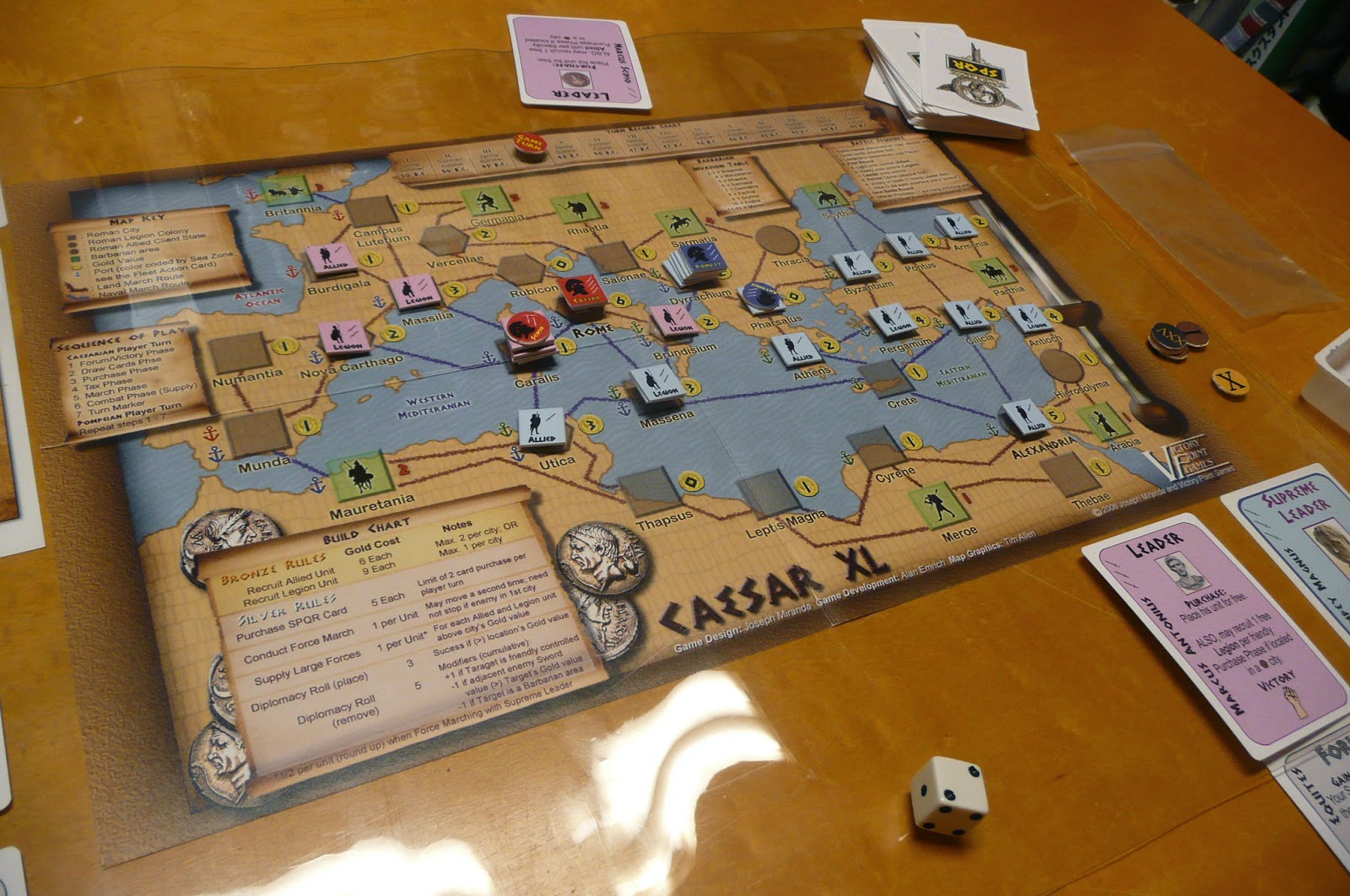
Roman Civil War in 90 minutes

I've got the game Caesar XL by Victory Point Games on my table at the moment.  It's a two-player strategic-level take on the battle for supremacy between Caesar and Pompey.

Using only 40 counters, a small sized map and a number of cards it doesn't take up much space to play. The rules are easy to figure out and seem to be complete to this point (ie, I've had no questions that the rules don't answer), which is a lot rarer than one might think!

It's turning out to be a fine little game, even when played solo, which is especially good for me. There are some lovely little touches such as legions being able to increase in experience over time and the cards add in some nice twists and a bit of historical flavour, usually manifested in the ability to recruit extra forces, fill up the coffers, or up performance in a battle.

One credibility strain is that leaders (aside from the big two themselves) arrive throughout the game by card draw, so Cato can end up fighting for Caesar or Antony throwing in his lot with Pompey.  To balance this quibble, the victory conditions are quite clever and add an extra level of decision making to the whole.

I do wish that the counters had been die-cut more evenly and the map image was higher resolution, but as VPG is a small operation such things are easily forgivable, especially when they don't detract from play.


I'm only one play in but indications are it will be a keeper. You never know, on candlelit occasions with the kids in bed I may even be able to convince my wife to give it a go!


Wednesday, May 21, 2014

Author of the Month: Patrick O'Brian

Picture borrowed from The World of Patrick O'Brian website.

As a kid I used to enjoy reading tales of adventure and derring-do on the high seas. The defeat of the Spanish Armada, tall tales about various pirates, books on men-of-war - HMS Victory in particular - and accounts of Trafalgar all passed before the eyes at one point or another.

But sometime during the teenage years my tastes changed and gradually I forgot most of what I had read and even why I had read it in the first place.

An interest in stories naval was however recently rekindled when, after my wife gave me a well-known e-reader as a Christmas present, I discovered the Aubrey/Maturin series by Patrick O'Brian amongst a massive stash of mobi-format books sent by a friend.

I hadn't read any of the books before, but having heard them mentioned favourably I started reading "Master and Commander".

It was an immediately engaging book. Witty and at times genuinely funny, O'Brian employed an array of voices and beautifully drawn actors to portray the character of a ship and the men who sailed and fought her. I was hooked from the beginning.

Over the next few months I read through the books one after another, rejoicing in Aubrey and Maturin's triumphs, laughing at their quirks and feeling their tragedies. I came to know them both: their loves and their families; their interests, hobby-horses, idiosyncrasies and struggles; their ships, shipmates, and enemies; and, as far as you can with fictional persons, what was in their hearts.

Last week I finished the last of the series, "Blue at the Mizzen", and have been pining a little, in the way you can when something that you don't want to end eventually must.

If the books are taken as single items they are not going to come across as masterpieces. But when read as part of a whole they have a cumulative effect that is wonderful. I can't remember having laughed as much at any books since I was a kid reading Billy Bunter, nor having been as deeply moved by scenes since I first read Lord of the Rings way back when I was ten.

Although I'm writing this as an author of the month post, in Patrick O'Brian's case it should really be author of the year.

Wednesday, May 7, 2014

Simple Zama

I had the chance to have a couple of friends come over for a game the other night and in line with recent musings about accessible rules I decided to try out a 'derivative ancients' scenario.

Units and combat were based on Commands and Colors: Ancients, but without the heavy/medium/light distinctions.

Four figures per base meant four attack dice, three figures three attack dice and so on.  All movement was by hex, as per CCA, and shooting was as javelin-armed shooting in CCA.  Unit casualties were removed in bases so it would be easy to see how strong/weak the units were.

Most of my CCA boardgame gear is back in New Zealand, so we used normal dice for fighting and although I have some cards here we used die-roll activation rather than activation by card play.

Activation pips were d4+1.  It cost one pip to activate a single unit, two pips to activate a line fighting or all moving at the speed of the slowest unit and three pips to activate a line moving or fighting at their own speeds.  Leaders gave a one pip discount to line moves, but lines could not extend across left/centre/right boundaries and nor could they exceed five units.

The activation rules were simple but they gave plenty of scope for players to do what they wanted to do while also giving them some tough decisions to make.  It also avoided adding the extra layer of complexity that using a card system for activation would have entailed.

The scenario was going to be important. I went for a famous battle that had both sides fairly evenly matched and that did not have much in the way of terrain to worry about.  Given the armies I have painted at the moment, Zama was the obvious choice.

I would umpire to give rules advice and help keep things going if the guys got bogged down with options.

To win the game would require nine victory points, with VPs to be scored by destroying enemy units.

The first picture (below) shows the game after the opening move, in which M (as Rome) advanced his light infantry to pepper the elephants and the left wing to threaten the Carthaginian right.


B (as Carthage) responded by shielding the elephants with his own lights and advancing cavalry on both flanks.


Rome took a points victory in the tentative tussles on her right but Carthage got a clear advantage on the other flank (seen below) by virtue of some bold cavalry attacks.


B opened up a 6-1 advantage in unit kills over the Romans and it seemed that Hannibal might have an easy win.

But things were not quite as one-sided as it would appear from the score alone: the Carthaginians had six units reduced to just one remaining base, so if the Romans could get in close enough they would be able to even things up reasonably quickly.


But this was the time when Rome went through a low-pip period, and her attempts to polish off enemy units with missile fire from the Numidians did not go to plan.  Still, the Roman advance got underway in the centre, which caused B to worry for his elephants again.


As M's missile volleys drew closer, B advanced troops out of the line in an attempt to drive off the offending velites. In the confusion the Romans began to score some successes against those already reduced Carthaginian units, bringing the victory count to a more respectable 6-4, and opening up the possibility of picking off some more (if only the javelin men would shoot straight!).


With the pressure building in the centre B sent forward a unit of elephants to hit the Roman heavy infantry, but he could not quite finish them off.


In the counter-attack the elephants were destroyed and two other units with them.  It was now 7-6 to Rome as her remarkable comeback gained pace.


Carthage committed a second elephant which attacked a unit of hastati and while it died in the attempt it took a Roman commander with it.  Still needing one more kill to win the game, M could not quite manage it this turn as he failed to kill off the auxiliaries.  With the score 8-7 to Rome, B and his Carthaginians took up the pip die once more.


With two unit kills needed to claim the victory for Carthage, B threw in everything he could - elephants, Spanish auxiliaries and Gallic warriors.  If they did not win they would be killed in battle back, giving Rome the victory. It was to be knife-edge stuff...


And knife-edged it proved to be: with his last two throws of the dice B managed to kill off the stragglers and claim the last victory points he needed to leapfrog his great mate M and win 9-8.

It was an exhilarating game that had a bit of everything and I was very pleased with how it all went. I think it vindicated the simple rules approach and the 'give-the-players-the-options' command rules.

Both players had a great time and are very keen to play again at some stage, so a good result all round!

Thursday, May 1, 2014

Quick (and extremely derivative) Ancients rules

As I try to work myself back into gaming mode again I've been going back to an idea I had a couple of months ago for a kid-friendly, language independent miniatures game.

The plan was to base the rules on Commands & Colors and to have the table layout give the players most of the information they need to be able to play.

Infantry units would be represented by four bases and have four strength points, cavalry would be represented by three bases and have three strength points, elephants and war engines by two bases and have two strength points.

Four-figure bases would roll four attack die, two-figure bases two attack die, and so on. Missile fire would be restricted to troops armed with javelins, slings or bows, with one attack die lost if units moved before shooting.  For each strength point lost, units would have to roll a die pre-combat.  If a one was rolled they would lose one attack die.

Non-missile units would hit on fives or sixes and missile units would hit on sixes, whether using close or distance combat.  Leaders would either add an extra die or allow hits on fours.  Ones could, in some cases, cause a retreat.

Movement would be regulated by a hex grid such as a I normally use for true C&C games.

Activation would be by d4 roll, with one pip allowing a single unit to activate and two pips allowing a line of connected units to do so.

Players would be represented on table by leader figures and might be able to fight hand to hand against enemy leaders if they wanted to, a la Warhammer Fantasy Battle.

To win the game you'd need to kill a certain number of enemy units.

If used with my students I might allow a few extra rules: if they were able to remember to use certain sentences, for example, they might be able to roll an extra attack die, or move one hex farther than usual.

The main thing though is to have something fun and accessible for the cousins / kids' friends to play when they come to visit.


Related Posts Plugin for WordPress, Blogger...