With some Civil War reading on the go at the moment I had a hankering to play an appropriate game. As most titles of that ilk on my shelf are of the 'need to stay set up for a week or so' variety, I betook myself to Table Battles from Hollandspiele for a bite-sized chunk of action, namely the 2nd day at Gettysburg. Whether that was the right call or not will be elaborated on at the end of the post.
Table Battles owes a heavy debt to the excellent W1815 by U&P Games, and while the former has the advantage of coming with lots of scenarios, it does not have the lovely map that accompanies the latter. In fact, Table Battles does not come with any maps at all: battles are represented by unit cards placed side by side and sticks as strength markers.
The lack of geographical setting takes away much of that 'we're playing a battle here' feeling I value in my wargames, so I decided to set out the unit cards and associated strength markers in the rough shape of the battlefield in an attempt to give more of a connection to the historical event.
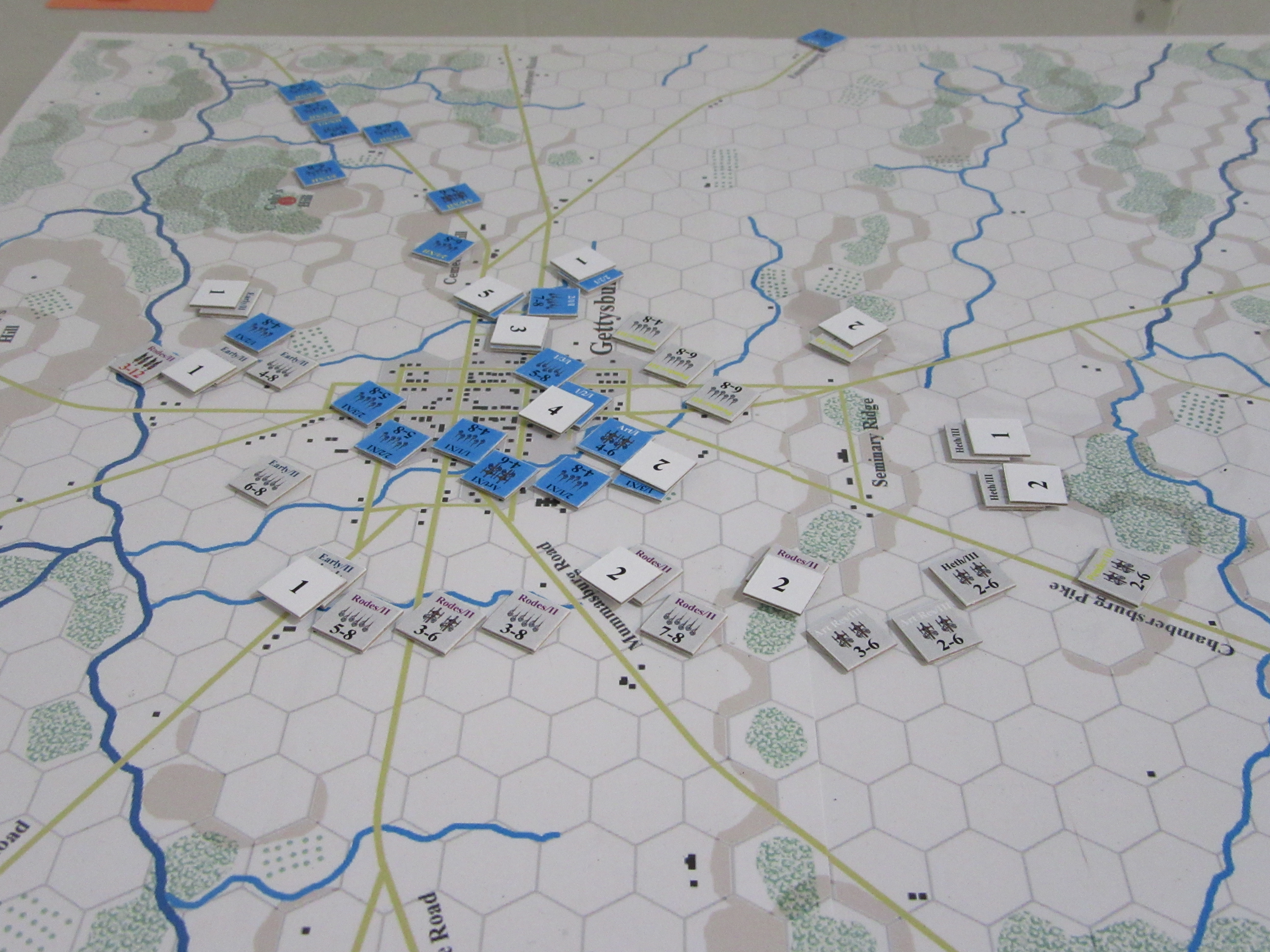
I'm sure most if not all readers will know the general picture of the dispositions of the Union and Confederate armies on July 2nd 1863, but as a reminder here is a map from wikimediacommons, and the Military History Fandom site.
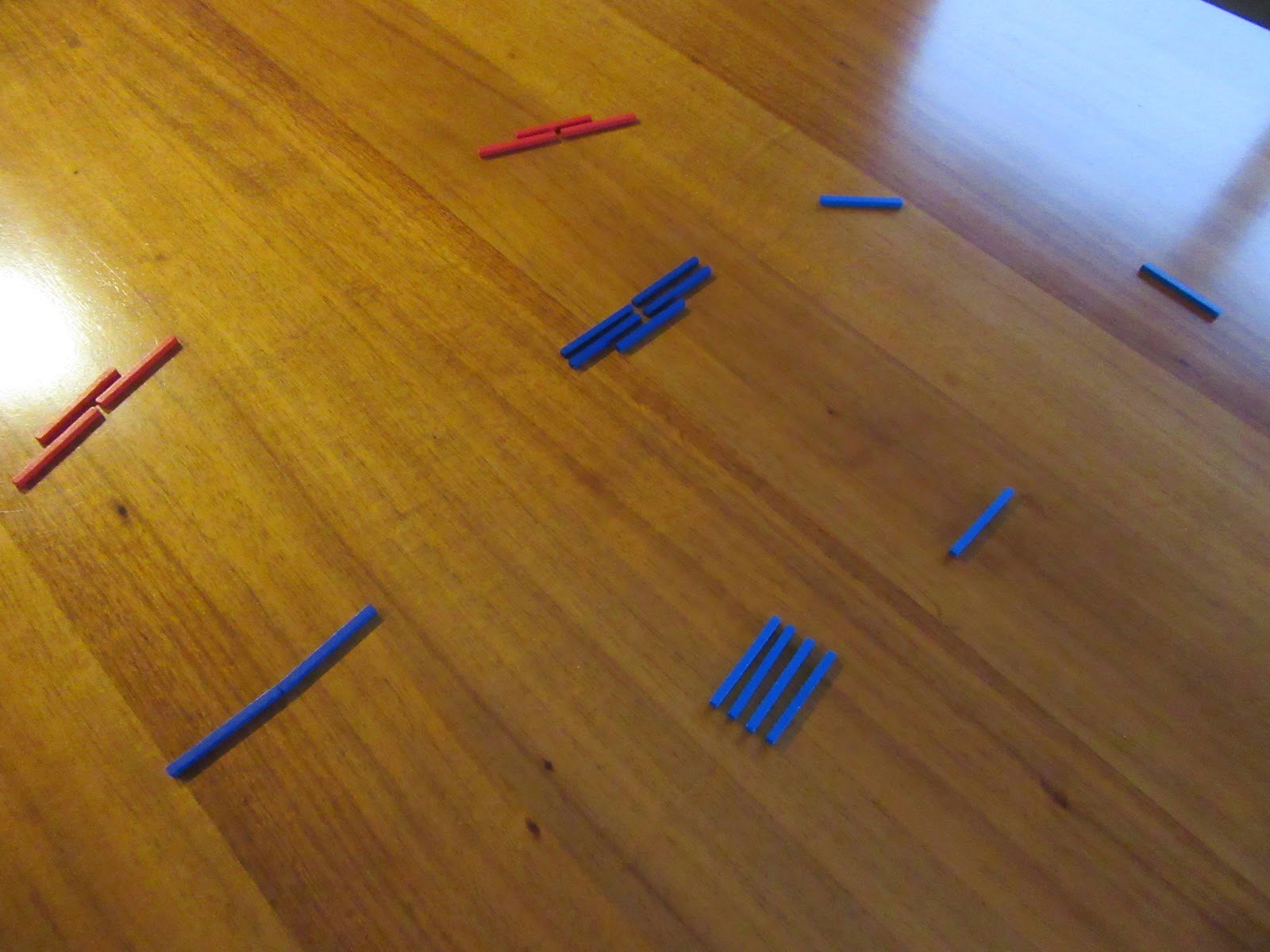
The Table Battles scenario, moving from the Union left around the Union right, has two strength sticks on Little Round Top, opposed by Hood's division with four strength points. Sykes has four strength points to use to replace (absorb, in game palance) any Union losses suffered on Little Round Top.
Moving back to the main battle line, Sickles, with six strength points, is faced by McLaws, with five. Hancock, at strength eight, is the heart of the Union line, and he is matched against Anderson at strength five. Howard with six strength holds against Early with five, and at the extreme end of the line Slocum, at a strength of just two, faces Johnson with four.
Meade is present as well, with the ability to allow Union units from the main line (i.e., excluding Little Round Top) to absorb losses for any other unit on the main line. Two damage scored on Howard, for example, could be transferred to Hancock, who may be better able to take the losses at that particular juncture.
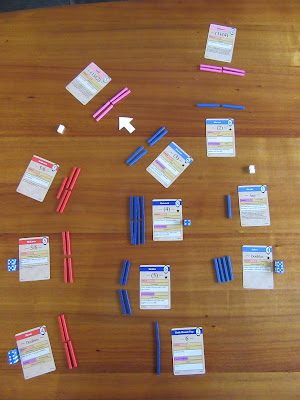
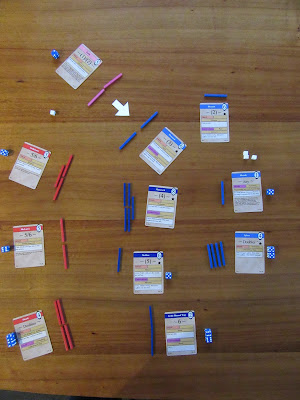
This is what my set up looks like (forgive the poor approximation of the battle map!):
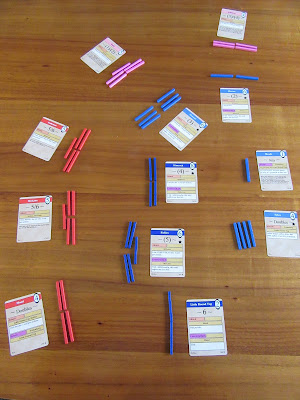 |
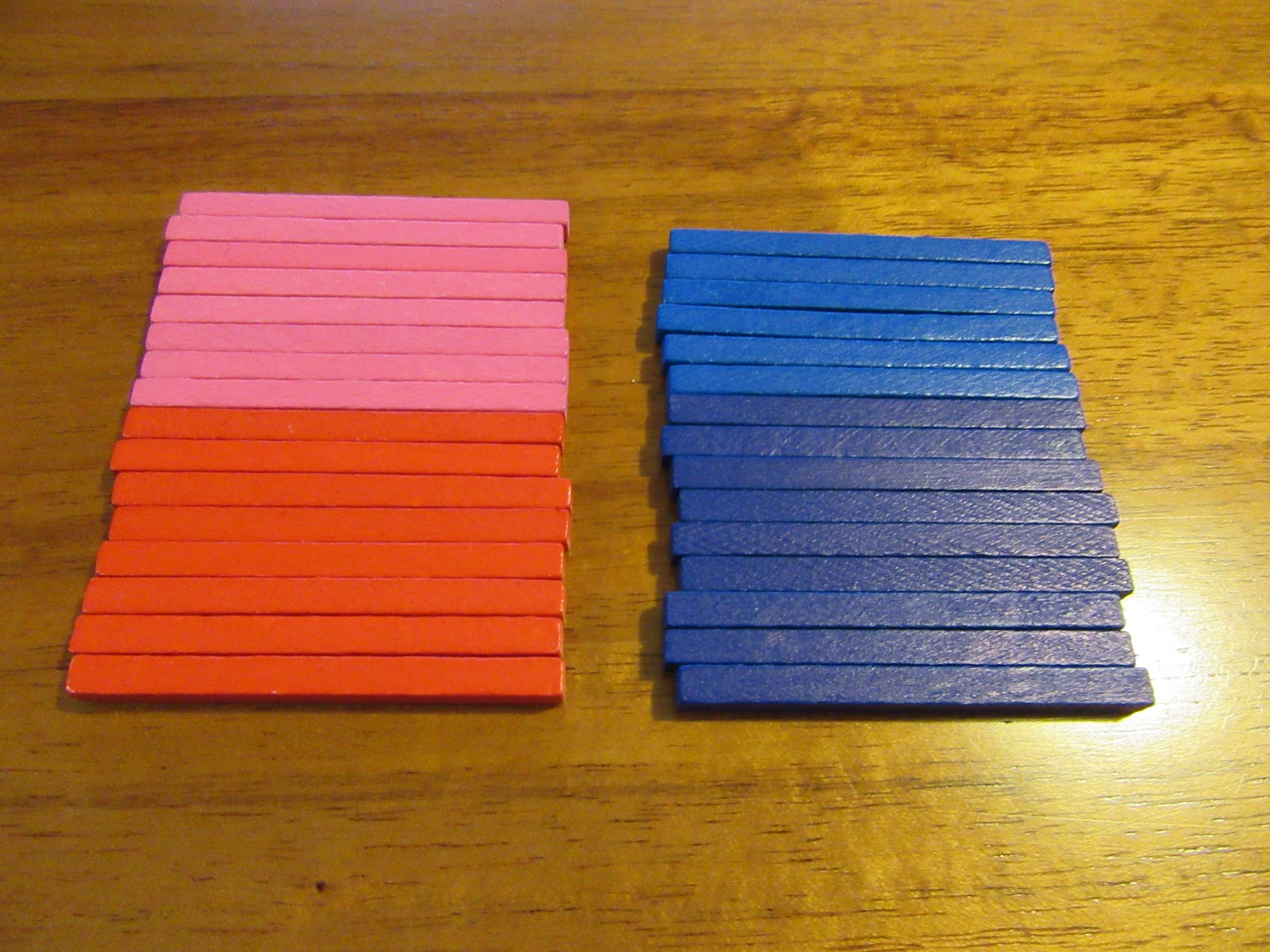
| Confederate wings are red and pink; Union ones light and dark blue. |
In Table Battles each side has a pool of six dice, which are rolled and assigned to unit cards to allow those cards to activate on a subsequent turn. Limitations are that dice can only be placed on one card of any particular colour per turn, and in the case of the Confederates units must wait for dice to be loaded onto first Hood then McLaws before they can be added anywhere else.
The Confederates have their best attacking opportunities with Anderson, then McLaws, then Hood. Every attack will also reduce their own strength, but the more dice per card the more damage can be inflicted on the Union troops. The Union, for their part, have the ability to counter-attack, which will increase the damage on any Confederate assault, and reduce the damage they take themselves. The trick for the Union is to load dice on the correct cards at the correct time to use the counter-attack ability, and use Meade's absorb feature to spread losses across the line so that no one unit becomes vulnerable to defeat. Union attacks, particularly against Johnson and McLaws, can help to break up the Confederate charge.
Without further jawing, let us move to the battle itself.
After dice build up on both sides, the action commences with McLaws attacking Sickles. McLaws does two damage and takes one himself, reducing strength to four and four.
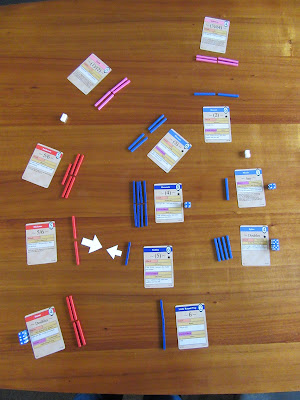
Howard then attacks Early, for one hit to himself, two to the enemy, leaving five and three blocks respectively. Unfortunately, I can see that I made a mistake here and did the hits the wrong way round - one off the Confederates and two off the Union!
Another attack from McLaws sees Sickles in strife and down to one block. The counter-attack ability has however taken two blocks off McLaws. Any further attacks by McLaws on Sickles can be transferred to another unit by using Meade's absorb ability.
Already it is clear that the Confederates have few good attacking options: they can wear the Union down, but to do this causes so much damage to themselves that breaking the line will become almost impossible. Nevertheless, they persevere.
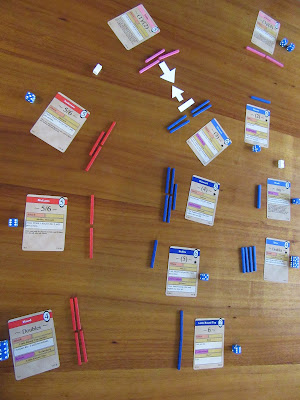
Anderson now attacks Hancock, but the counter-attack means both sides lose two strength.
Johnson batters himself against Slocum.
Early attacks Howard, but Hancock takes the damage.
These no-advantage attacks by the Confederate are required to force the Union into counter-attacks. If the Union gets a free turn (i.e., they are not forced to counter-attack), they will be able to attack McLaws with Sickles, exhaust both units, and prevent any further dice being added to Anderson by virtue of the special rule that dice can only be placed on Anderson if there are dice on McLaws. For this reason the Confederates must keep attacking and hope against hope to get good enough rolls on their allocation phase to load up on Anderson and deliver a killer blow. The Union however need only sit tight, absorb losses, and wait for the opportunity to hit McLaws.
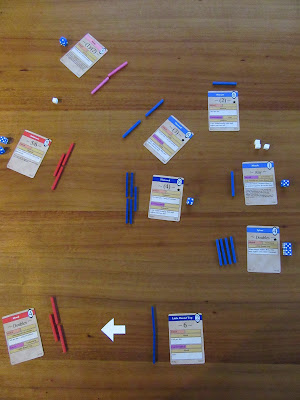
Johnson self-immolates for the cause.
Then Early attacks.
No counter-attack is forced, and the Union is now free to use Sickles to attack McLaws.
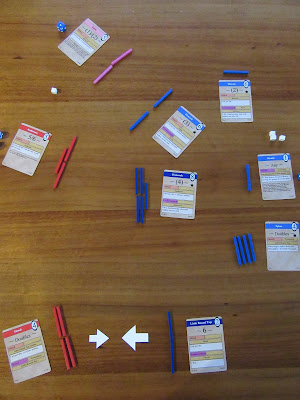
And that is effectively the battle decided. It is now over the Union to clean up as they will. The troops on Little Round Top attack Hood twice in succession.
The Confederates are no longer able to place dice anywhere but on Hood, and it is just a matter of time before the Union administers the coup-de-grace.
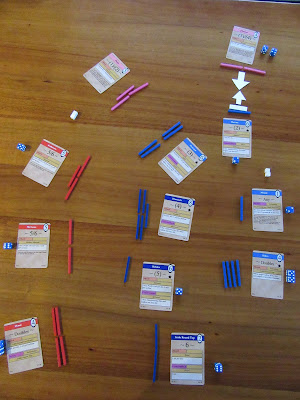
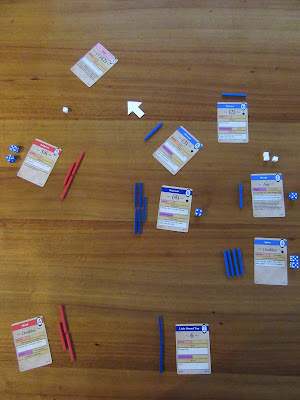
It comes against Early and the Union has held the high ground.
The casualties favour the Union by one. The Confederates have expended themselves to no good end.
And so the battle is over.
As I am increasingly finding with Table Battles, the effort expended to play the game (much less write a report) is out of all proportion to the reward. The game only approximates the battle it purports to represent, and is more like a hand of cards than a wargame.
The central difficulty with Table Battles is that, unlike with W1815, the dice rolls come before the decision. In W1815 you make your decision and take your chance; in Table Battles you take your chance and make your decision. Once dice are allocated to a unit they cannot be removed until an action or reaction is taken, so there is no flexibility in changing the point of attack. When an opposition card has a counter-attack die on it, you can see the situation is hopeless ahead of time but must do an attack anyway to free up dice to roll for more activations on the off chance that you might roll, say, two fives to put on a powerful unit, and then hope that the enemy will roll something less useful.
Some scenarios such as this one are heavily skewed towards one side or another, and there is no way to assess one result against another over a series of games to find a winner. It is zero-sum win or lose. You cannot, as you can in, say, Commands and Colors, keep track of victory points scored by each side and compare after a game apiece to find a winner. You could assess casualties, but casualties themselves are not the focus of play - the focus of play is scoring casualties in the right place, so that you can break the enemy formations needed to get victory squares - so to look at inflicting casualties in total is to deviate from the path to victory.
Playing Gettysburg with Table Battles was one way to get a Civil War game in, but it is not one that I can take any satisfaction from. The more I play this game the less I like it. I liked it more when I was playing the rules incorrectly.
Anyway, I will stop my rant there, but suffice to say I'm annoyed with myself for having bought four expansions!