Prufrock's Wargaming Blog

Prufrock's Wargaming Blog
Showing posts with label thoughts. Show all posts

Friday, September 30, 2022

The changing face of wargaming

One of the things that has impressed me most in the time I've been wargaming is the way that game design has progressed.  

When I started it was with Diplomacy and Warhammer Fantasy Battle, both of which required a certain time investment to play. Warhammer Fantasy Battle 3rd Edition was massively fun at the time, but it took an evening to cost out your army, took all day to fight, and the amount of dice rolling was phenomenal. Diplomacy required eight people (seven if you could get by without an umpire), and by the end of the game your relationship with at least one of those players would be damaged almost irreparably. 

That said, each game was a genuine event, and would be remembered for years.

When I got into wargaming again in the post-university years, it was with process-heavy historical miniatures games - seemingly cut from similar cloth to WFB - and sprawling hex-and-counter games such as those from The Gamers. 

Enter card-driven games -  Hannibal: Rome versus Carthage and For the People, for example - which used point-to-point movement instead of hexes, based victory around control of blocs of territory, and made card play the central decision mechanism. Able to be used in a variety of ways, each card gave players the choice to trigger an event, use the card to perform an action, or try to bury it so that it could not be leveraged to advantage by one's opponent. 

Then there were Commands and Colors: Ancients and Lost Battles: both hybrid developments of earlier miniatures and board game types. Commands and Colors used cards for unit activation, employed custom dice, and provided generic units with customisable battlefields. Lost Battles used a square grid with a lead (as in front, not metal!) unit model to allow tactical match ups, a handicap system to afford outmatched armies a chance at a game win, and followed a uniquely academic approach.

In the meantime both eurogame and wargame designers had been coming up with interesting new takes on old game mechanisms, such as tile drawing, deck building, trick taking, dice hoarding, chit pulling, and bluffing. Friedrich, Maria, the Simmons titles and Sekigahara all helped bring some of these interesting intersections into the world of wargames. 

Then along came W1815, the strikingly innovative map game on Waterloo, which featured static forces, and an action card for each commander, not only designating possible actions as in other card-driven games, but also - brilliantly - functioning as individualised combat results tables. This game on its own has led to an entirely new 'static battle' genre that is being explored by designers to take on previously hard-to-game situations, and its influence is felt almost everywhere. 

Ian Brody's groundbreaking Quartermaster General series has been another landmark modern design. In terms of how cards can be used to introduce player options, create gruelling battles of hand and mind, while also reducing large conflicts to key elements playable in ninety minutes, it is hard to overstate its importance. Who would have thought in 1980 that you could take World War II and play it out as a six-player game in recognisable and satisfying fashion in less time that it takes to complete a game of Risk, and without a die in sight? Certainly not Milton Bradley!

The Quartermaster series has broadened the definition of wargame.

And the dance continues. The Undaunted series has added new layers of depth to map, card and dice combinations in wargames. Solitaire games, using bots, are plentiful - and designers are retro-fitting older games for solitaire play using these new concepts. We are seeing an explosion of impressive fast-playing, decision-centric, bot-soloable, war-themed crossover games that bring in ideas put together in fresh ways by young(ish), crafty designers who are not afraid to defy wargame convention, who have wide gaming experience in different genres, and will borrow and refine from anywhere in the service of the game.  

It seems, at the moment, that possibilities are legion.

What a great time to be a wargamer! 

Wednesday, July 18, 2018

(Warning) A political post

I keep politics out of my posts here, except perhaps for sideline observations about those practitioners of the art who have not read their history books.

But this last couple of weeks, and particularly today, I have been quite disheartened by political events and various commentaries I've read, and where they are leading us (and I include the commentaries in that).

I took my opinion of politicians from my grandfather, who served in North Africa and Italy, and was a man who believed in a fair go for everyone. Basically, according to the Jim Nicol doctrine, no one really trusts politicians. If they don't start a war, cause an economic meltdown, break the law or obviously use their position for personal gain they've done about as well as you could hope. You expect a bit of grandstanding, but when it comes down to it, you demand they put that aside and the needs of the country first.

Like everyone where I come from and of my age, I believe in democracy as a political system. People run for office, tell us what they want to do, and then we vote for them, or don't. After the election we watch what they do and factor that in for next time. Talking politics among friends is fine - and good debate time, if you enjoy being challenged, as I do - but always with the understanding that friendship is more important than any political or debate stance, and that we will agree to disagree when ideas do not align, and that this will not be a problem.

But that was in New Zealand, and twenty years ago.

I was extremely disappointed to read, a week or two ago, in a New Zealand media outlet, an article calling for a perk that was available to elderly people - a subsidy for folks on benefits, including the pension, to help them heat the house in winter when electricity costs are so high - to no longer be extended to the elderly, on the grounds that older people tend to be better off financially than other demographic groups, and because most of them are white. This was done without spending any time examining the simple facts around either of those condemnations.

Then, in the same outlet, there was discussion of a recent New Zealand free speech kerfuffle. This article examined the implications of denying speakers we don't agree with a platform, and concluded that it was a complicated issue, but denying the platform was probably worse. Sadly, the most liked comment on this article proved that neither the commentator nor his 'likers' understood either the article or the concept of free speech.

Then of course we've had more international politics, but I don't want to go into that.

What disturbs me is this: essentially, the ability for democracy to function is being undermined, and at a scarcely believable rate. At its heart, democracy requires an informed, engaged, and parochial electorate (by parochial I mean an electorate that considers wanting the best for country and citizens to be an essential 'good', while also recognising that such is not the only good). To get that within a democratic state we need a number of things. We need common ideas about what is good for the particular state and its citizens. We need accepted ideas of right and wrong. We need a common standard for verification of truth. We need laws, an acceptance that the law is just, that it applies to all equally, and that those wronged have recourse to challenge the law itself when the law is wrong.

All of these things are under threat.

Instead of an informed electorate, we have lifestyle opinions. People are engaged, but upon very narrow lines. Local-issue parochiality has been replaced by selectively appealing global-issue parochiality, and inevitable distortions have ensued. Ideas of what is good for a particular country have been undermined by what is good for the parochial sub-group. Basic ideas of right and wrong are I hope holding up, but it's getting more fraught all the time. The common standard for verification has been bushwhacked. Claims of self-interest, systemic bias and so on have made it very difficult to get acceptance on a common set of public facts, and this has led to competing claims and competing constituencies. The law is seen as something which favours certain groups, and so other groups feel justified in using whatever means to highlight and subvert this (not necessarily in that order).

As wonderful as the internet is for wargaming, in politics it has removed our idiot filter. The newspapers, magazines and publishing houses that filtered discourse and maintained common standards of fact and evidence are no longer the gatekeepers. The internet has become one giant letter to the editor, and those who share similar views congregate and make their own truth.

There is a militant attitude, based around causes, that defines a lot of internet interactions: a strange but understandable sort of mutually endorsing 'belonging' affair. Again, we are confronted with parochial - and often not fact-based - opinions which many people do not have the intellectual tools to treat with discernment.

I'm worried about where we go from here.

I fear as constituents of democracies we are losing our ability to make informed choices. My hope is that innate scepticism and cynicism will come out, even among the parochially engaged, but I am concerned that time may be running out on our old order.

Thursday, July 5, 2018

Caesar

For a project I have on the go I've been dipping back into Caesar's commentaries. Once again, I am struck by the immediacy of the observations, the depth of information, and the quality of the insights. Such a pivotal figure in history, and we are lucky enough to have accounts of his campaigns, and in his own words. It's just astonishing.


Picture from here.

As works of history they are invaluable; as works of literature they are brilliantly composed; as persuasive, case-building and legacy-securing texts they do their job to this day. They are an astounding achievement.

The man was of course a butcher in a time of butchery, but he was not a spiteful one. He preferred to win loyalty and exercise clemency when he could. By comparison to the murderously vengeful Sulla who came before him and the callous and devious Octavion who came after, he was an honourable man.   

But that's not really my point: my point is that when you read Caesar you begin to understand on both an intellectual and a visceral level the kinds of things that an ancient commander had to deal with. You see what he had to take into account before a battle, during a battle, and after the fight was over. You see what went into a successful campaign. You see what led to failure. 

Anyway, whenever I get back into reading him I am always made forcibly conscious of how fortunate we are that the commentaries survived, and how much poorer our understanding of the man and the era would be if they had not.


Wednesday, June 13, 2018

"We love to share"

I was just reading through my facebook feed this morning and saw this comment from Chris S, a member of one of the wargaming groups there:

I think the best thing about being new to wargaming is that there are so many of us around that did not have anybody to teach us so we had to learn on our own and we love to share.

It struck me as being an excellent observation, and certainly true to my experience. While a lot of wargaming is solitary (army research, painting, rules learning, solo play, etc) Looking back over my wargaming history, there are a few landmark 'shares' which really set the course I've followed.

1) The library and its copies of books by Don Featherstone, Charles Grant, Peter Young.

2) My school friends. We would swap toy soldiers, give each other things we didn't want any more and generally pool resources. Our play wasn't formal gaming at all, but it planted the seed.

3) My mate's brother. He had Warhammer Fantasy Battles 3rd edition, figures, and a table. These he shared. That hardback book was passed out so many times it's probably just tattered paper by now, if it still exists at all.

4) TMPers, BGGers and yahoo groupers. Back when I came into the hobby of my own volition The Miniatures Page, Boardgamegeek and various yahoo groups were brilliant places. So much advice given on painting, figures, games, rules and ways to approach wargaming. I owe a great debt to those people, some of whom I still have as email, blogging, or VASSAL buddies.

5) Luke Ueda-Sarson. Can't say enough about Luke. Luke was one of the first people I met face-to-face in wargaming, and we've been gaming buddies for over ten years now. He showed me on the first day we met how a base was flocked and how good a big army looked, and has shared so much knowledge over the years that I don't know where to start in recounting it. He has basically been the model (in miniatures gaming at least) for my approach.

6) Pat Hirtle and Andrea Tosti. What Luke has been for miniatures, Pat and Andrea have been for board wargaming. Can't offer much higher praise than that, really!

7) Bloggers. Such a lot of good information, inspirational material, and encouragement around.

I'm sure we've all benefited in some way from other hobbiests sharing their knowledge, advice, time and toys with us. The attitude of helping others and sharing what we know is one of the things about wargaming that I value most. Long may that continue!

Monday, May 22, 2017

The tottering giant


Ever since I've been a proper wargamer, the miniatures page forum (TMP) has bestrode the virtual wargaming world like a colossus. It's been the place to go to for news, general info, chat, and good advice; the spot to meet like-minded enthusiasts, to share a recent thrill, post a link to a latest game report, or hear the things in wargameville that are exciting people.

Being myself physically distant from any other miniatures gamers, TMP and TMPers taught me most of what I needed to know about collecting, prepping, painting, researching and so on when I first got into the hobby. Of course, there were other good places too (and good people - thanks Luke and Pat), but if you needed to know something right now, or if you were facing a conundrum and wanted to see how others with more experience had handled that same issue in the past, or if you wanted interesting discussions, TMP was indispensable. In fact, I would not be a wargamer without TMP, and I owe it and its denizens a huge debt (in more ways than one, says my wife. Ha!).

So the fact that things have not been right there for quite some time, that periods of calm followed by bitter and seemingly unnecessary blow ups over peripheral things that have nothing really to do with the primary aspects of our hobby contrive to drive more and more people away, is a great shame.

I finished up my membership there in January or February of this year, for reasons which I won't go into, but I still drop by as a casual viewer.

All things go in cycles, and as I've said here before, there seems to be a trend in the hobby towards fracturing, but it's a shame to see such a formerly (and, for me, formatively) influential place in such a bad way. Maybe the editor at TMP has just been doing it too long and has had enough. It's hard to maintain enthusiasm and keep perspective on one thing for as long as he has; perhaps he's just worn out and hasn't quite seen it yet.

I think there was a tremendous amount of goodwill around TMP for a long time, but it seems to be running on empty at the moment. Some people with a bone to pick are glad about that, but I am not glad about it at all. It was a huge help to me and I don't enjoy iconoclasm for its own sake.

In the end though, it's only wargaming; it's no great matter. Still, for a time, it was about as good as a wargaming warren gets, and, being the place that nurtured me as a fledgling gamer, worth remembering with fondness and gratitude.

Tuesday, August 11, 2015

Basing schemes for smaller armies

As my 'Dip' experiment turns into a project, thoughts naturally turn to how many of the little metal blighters I need, and how I'm going to base them.

As background, a couple of years ago I ordered the DBA 2.2 rules and took advantage of a generous offer from Essex miniatures who were doing a 3 for 2 sale of their DBA 15mm armies. I decided I'd like to get into a Dark Ages / 1066 campaign, and so picked up 6 armies, adding a couple more, specifically Crusaders and Syrians.

Unfortunately, I've since found that I don't like small armies - and DBA armies are small! - but nor do I like the period enough to mortgage the house so that I can paint up armies to the size I do for my ancient fetishes fixations.

My problem therefore is twofold: I don't want to play DBA; nor do I want to build massive armies for what is (for me) a period of only secondary interest.

The first thought I had was to base them up on x4 bases (ie, 80mm x 30mm) for infantry, and x2 bases for cavalry (also 80 x 30), but I think that DBA armies spread out on bases of that size are going to look rather forlorn.

Instead, I think I might use the 28mm DBA scheme (60mm x 20 / 60mm x 40mm). This should allow me to get away with 8-10 15mm infantry or 4-5 15mm horse per base without the lines looking too sparse. The downside is that my basing won't be compatible with that of anyone else, but as I am going to provide all the armies anyway, I don't see that being a major problem in the foreseeable future.

The plan as far as rules go is to use Dux Bellorum (modified as needed), which means that I'll require somewhere between 7 and 10 units for each army. I may have to buy in a couple of extra packs of figures here or there, but first impressions are that the armies I have when mounted on 28mm DBx bases should just about hit the spot.

Now, with that sorted I can get back to painting!


Friday, June 7, 2013

D-Day +1

One of the things I always remember on D-Day concerns no one who was there.

When I was studying at university I had a friend who was what in those days was called a mature student.  What that meant was that he was a guy who, having spent twenty-five or thirty years slaving his guts out in a job he disliked, had decided to quit the job, enroll at university, and study the things he'd never had the chance to study as a young bloke.

We were regular mates for a few years, and around the time that the movie Saving Private Ryan came out, he and I met one Friday afternoon at the bar, as we usually did, and amidst the talk of rugby and books the subject of the movie came up.  I remember saying that one of the interesting things about it for me was the mix of cliche and anti-cliche, and that I wasn't sure if I'd liked it.  He then sat back for a moment, took a swig of his beer, and told me that he had never known his father.  I nodded and said that I could perhaps understand what that might be like.  He then said that his mother had married a fellow after the war, and that he'd always considered this man to have been a father to him, and that no one could have asked for a better father than this man.  Again, I nodded.  He then told me that his dad had been killed in the landings at Dieppe, and that this was the reason why his biological father and mother had never married.  I felt pretty bad for him at this point and didn't know what to say except to say how sorry I was to hear that.

He sat back for a moment more and then said that after having watched the first 20 minutes of Saving Private Ryan, he now had an idea of what his father's last moments in life must have been like.

So when I think of D-Day I always think of Andrew, the father he never knew, and the man who took on that father role in Andrew's life.

Some years later, in Japan, I told Andrew's story to a student of mine.  The student was a-typical: he was an 80 year old doctor who had fought in the Pacific war, had kept himself sane at the time by playing Go - and at the time I knew him by denying that Japanese had committed atrocities - and had been periodically bombed by Australians.  He always used to joke with new teachers or new students that he and my grandfather had fought each other in the war.

During one particular lesson I was asking him about his favourite movies, and as he listed them it turned out that almost all of them were war movies.  I wondered if he'd seen Saving Private Ryan, and as he said he had, I told him Andrew's story.  Well, during my telling of it the doctor's usual cheerful demeanour changed, and by the time I'd finished he'd sort of hunched over and leaned on the table.  I thought he might have taken ill suddenly, but then realised that he was shaking and opening and closing his mouth in an effort not to sob aloud. I wasn't sure how to handle the situation, so I patted him on the back and apologised for upsetting him, but he shrugged off my hand. Soon he looked up, and without wiping the tears that were still coursing down his face started describing to me the plot of an Italian movie that he had once seen, and he continued on in this way until the end of the lesson.

He never mentioned that movie (or lesson) to me again - though he would still make jokes about our grandfathers' having fought each other.

So now when I think of D-Day I think of Andrew and his situation but also of the Japanese doctor, and how that day and the stories we have of that day have affected all of us, often in surprising ways, and sometimes at not such great remove.


Friday, March 22, 2013

Introducing pre-battle stratagems.


A chap called ToneW at the miniatures page recently posed this series of questions:


Are people interested in gaming pre battle strategies in order to influence the set up of the miniature battle?

If so what do you find are the best methods to achieve this? or are there any rule sets that cover this well?


This is a topic which I have thought about a bit in the past.

I've often wondered if playing a mini matrix game beforehand would not be an easy, low-rules-overhead way to introduce stratagems into an umpired game (if you are lucky enough to have an umpire, that is!).  Each player would be allowed to make one argument for a stratagem and one counter-argument against potential enemy ruses.

The umpire would consider these arguments, rate them on their merits, dice to see which, if any, of the arguments succeeded, and then decide on appropriate in-game effects.

For example, before a typical ancients equal-points field battle, Player 1 might approach the umpire and proffer a "for" argument, which could go something like this:

"I give my troops an early breakfast and deploy them at sunrise.  The enemy has no time to eat and therefore his troops will begin to suffer the effects of hunger as the battle goes on."

At the same time, and without knowing the enemy's "for" argument, he would present a "counter" argument.  Let's say this one:

"To prevent the enemy getting the jump on me, I've had scouts out during the night who will immediately report back to me any suspicious movements, such as marches towards prepared or ambush positions."

The umpire might then decide that although Player 1's "for" argument is reasonable, the enemy has a slight advantage in light troops, so this reduces the probability of such a ruse working.  He gives the argument a 33% chance of succeeding.

Player 2 then approaches him with his own"for" and "counter" arguments.  Perhaps presenting something like this:

"As we are in home territory and know the terrain well, we infiltrate light troops into the wood in the centre of the board.  The troops are able to conceal themselves there until I give the signal for them to show themselves and attack."

His "counter" argument might go something like this:

"The enemy has been relying on local guides, and they will surely get a message to our camp if the enemy has a scheme that they are working on."

The umpire might consider that Player 2's argument is sound, given the situation, and gives it a 50% chance of success.

He now dices for each argument, but let's say for example's sake that both succeed.  In such an event, the umpire would compare each "counter" argument with the successful "for" argument and see how effective it might be in hindering the stratagem.

For example, Player 1's 'early deployment causes hungry enemy' argument is quite well countered by 'the local guide reports enemy intentions', so he gives the counter-argument a 50% chance of succeeding.

Player 2's 'ambush' argument is conceivably countered by the 'scouts out' argument, but feels that local knowledge is against them, so gives the counter-argument a 16.5% chance of cancelling the stratagem.

If we assume that both counter-arguments fail, the umpire will decide the effects of the stratagems and tell the players as appropriate.

He might tell Player 2 that his infiltration plan has succeeded, and he can order those troops from turn 3 onwards, but that the rest of his army is hungry because of the enemy's early start.  He would then note down the appropriate effect in his little notebook, perhaps something like this: "from turn 4 onward, Player 2's army must dice for hunger during the morale phase.  A score of 6 means that the army attacks from then on at a -1, the troops of the ambuscade excepted."

He might tell Player 1 that the enemy is indeed hungry, but instead of mentioning the success of the enemy stratagem he will secretly note that Player 2 has two units of skirmish infantry concealed in the wood in the centre, but their cover will be blown if Player 1 moves any of his units into said wood.

It would be the umpire's job to ensure that the arguments are kept reasonable.  Rating unreasonable arguments 'impossible' would probably help to keep commanders from getting over-ambitious.  It could even be done remotely if the umpire is familiar with the scenario and the rules.  An email exchange before the battle, after which the umpire dices for results and send instructions to the players could do the trick.  Of course, some of the fog of war would be lost doing it this way, but necessity being the mother of invention, no doubt means could be found to retain it as long as possible.


Friday, January 11, 2013

The search for the Perfect Ancient Wargame...


When I got back into miniatures wargaming about eight years ago I had only a vague idea of what I was letting myself in for.  I imagined that I would paint some figures, find a set of rules, and achieve a comfortable wargaming stasis.

The rules set that accompanied my first forays into figure purchasing and painting was Classical Hack by Phil Viverito.  I joined the yahoo group, asked for advice, then ordered the rules and figures for the 2nd Punic War at the same time.  "I'm off!"  I thought.

Three months later, with two small armies painted and a couple of games under my belt, I got an uneasy feeling.  How on earth, I wondered, can it be right to allow a unit attacked by two others the chance to score twice as many hits as a unit attacked by only one?  One on one the maximum hits were three vs three; two on one the maximum hits were six vs six.  It didn't make sense to me.  I tried to get around it by writing house rules.  Then I gave up.

Next up was Simon MacDowell's Legio, which a fellow ancients enthusiast was modifying.  I was very keen on this and had lots of ideas about how to reinvent the wheel.  We engaged in lengthy email discussions.  Some months later, I realised that I did not really know what I was talking about, did not yet have enough figures for the game, and did not like two of the key mechanisms in the set, namely dicing for control and the variable move distance.

During this phase I also ordered a number of other rules and downloaded a few free or community sets: DBM, Armati, a diceless one, the Crusades set Shattered Lances, Hoplon, and some I now forget.

By now I had been introduced to another ancients gamer who lives a couple of hours north of me, and he showed me DBA, DBM, and Strategos.  I joined the Society of Ancients and we both ordered a copy of Strategos II.

Around this time I discovered a new boardgame called Commands and Colors: Ancients and grabbed that.  I joined the online community and spent a year or two playing countless Commands and Colors games live using VASSAL or solo at home.  I was a member of boardgamegeek, wrote some reports, took photos of the game with miniatures, partook of spirited debates and so on and so forth.  I won a couple of competitive but gentlemanly online tournaments and started to think this was the best game going round.

But there was a problem with Commands and Colors that nagged at me: it was much better played online or as a boardgame than it was played with miniatures.  Sure, it looked nice, but half of the units hardly moved at all during the battles, and it slowly became apparent that the attraction of Commands and Colors was not after all playing out an engaging alternate history, but the thrill of how you handled your cards, positioned your units, rolled your dice and bluffed and outwitted your opponent.  There were great depths to the strategy, but no matter how hard I tried to convince myself otherwise, the reality was that that strategy did not have much to do with what I was encountering in Livy, Caesar, Polybius and Plutarch.

And on the home front now we had a daughter.  It was a harder to commit to online tournaments.  I could play, but not every week or two.  I began rationing the tournaments I played in and quietly slipped out of the scene.  I commenced looking for other games to play, ones that I could jump in and out of in better sympathy with domestic rhythms.

I started playing a bit more Strategos II.  Of course, I was playing every few months with my mate in Osaka, but I began giving it the odd go solo at home.  I'd write up a report for the yahoo group, or for  boardgamegeek, and I started to see how well it played and how well it reflected what I was reading in the ancient historians.  I became enthusiastic, as is my wont with these kinds of things.  There were grand discussions on the yahoo group.  I learned a lot about how to approach the primary sources.  I wrote a review and an article, I bought the newest edition, Lost Battles. I started a blog, began photographing, recording and writing about games.  I began playing other rules sets occasionally, in desultory fashion: Basic Impetus, Ancient and Medieval Warfare, Ancients D6, Warhammer Ancients.  I had PBEM games.

It was good, but it all lead back to Lost Battles.  In Lost Battles I could see the narrative.  The story of how the game unfolded struck me there more than it did anywhere else.  Everything made sense, was plausible, and could be explained in real terms.

As I played more I organised a couple of multiplayer online games of Lost Battles, mainly to teach people the game, but also to see how it worked with a chain of command superimposed.  The game and its multiplayer rules sort of worked, but participants got a bit annoyed about the limitations of the format and some players didn't get the rules very well or decided they didn't really like the set after all.  There was perhaps a little frustration or bad feeling, and that was the very opposite of what I was trying to generate.

It wasn't the multiplayer success I was hoping it would be.

By this stage we had three children and it was increasingly difficult to find time to pursue hobby activities at night.  The number of solo games I was playing dropped off, but there was a big push on the boardgame version of Lost Battles, and I got excited about it.  I wrote a review, played a number of games, had a good time; but without the spectacle of playing with figures I couldn't quite get into it as much.  It didn't scream at me to take it off the shelf.

I found when I did play with miniatures that I had played - almost to death - the scenarios I had the figures for.  I fiddled around with some rules changes, tested a friend's low-luck variant in a couple of email games and thought about how I could get a campaign going.  Again, there were periods of enthusiasm, but I couldn't sustain it as I had previously.

I decided to freshen up.  I got Warmaster Ancients and Hail Caesar and played a few playtest turns of both.  I tried looking at Field of Glory again and promptly looked away.  I went back to Commands and Colors for a game or two and was reminded anew that it was fun and skillful but just not really that good as a miniatures game.  The amount of effort it took to set the game up and move the figures around was disproportionate to the reward.  And I couldn't find a story in it that could rise much above the game mechanisms.  There was both too much inaction and too much action.  It was out of kilter; unbalanced.  I couldn't get a plausible 'game-as-alternative-history' story out of it unless I was prepared to make things up or play sub-optimally.  It would always come down to "and then X card was played and some good dice rolling got side Y home," because that's where the interest was: how and in what way the cards were played, how you exploited the weaknesses of your opponent, and whether the dice supported your play.

So, there I was.  As far as Lost Battles was concerned I'd run out of scenarios to play solo, I couldn't get a campaign started, development of the VASSAL module had stalled, I was out of steam, and other alternatives were not quite what I was looking for.

In view of this I decided to challenge myself to write some rules of my own that would work with non-wargamers.  I'll give it a go, I thought, and try to see things with new eyes.

The whole project was stimulating, and in doing it I developed a better understanding of what designers must do, and how they must target certain things at the expense of others.

What I see now is that there is no perfect wargame, and no "comfortable wargaming stasis".  There is no one game that will be right for all situations. Rules will grab me for a season at different times, and for different reasons. Their immediate appeal will wax and wane, but if they are good I'll keep coming back to them, seeing them again from different angles, with different ends in mind, and hopefully with new understanding of what they are trying to do, and of what can be reasonably expected of them.

It's taken me a while to reach this point, but it has been a wonderful journey through a world that is part history, part alternative history, part mathematical framework, part participatory drama.  It has been experienced alone, with friends, with strangers via a computer, and with kindred spirits across the wargaming spectrum.

Long may it continue.

But if I could find perfection within a wargame (we can always live in hope...) what would it look like?

I think I'd see it in those moments within games when all is balance, excitement and potential, in those times when something echoes history so keenly it jolts us, when the satisfaction of a plan well made, a move well executed, or the observation of a brilliant, mournful, heroic, tragic tabletop action fills us with a childish delight in play allied to an adult awareness that this world we create, this little space that is ours, where this cinematic, dramatic need to enact stories on our tabletops is fulfilled is - in its very fragility, in its practical uselessness, in its capacity to lift our spirits, reveal aspects of ourselves to ourselves and heal the little wounds of the long day - something that is worth doing, worth recording and perhaps even worth a little celebrating.

And if you can't have perfection, I've found that rolling double box cars to order makes a pretty good substitute!

And for readers (if anyone has got this far, thank you!) do you have a perfect or close-to-perfect set?  What do you see as 'perfection' in a wargame, and what will mar one?  Have you found a comfortable stasis, or are you too something of an itinerant?

Thursday, October 18, 2012

Caesar's Conquest of Gaul.

Caesar’s conquest of Gaul is one of the most successful invasions and subjugations of a people in history.

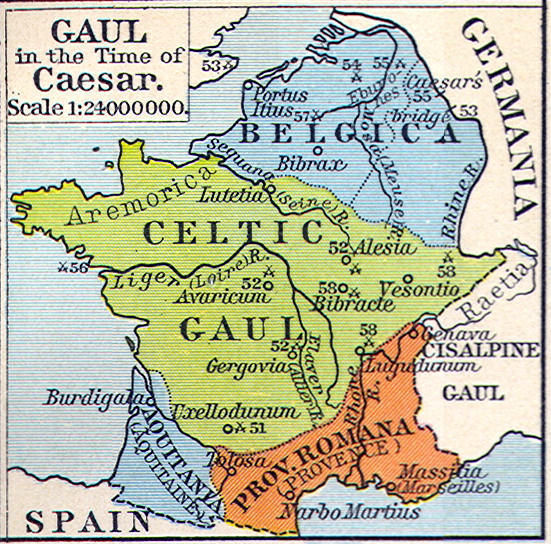
In Caesar's time, barbarian Gaul was – as the man himself so famously observed - divided into three parts. The Belgae inhabited the area that is modern Belgium and the Netherlands, bounded by the Marne, the Seine, and the Rhine. The Celts occupied the region from the Marne and Seine to the Garonne in the south and the Rhone in the east. The Aquitanii controlled the area south of the Garonne to the Pyrenees, constrained in the west by the Atlantic Ocean and in the east by the Roman province.

Map from the heritage-history.com website
http://www.heritage-history.com/maps/shepherd/shep038a.jpg 
The Gallic tribes were warlike. Frequently fighting amongst themselves, subject to ancient hatreds, forming alliances based upon friendship, conquest or shared interests, they were, according to Caesar, passionate, willful, easily lead and easily discouraged.

They were in awe of the Germans who, in their periodic ventures across the Rhine, had time and again proved themselves hardier and more formidable in the field than their more civilized Gallic cousins.

At the time of Caesar, Roman traders were already established in many areas of Gaul, bringing wine and other luxuries in exchange for slaves and raw materials. Rome had established friendly relationships and more or less formal alliances with some Gallic and German entities, most notably the Aedui. For Rome’s prestige it was important that her friends a) accepted Roman direction and b) were materially improved by the relationship.

Into this jumped Caesar. Rightly or wrongly, he found a pretext for war, and between 58BC and 50BC proceeded to bring Gaul into the Roman fold, defeating his enemies in open battle, by siege, on sea and on land, subjugating them militarily and diplomatically, physically and psychologically, and did so so completely that this passionate people did not cause any more trouble for Rome for a very long time.

What then were the factors in Caesar’s success?

1) Command flexibility. Caesar and his subordinates were sufficiently capable to deal with all issues that arose. They were able to learn from past mistakes and could improvise solutions to problems caused by local conditions and unfamiliar tactics. The Rhine is an obstacle? Bridge it. The Venetii have command of the sea? Build a fleet. Their vessels are more mobile than those of the Romans? Devise a tool to bring down the enemy’s sails. There are many more such examples.

2) Pragmatism. Ever practical, Caesar tailored his approach to meet the changing social, political and military situation in Gaul. He used diplomacy when it seemed appropriate, force when a statement had to be made, and was not above employing dubious arguments and dirty tricks to achieve his ends. The Germans send their leaders as envoys? Arrest them and slaughter the leaderless rest.

3) Clear goals. Apart perhaps from his expedition to Britain, Caesar knew what he wanted to do and made sure that his subordinates knew this as well. The definition of victory was clear, and the path to it well-trodden: subdue the enemy, take hostages, form alliances, honour friendships, create dependency, provide protection, crush opposition.

4) Intelligence. Caesar’s intelligence network was very good. Most of the time he seemed to know what was brewing, and in addition to this helping him prepare to meet the enemy it allowed him to spin the narrative of war for political gain. There were times when he was caught unprepared – the attacks on Sabinus and Cotta and then Cicero being cases in point – but generally speaking the intelligence he gathered allowed him to meet the enemy on equal or superior terms, and to do this hundreds of miles into hostile territory. This was a considerable feat.

5) The motivation of the troops. Under Caesar, the legionaries could be sure that bravery would be acknowledged by their commanders, cowardice punished, and battlefield success rewarded with loot, slaves and – when it was all over – land to settle down on. With success translating directly into honours and material gain, Caesar’s men were devoted to their commander and proud of their reputation. Caesar had only to disparagingly address his mutinous soldiers as “citizens!” to quell dissent.

6) Man management. Caesar was acutely aware of the psychological state of his men and took care to build up morale before pushing them into a fight. When facing a formidable enemy he would test the mettle of his men in skirmishes, improve confidence through demonstrated success, shame the reluctant into action (“All I need is my loyal Tenth!”) and seek out every advantage that terrain, logistics or morale could give him. His skill in manipulating the psychological state of his men was a key element in his success. He would refuse to engage if he was unconvinced that his troops were mentally up to the task.

7) Generalship. Caesar was clearly a general of genius. Not only did he devise appropriate strategy and tactics, demonstrate command expertise and inspire his troops, but he could also frequently get inside the head of the enemy and induce them to engage him at a disadvantage.


8) Demonstration. Caesar was a master of the big statement. Whether it was slaughtering the vanquished, bridging the Rhine, invading Britain, besieging Alesia or any of the countless other demonstrations of Roman and Julian might we read of in the Gallic War, Caesar constantly impressed on both enemies and friends his military power, engineering ability, diplomatic clout and implacable will to victory. This must have had a daunting effect on the morale of all who came up against him.

9) Building local relationships. Caesar was careful to reward those Gallic individuals and tribes that sided with him. He was forgiving – to a degree – of their occasional reluctance to co-operate, and made a point of improving the lot of his allies both in terms of territory and in terms of honour in counsel. He used both the carrot and the stick effectively.

10) Commitment. The Gauls soon realized to their dismay that Rome was here to stay, and while this united opposition against Caesar, it also gave his allies confidence that there was a future in siding with Rome. He demonstrated that he would not be put off by setbacks, would not vacate Gaul, and would not abandon his friends to vengeful enemies. His defeat of the Germans sent a powerful message, and over time the tribes came to see that there was more to be gained by friendship with Rome than opposition to her. That sentiment reached tipping point, and by the end of Caesar's governorship the tribes were grudgingly accepting of the Roman yoke.

11) Remorselessness and magnanimity. Caesar would neither give up nor rest until he had avenged defeat or insult. Troop losses were replaced by a factor of two to one, and the tribes which continued to oppose him paid an unbearably heavy price. But he also respected bravery and was generous to enemies who submitted to him. A terrible enemy and a good friend, there was little shame in losing to him, but a great incentive to show him loyalty.

In this brief analysis I have narrowed down the factors in Caesar's success to eleven points, but these could easily be expanded or contracted.  What seems clear to me - by any definition - is that Caesar’s achievement was remarkable. Even today his methods and successes stand out, and without wanting to get into political territory here I think there are cautionary lessons to be drawn from Caesar’s example that modern politicians would do well to study.


So, what do readers think?  Do you agree with this assessment of the important factors in Caesar's success?  Are there other key contributors that I have missed out?  Do you feel I have got my facts wrong or jumped to conclusions that the historical record does not support?

Please feel free to discuss, criticize or comment, and thanks for reading.


Map taken from Wikimedia Commons,
http://en.wikipedia.org/wiki/File:Map_Gallia_Tribes_Towns.png


Tuesday, October 16, 2012

In praise of Facebook and old mates

As maligned as Facebook can be, I'd just like to tell a little story about what it's good for.  There is some relevance to this little diversion, so please do bear with me (or not, as it pleases you!).

I got out of high school about twenty years ago and, after dusting off my hands, went off to college in Christchurch, New Zealand (lately victim to earthquake trouble...) to study this and that.  Second year in, some school mates and I got a flat together (ie, we shared a house).

In many ways it was a pretty sad time.  We lacked for female company, heavy, heavy drinking was the norm (when we could afford it!); the sink was clogged with tea bags and the shower with long hair.  There was a farting chair, the odd shaved eyebrow, lots of Led Zeppelin, Pink Floyd, Hendrix, Black Sabbath, Alice in Chains and (perhaps more shamefully) U2 on the various stereos; a computer game called (I think) Tank Attack, which we would play 4-player on high rotation, and plenty of fish and chips.  We all bashed on the guitar to some degree of unsophistication and took pleasure in having mildly unsavoury characters visiting us, mostly by way of one of our party nicknamed the doctor.

We were mostly pretty good kids.  There was no violence, no mistreatment of persons, very little damage to property and no arrests to speak of.  We were young guys trying to figure out who we were, where we had come from and what we wanted to do with ourselves.  We were at that brittle-bright stage where aspirations could yet co-exist with current circumstances.

Fast forward about eighteen years and things are very different.  We have all lost touch to a greater or lesser degree.  Some are working in New Zealand; others overseas.  Some have families; some do not.  I doubt that many of us play the guitar much anymore, though I think we all probably still love our music.  I am in contact with one of the guys via e-mail, and another through the grapevine.  We might have a beer when I'm back in New Zealand, but there's not a lot of communication between times.

But of Nigel I've heard little.

I knew that he was working for a newspaper, and had hooked up with a girl that we in New Zealand would call a 'keeper', but that was about all.

Then a couple of years ago, after urging from some mates, I set up a Facebook account.  To this point I had resisted Facebook as yet another newfangled cybernetic intrusion.  But after joining find I'm pleasantly surprised.  I can get back in touch with people I haven't talked to in years; can see photos of them, learn what they're up to, figure out who and what not to mention in connection with them and - sometimes tentatively - re-establish long-broken ties.

One day I got a friend request (which, for non-FB uses, means an invite to connect) from Nigel.  I hadn't seen him in about fifteen years.  There was a flurry of emails, comments on photos, and (in our case) the establishment of an erratic chess rivalry (in which Nige has a comfortable edge!).  It was very good to catch up with him again.  It was clear that we had both grown up in many ways, and there were more commonalities - kids, chess, family life - than just music, quaffing ales, and the occasional hike - which is not to say that those are commonalities to be sniffed at.

As we chatted a bit more, and skyped here and there, I ended up sending Nige over some fishing lures from Japan.  He wanted to pay me for them but the cost was so minor and the pleasure in hooking up an old mate so great that I didn't give him the option to.  So what he did was take a look at my blog.

To cut a long story short, the changes from the standard blogger template that you might've seen over the last few months on 'here's no great matter' are all due to Nige.

I couldn't be happier with what he's done.  I'm no graphic artist (nor even a family-friendly one!) and would not have thought about - much less have known how to do - the kinds of things that he has taken the time and pains to put together for me.

So I'd like to take this chance to raise a toast to Nige, to old mates in general, and to facebook for making re-acquaintance possible.  Next time I go back to NZ Nige and I are going to get together (by hook or by crook) for a game or two of chess, a quite beverage, and a face-to-face reminisce after so many years.      

To Nige, with many thanks (and good game)!


Sunday, July 1, 2012

Thoughts on the hobby and my top ten wargaming books

One of the appealing things about wargaming as a hobby is that there are so many facets to it.  For starters, there is the purchase of figures, rules and boardgames, and the research that attends these activities.

As an aside, I don't know about others, but I can spend hours looking at figure lines and still come away without having come to a final decision on whether and in what quantity to buy.  If that is not in itself pathetic, knowing that I will come back and do it all over again three months later certainly is!

Then there is the late night painting or prepping of figures and the weekend modelling of terrain.  And when you are tired of dragging a brush over lead or plastic or cleaning up after experiments with flock, white glue and sheets of polystyrene, there is the reading and testing of rules to turn to, the checking of details online, the first tentative steps solitaire.

And there are still other interesting distractions: the writing and reading of blogs, discussions to follow on internet forums, the creation of rules, variants, scenarios and campaigns.  There are reviews and battle reports to compose, painting, washing and dipping methods to chronicle, opportunities to submit articles to hobby journals or games magazines, and for those of a more artistic bent there is also game-related photography to pursue.

In short, if you've had a gutsful of one thing or another, there is always something different you can turn to without needing to abandon the hobby altogether.  The chances are that concentrating on something else for a while will freshen you up, recharge the batteries, and perhaps provide a new idea or two.  If you've done as much painting as you can reasonably handle, it can be a fine thing to play a few games; if you have no clear and present enthusiasm for gaming, you can write a blog post, think about your next army, research figures, browse the internet forums or pick up a favourite book. 

In fact, even if other aspects of the hobby can temporarily lose their appeal, I find that the last mentioned, books, never do.  Whereas I can go for long stretches not wanting to look at a paintbrush or a prepping file, I visit the wargaming library at least once a day, and no matter how jaded I might be feeling there is always something there to spark my interest.

My library here is by no means extensive (most of my books are in New Zealand, unfortunately!), but there are ten books in particular that I find - for various reasons - to be essential.  So what follows is a list of those ten canonical texts.  These are the ones I'll pick up before bed, take on the train, put into the travel bag or smuggle into the toilet (that's right - don't borrow any of these books from me!).


- Armies of the Macedonian and Punic Wars, by Duncan Head.


This one is chockablock full of essential information for the ancients wargamer.  Army tidbits, tactical details, references to primary sources, battle overviews and - most useful of all - drawings and information on the various troop types wargamers need to know about and paint.  I don't know how I managed to get by without it for my first few years in the hobby.

Rome first met elephants when fighting Pyrrhos in Lucania, and these "Lucanian oxen" made a great impression at Heraclea.  Trying to work out how best to deal with them, Rome first experimented with gimmicks, like the wagons used at Asculum (see figure 180), squealing pigs, or incendiary javelins.  These were no great successes, the most effective weapon in the Pyrrhic wars being the javelin fire of the camp guards at Beneventum.  Regulus at Bagradas tried to meet the elephants' charge with a deep formation in the hope of standing up to it; this failed miserably.  Thereafter, Rome reverted to relying on javelinment, who wounded and picked the beasts.... (p.61)

- Lost Battles, by Philip Sabin.


As an ancients enthusiast I can pop this book open at any page and spend a profitable ten minutes reading around it.  It's usually a first port of call when I want to research a particular battle or think about rules issues.  As in indicator of just how tragic I am, I have three copies of this book situated in various strategic locations throughout the house and school.

Although Xenophon (Hell. VII.5.21-2) does emphasize how surprised and unprepared the allies were in the face of Epaminondas's advance, their established blocking position means that it is better to give them the first move as at Leuctra.  Epaminondas can then focus his attack where he chooses, and use his superior command to reach the centreline first while the allies are still coming back into their battle positions from the wood where Hammond suggests they may have been sheltering from the sun.  As at Leuctra, the Thebans concentrated against the ....  (p.123) 

- Wargames, by Donald Featherstone.


One of the first wargaming books I read when I got it from the library as a youngster.  I don't have Charge! or The Wargame (yet!), so this is a placeholder for the classics of that earlier era.  It was given to me by a friend, and out of respect for him this one does not go into the toilet with me, just in case he ever wants it back!

It must be confessed that the question of how to fight a successful action with natives against disciplined troops has yet to be completely solved by the writer.  One method allows the natives to move a longer distance than the troops, or to time the moves and have the disciplined troops on movement trays so that they can move as one whilst the natives move individually in a rabble.  Another means lies in having low morale ratings for natives when the situation arises that the morale of both or either is in question.  A compromise can lie in having....  (p.59)

Honourable mention for Scenarios for Wargamers, also by the Don.

A Guide to Wargaming, by George Gush with Andrew Finch.


I found this in a second hand shop in New Zealand a few years ago and it was a score.  It contains a history of wargaming, numerous sets of rules, and a discussion of approaches to game design that are still relevant today.  If I had thirty minutes to evacuate the house this is one book I'd save.

A New Era

Reverting to the miniatures game, the next 'great leap forward' undoubtedly came on a Saturday evening in summer 1957, when Southamption physiotherapist Don Featherstone read an article in his local paper about a certain Tony Bath, a local wargamer unable to find an opponent.  Don had played games based on Little Wars as a boy before the Second World War.  He now, on impulse, fixed a meeting with Tony....  (p.31)

- Armies and Enemies of Imperial Rome, by Phil Barker.


As with Duncan Head's book, this one is filled with very useful information about the period and its actors.  Again, the real gems are the illustrations and notes on troop types.

44, 45, 46 and 47.  Roman Infantry Officers

Up to the 1st century A.D., Centuriones may have been dressed and armed pretty much like their men except for their crest and greaves, but there is no definite evidence to confirm this.  From then on, they seem to have been allowed some latitude in dress and armour, as a number of different outfits are depicted on monuments.  Alternatively, this may represent differing regimental practices.  (p.77-78)

Honourable mentions also for Armies and Enemies of the Crusades and Armies of the Dark Ages, by Ian Heath, and also published by WRG.

- The DBM army lists, by Phil Barker and Richard Bodley Scott.


First-class resource for information about armies.  If I'm thinking about beginning a new army this is the first place I turn to.  You get proportions of troops, an potted history of the army and a good starting point for further research.
    
This list covers the period of the initial revolt against the Seleucids until the death of John Hyrcanus.  The varied classification of the guerillas reflects the initial difficulty in obtaining an adequate supply of weapons, and the rapid shrinking of the army from 3,000 to 800 men on sighting the enemy at Elasa, contrasted with a generally high state of morale fostered by religious enthusiasm.  The course of other later battles implies the presence of more solid troops.... (Book 2, p.39)

Honourable mention to other army lists such as those of Field of Glory, Armati, DBA, Warmaster Ancients, Warhammer Ancient Battles and Hail Caesar.  None of them quite compare to these though, to my mind.

- Ancient and Medieval Wargaming, by Neil Thomas.


This is another modern classic that harks back to the golden age of wargames publishing.  Containing simple rules modified for different periods, army lists, battle reports and information about figures, it is a good starting point for those new to the hobby or for veterans who like to take rules sets apart and put them back together again after their own fashion.

With the onset of turn 6, the stunned Saxon general had more decisions to make.  Having just eliminated its opponents, one of the Saxon nobles (unit 2) had three options.  Firstly, it could head for the edge of the table, and exit on turn 7.  This option was rejected on the basis that to do so would expose its flank to cavalry assault....   (p.193)


The Gallic War and The Civil War, by Caesar.


While these were not written specifically for wargamers, we could be forgiven a certain solipsistic conceit, as it's impossible to go two pages without finding something of immediate import for an ancient wargamer.  It's not an exaggeration to say that every time I pick up Caesar I find something else I would like to underline, highlight, or shout about on some internet forum.  Absolutely essential.

But the Roman citizens quickly defended themselves by constructing wooden towers, and since their resistance was weak because of their lack of numbers, and they were enfeebled by the many wounds they suffered, as a last resort they set free all the adult male slaves, and cut of the hair of all the women to make artillery.  (The Civil War, III.9)

Honourable mentions go to Arrian, Appian, Polybius, Livy, Herodotus, Xenophon and Thucydides.

- Simulating War, by Philip Sabin.


The newest book on the list is likely to be regarded in future as a classic of the genre.  If you want to learn more about studying and designing wargames, this is excellent.  It contains a nice mix of theory and practice, and includes eight simulation games that illustrate some of the principles Phil Sabin espouses.

The drawbacks of a simple combat resolution system such as the one I have just outlined are that its outcomes are rather unidimensional, it can involved lots of die rolling and it often embodies the same unrealistic assumptions as in Lanchester's flawed model (which the system here would mirror faithfully if continued over several turns of fighting).  Hence, most wargame designers instead construct one or more 'combat results tables' (CRTs) to streamline resolution procedures and to give them the flexibility to....  (p.93) 

Honourable mention goes to Board Wargaming, by Nicholas Palmer.


- Warfare in the Classical World, by John Warry.


An illustrated history of classical warfare that is good as a surprisingly detailed overview of the period.  I don't always agree with all its conclusions, but it is a very useful resource despite that.  It has plenty of information about particular campaigns, tactics and equipment which have proved of great help at various times.

Punicus is the Latin for "Carthaginian".  The first Punic War was provoked by those perennial troublemakers the Mamertines who, based on Messana (Messina), appealed to the Carthaginians against Hiero II, the Greek king of Syracuse.  Their object achieved, the Mamertines wished to be rid of the Carthaginian garrison which had protected them, and they appealed to Rome.  (p.114) 


So, there we have them: the ten most essential books in my wargaming collection.  I'd be interested to hear what readers' top wargaming books are, so please feel free to talk about yours in the comments section - and many thanks if you made it this far!
Related Posts Plugin for WordPress, Blogger...