Prufrock's Wargaming Blog

Prufrock's Wargaming Blog

Monday, May 27, 2024

A Game of Empire

 As a break from painting I got out my copy of Phil Sabin's Empire to play a solo game. Empire is a light wargame set in the ancient era covering 200 years from the time of Alexander through to the demise of an independent Macedon. The map covers Iberia to India, with areas connected by land or sea. It starts with the Achaemenid Persians pre-eminent in the east, controlling eight areas, and Carthage (three areas) dwarfing the foundling Roman Republic (which has to meet consolidation conditions before it can begin to campaign) and Macedon, both of which control just one home area to begin with.

There is a revolt phase (die rolls to find which area throws off the yoke of its oppressor) then a campaign phase in which each of the four powers look to expand their territory or reassert control over territory lost. Three 'great captains' (you can probably guess who they are!) allow five campaigns on the turn(s) they are active instead of the usual single campaign per power.  

There are two scoring rounds, turn 10 and turn 20. Carthage and Persian start with 12 VPs each; Rome and Macedon start with 0

We pick up the action in 350 BC.

350-341 BC. Bactria revolts. Carthage conquers Sicilia. Rome bickers with its Latin neighbours. The Persian Empire moves on Aegyptus but is defeated. Macedon conquers Graecia.

340-331 BC. Persia revolts. Alexander rampages through the east, taking Thracia, Asia, Pontus, Syria and Aegyptus. Rome continues to bicker. Persia takes back the province of Persia. Carthage fails to take Magna Graecia.

330-321 BC. Aegyptus revolts. Alexander continues his campaign, taking Armenia, Mesopotamia, Persia and Parthia. The Persians attempt a revolt in their home territory but fail. Carthage again fails to find a foothold in Magna Graecia. Rome is still embroiled in internecine conflicts. 

320-311 BC. Macedon fails to take Bactria. The Parthians successfully reclaim their capital. Rome consolidates Italia and now has a presence in the Mediterannean. Carthage fails to make any headway in Magna Graecia.

Alexander's conquests and Parthia reclaimed for the green team.
 

Carthage dominates the western sea as Rome emerges.


310-301 BC. Pontus revolts. The Parthians fail to take Bactria. Rome fails to take Magna Graecia, and so fails Carthage. The Successor kingdoms reassert control of Pontus.

300-291 BC. Thracia revolts. The Parthians again fail to take Bactria. Carthage takes Magna Graecia; Rome promptly takes it off Carthage. 

290-281 BC. Persia revolts. Carthage tries another futile expedition to Magna Graecia. The Successors fail to bring Aegyptus into their orbit. Parthia fails to take Bactria. Rome fails to take Cisalpina. Failure is epidemic!

280 - 271 BC. Macedon takes Thracia. Rome fails in an expedition to Sicilia, Parthia fails to take Bactria, and Carthage fails to take Magna Graecia.

270 - 261 BC. There is a revolt in Numidia. Rome takes Sicilia. Successors fail to take Aegyptus. Carthage fails to retake Numidia. Parthia takes Bactria at last. 

260 - 251 BC. Thracia revolts. Carthage brings Numidia back into the fold. The Successors again fail to take Aegyptus. Rome fails to take Cisalpina. 

Rome and Carthage with their spheres of influence (251 BC).


Rome and Macedon (251 BC)


The east (251 BC)


This is now the first scoring round. Parthia controls Parthia and Bactria for 2 points, taking them to 14. Carthage controls Africa (2), Numidia, Iberia (2) for 5 points. This takes them to 17. Rome controls Italia (3), Magna Graecia, Sicilia for 5 points, giving them 5. Macedon controls Macedonia, Graecia, Asia, Pontus, Syria, Armenia, Mesopotamia for 7 points. 

At this stage I thought that Rome looked to be in a strong position to push for a win in turn 20. 

250-241 BC. Revolt in Graecia. Rome tries to attack Africa, unsuccessfully. Carthage attempts to take Sicilia but fails. Macedon takes Graecia again.Parthia fails to take Persian. 

240-231 BC. Rome takes Cisalpina. Carthage fails to take Gallia. Greeks fail against Aegyptus; Parthians fail against Persia.

230-221. Revolt in Magna Graecia. Rome fails to retake it. Parthia fails to take India. Legacy Successors take Aegyptus. Carthage fails to take Gallia.

220-211 BC. Hannibal sweeps through Gallia, Cisalpina, Italia, bringing Rome to its knees. Macedon fails to take Thracia, Parthians succeed in taking Persia, Rome, forced to consolidate again, fails. 

After Hannibal's devastating campaigns against Rome.


210-201 BC. Revolt in Iberia. Scipio consolidates Rome and retakes Magna Graecia, but three other campaigns fail. Carthage fails to reclaim Iberia. Macedon takes Thracia. Parthia successfully conquers India. 

200-191 BC. Pontus revolts. The Roman expansion continues: they take Cisalpina, Gallia, Iberia, Numidia, and just fail to take Africa. Parthia fails to take Mesopotamia. the Successors retake Pontus. Carthage reclaims Numidia.

The Roman revenge is swift, but they do not expand east into Greece.


190-181 BC. Revolt in Syria. Carthage fails to take Iberia. Parthia fails against Mesopotamia. Successors take Syria and Rome fails to claim Sicilia.

180-171 BC. Revolt in Syria again. Parthia takes Mesopotamia. Carthage fails to take Iberia.  Successors claim Syria. Rome takes Sicilia. 

170-161 BC. Revolt in India. Macedon fails to take Illyria. Rome takes Numidia. Parthia fails to claim India. Carthage can't wrest back Numidia.

160-151 BC FINAL TURN: Revolt in Asia. Rome takes Africa. Carthage's attempt to revolt fails. Parthia is unsuccessful in India again and the Successors fail to take Asia.

Last turn scoring: 

Rome: Italia (3) Magna Graecia, Sicilia, Africa (2), Numidia, Iberia (2), Gallia, Cisalpina for 12 points, taking them to 17.
Macedon: Macedonia, Graecia, Thracia, Aegyptus (2), Syria, Pontus, Armenia for 8 points, or 15 all up.
Carthage: no territories remaining, it rests on the 17 it had at turn 10.
Parthia: Parthia, Bactria, Persia, Mesopotamia for 4 points, taking them to 18.

Parthia takes the win with 18. 17 for Rome and Carthage and 15 for Macedon.

Views of the board at game end.

Final positions. 


It was another interesting play of a Phil Sabin game, and surprisingly close. With two turns to go any of the four powers could have won mathmatically. By the last turn it was down to Carthage and Parthia, though I didn't know that until I tallied up the final score. If Carthage had held Africa on the final turn they would have taken the game.

Thoughts: Rome was fighting Carthage all game and never got a chance to expand east. Macedon could not hold Alexander's conquests, with vital revolts depriving it of a stronger result in the first scoring round. But it did manage to stay competitive. Carthage had a worthy fight with Rome and was only just short of victory. Parthia got back into the game with an early successful revolt against Macedon in its home area, and did just enough to take the win.

I wonder if Rome slightly underperforms in Empire. I don't recall a Roman victory in the times I've played it, and the need to risk a sea attack to get a foothold in Greece seems to result in a 'Carthage first' policy when an attack east earlier is probably necessary to achieve a win. 

Good, thoughtful fun anyway, as is usual with Phil Sabin's designs.


Wednesday, May 15, 2024

Ventures into the leadpile and other matters

Now that I seem to have got myself back into a bit of a painting routine* and have nearly finished my latest batch of figures, I've naturally started to look at a) what to prep next and b) what next to buy. 

I would dearly like to get my Achaemenid Persians to the point that they could be fielded for a Lost Battles scenario or two, but it would also be an asset to have more Hellenistics painted up. Greek City State and Successor scenarios make magnificent spectacles, but Plataea, Issus and Gaugamela would look fairly presentable as well.  

What to do.

Well, I had a look at the lead pile, or at least the most relevant portions of it.

Hellenistics

Geez, that's a lot to paint... 


The Persians

And so is that... 

For the Persians, ironically enough, what sticks out is what I don't have. There are no Immortals or Sparabara in the pile, and I want to be able to cover Early Achaemenids as well. I've placed a test order with Potbelly Miniatures at the suggestion of Mike, author of the excellent Bucellarii blog, and am also going to look at putting in an order at Museum for some of their Z range Persians. Right at this moment I am probably more interested in gaming the Persian invasion of Greece than I am in Alexander's expeditions (for which I have, unpainted, the Persian figures already). I don't however want to rush in and buy figures that may not fit with the rest of the collection. I will get a few samples and make sure I'm going to be happy with what I do finally order.

As always, the painting focus is on economy of action: the quicker I can get to playing status the better. Coming off painting Libyan foot, more phalangites (for Raphia and the bigger Successor battles) is tempting - it's basically the same colour scheme but with pikes - but that is also the challenge: would painting ennui await? 

While economy of action is all well and good, at some point, with any army, you simply have to knuckle down and do the work. I think that's about where I'm at with the Persians. I have quite a few skirmishers, archers, Egyptian spearmen and cavalry done already, but nowhere near enough to field a Lost Battles army. If I want to make decent progress I need to just sit down and do it.

That said, at the moment I think I will prevaricate, prep some Greek horse, and see what the new orders look like when they arrive.

One of the things I have to be wary of (and seeing the huge amount of lead in the Hellenistic pile above provides proof!) is a tendency towards the never-ending army syndrome. For a variety of reasons, I buy figures for armies that are, by most reasonable measures, finished. A sensible person would be devoting their dosh and time to working on their other armies that are not. 

But who said that you have to be sensible in wargaming? 

State of my 15mm Ancient-era armies.

Complete:
Polybian Romans (x2). Marian Romans (x2). Gauls. Iberians. Early and Later Carthaginians. Macedonians/Successors (x1.5). Latins/Samnites.

Incomplete but fieldable for some scenarios or as contingents:
Hoplite Greeks. 

Fieldable as contingents, or for half-sized games:
Parthians. Numidians. 

Awaiting the brush:
Achaemenid Persians. Second Successor army. Polybian Romans (to replace some figures I'm not happy with). Second hoplite Greek army.

Looking at this, it is clear what I need to do: just get on with the Persians, and throw in some Successors / Greeks in small batches every now and then for a change.

 *at the cost, sadly, of my guitar-playing routine!

Thursday, May 9, 2024

On the painting table

A little later in the year than I'd hoped, but we're finally making a spot of painting progress at the house of Prufrock.

I had planned to have these ready to do Ilipa for the Society of Ancients Battle Day, but as so often happens, the plan did not come to fruition!

These are work in progress Carthaginian spearmen with hoplon, who can be used as Sacred Band for earlier periods or Libyan infantry for Hannibal's war. They are from the Corvus Belli range, but produced in plastic by the Plastic Soldier Company. They are lovely figures. I'm a little pickier with their cavalry, but the Corvus Belli infantry ranges are superb. Unfortunately, they seem to be out of stock at the Plastic Soldier Company now, so when or whether they will be available again I don't know.

Getting close to completion...

Which means I'd best make the most of the ones I have. There are enough for four 16-man units, but as my initial purchase was a couple of figures short, they sent me an extra 8, meaning if I scrounge the bits box and repurpose some command figures I can probably field 72 altogether.

Batch 2 still has more work to do


I'm yet to decide whether to leave the shields as they are or add designs. 

Painting guide:
Dark grey undercoat
Mid brown for spear shafts, sandals, shield backs
Flesh for arms, legs, hands, faces
Light grey for linen armour and shields
Red brown for straps, scabbards
Red for tunics
Dark silver / iron for spearheads
Antique bronze for helmets, shield edges.
White highlight for linen armour, shields
Gold to highlight bronze, shield edges
Silver highlight for spearheads
Highlight for tunics
Green for bases
Magic wash
Highlight for flesh, other areas that might need a touch up
Spray varnish x 2

I haven't been in a painting routine for a long time so am just trying to do a bit each night before dinner and/or after the kids are in bed. I'd like to get some Greek cavalry done next and then try to make a dent in my Achaemenid Persians.

We'll see how we go!


Wednesday, April 24, 2024

Chancellorsville and Glory II

If there's one thing I love about boardgames, it's setting them up. I may not get through a whole game, but I do like to get the maps on the table, weight them down for a couple of days to sit flat, leisurely put the counters in place (in consultation with appropriate reference works), and then admire the scene. 

I got Richard Berg's Glory II: Across the Rappahannock about ten years ago, I would guess, when I was in Japan. I set up a couple of one-mapper scenarios, but the whole battle of Chancellorsville is a three-mapper, and I didn't have the dedicated space over there to tackle it. 

The first thing you appreciate is that three maps do the terrain justice. Here we are looking from the west towards Fredericksburg, with the Union forces in the foreground converging on Chancellorsville itself.


Moving east, we see Anderson and company digging in around Zoar Zion Church and waiting for support to come up.


On the heights overlooking Fredericksburg, McLaws stays in prepared positions (for the moment, at least).  


Further south, Early observes Sedgwick and his command across the river. 


It is 7:15am on May 1st, 1863: Hooker is at Chancellorsville, the Federals are massing, and the action is about to commence. Shelby Foote provides commentary and atmosphere; we are all set.


With the prospect of playing this out solo in front of me, I re-read the Foote account and traced it out on the map. I planned to come downstairs the next night and start the game.

But I didn't. 

And that is all we got to.

A week later, I still have not started. Back into its box it goes.

It was a nice project to a certain extent, but I'm a touch concerned, looking at the vast numbers of boardgames on my shelves, how little I actually play them. I wonder if this is what my relationship to the meatier boardgames has come to: are they now just a tool to visualise action, rather than to play it out? 

Or maybe I just need to start pulling chits and rolling dice rather than opening my phone!

Sunday, April 21, 2024

Shogun

I'm not a huge TV watcher, but a mate told me I had to watch the new Shogun series, so I did. I now join the vast majority and recommend it highly. Sanada Hiroyuki (as producer) has got it spot on.


It widens and narrows its scope superbly. Great job. 


Tuesday, April 9, 2024

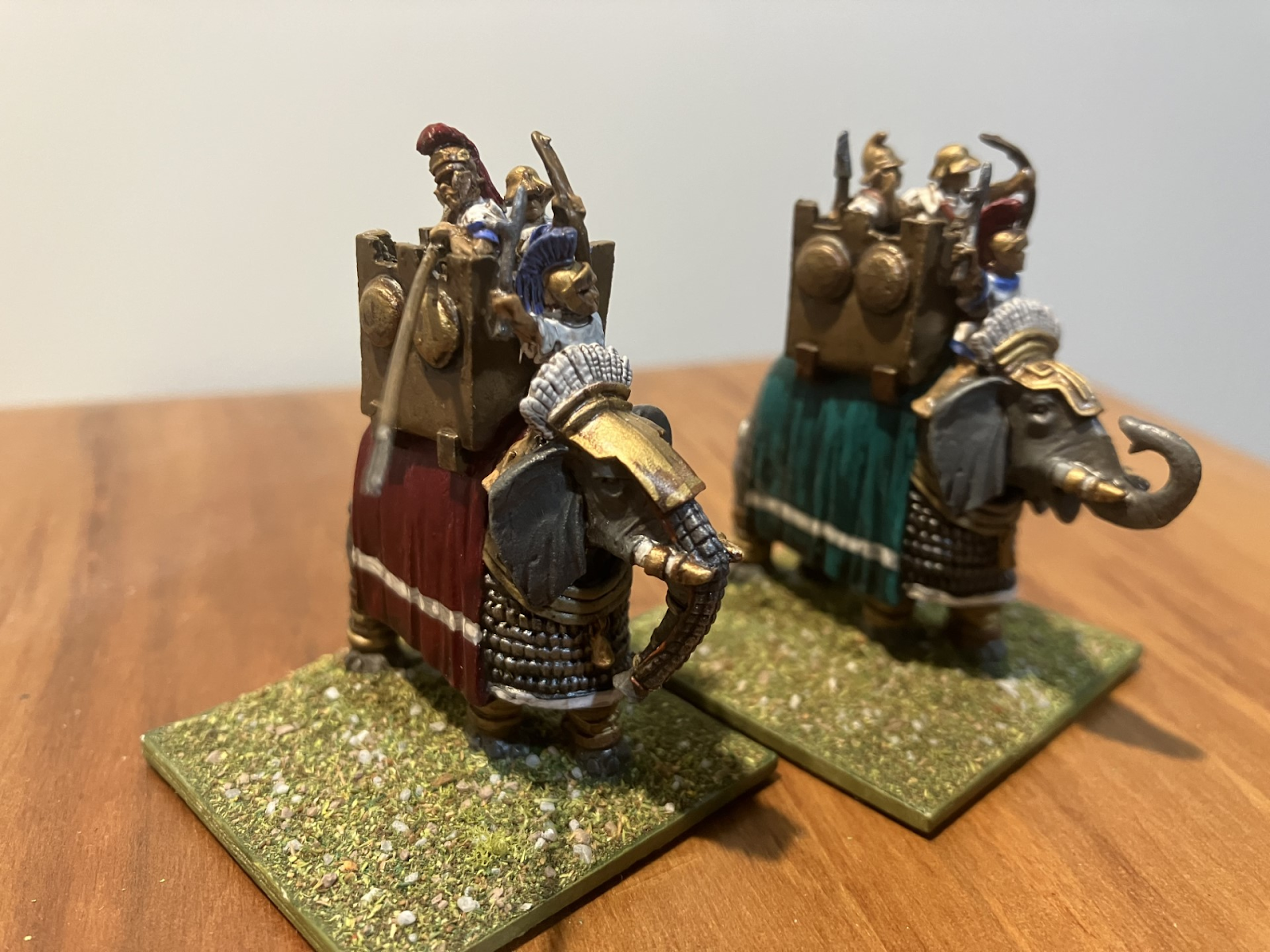
Review: Forged in Battle 15mm Later Seleucid Elephants

 (This review was originally written for Slingshot, the Society of Ancients' Journal, after a review pack of elephants was passed my way. For whatever reason, the review was never published. I happened upon it while going through some old files and thought I would post it here)

Forged in Battle 15mm LATER SELEUCID ELEPHANTS (code MS05) review.


Contents

The pack comes in ten pieces: two identical elephant models with attached towers – the towers are filled in, not hollow – two elephant heads, one with armoured trunk, one without; two identical mahouts in tunic wearing crested Attic helmets (though there may be variations – the website image shows a differently-attired mahout in what appears to be tunic and headband), and six crew figures modelled from the torso up, to be attached to the top surface of the tower. The crew figures are comprised of two archers, two javelinmen and two pike-bearers. They are in various combinations of linen armour, breastplate, and tunic, and wear Boiotian, Attic or Phrygian helmets. In my pack the two sarissa bearers are in different poses, but the archers and javelinmen are not.


Assembly

The pieces required a bit of filing to fit, but that is to be expected. The head of the elephant is attached to the body by means of a male/female joint, but the mahouts had to be filed thinner, their legs positioned carefully and glued to the front of the tower to allow the heads and bodies to meet. I used epoxy putty to fill in the gaps and ensure a strong bond.


The towers are cramped and I could only fit two crewmen per tower, but others may have better skills and more patience at fitting the third figures in than me. I also attached pikes before checking the crew positioning, which resulted in one pike being angled too steeply and the figure thus unusable. Lesson learned.


Modelling

After assembly it became apparent that there was a modelling oversight: the left-hand side of the elephant has the covering cloth right up to the elephant's front shoulder, but the right-hand side does not, so that when viewing from the left the mahout is sitting on the cloth, but from the right he isn't. Ideally you would want to use putty or green stuff to give the impression that the coverings meet, and do it before the mahout is attached. Unfortunately, I didn't notice this until too late, so I have used paint to try to do the same job. Otherwise, the sculpting is crisp, the details are good, and the proportions are attractive.


In terms of dimensions, the elephants are taller and slimmer than the other Seleucid or Indian elephants in my 15mm collection but they are still within the possible size range of the breed so they make for good variety.


Comparison with Chariot elephants (two in centre)


There are no straps across the elephants' rear ends, so people wanting those will need to add them in with putty or paint.

Comparison from the rear


Summary

They are a little tricky to put together, but they look grand. The folds in the cloth, the elephant armour, and the ridges on the elephant skin are very nice to work with and respond well to dry-brushing and washes. They are a very good addition to the current 15mm Successor elephant options, and the sculptor should be commended for going for a slightly different look. These models will work alongside Chariot elephants, for example, and the army will look much the better for their presence. I would certainly recommend this set and am now considering putting in a Christmas order with Forged in Battle, even though I shouldn't really be buying up even more lead…


Monday, April 1, 2024

Easter activities

Well, the Society of Ancients Battle Day has come and gone, and I didn't get to do an Ilipa refight after all. With SP busy with work and my not having cultivated enough other interested parties we will have to do it belatedly.

I did get to take the family over the Takaka Hill to Golden Bay for a couple of nights though, which was a great success. We stayed with my aunt and her partner, who was born in America and is an American Civil War buff. As I knew of his ACW interest I put a copy of Battlecry in the car, and on the second night asked if he wanted to try a game. He did. It turns out that he used to own a couple of America Heritage games in his younger days.

He took to the game quite quickly, and we got through two scenarios in about four hours.

I have a couple of copies of Battlecry (one given to me by Pat Hirtle; another that came with some other games I bought from a fellow online), so I have given him the one I took over.

Hopefully he enjoys it, and we might be able to get a game or two in when he's over this side of the hill on business. 

Hope Easter has been restful for you all!

Related Posts Plugin for WordPress, Blogger...