Prufrock's Wargaming Blog

Prufrock's Wargaming Blog

Wednesday, November 16, 2011

Chaeronea, 86BC - the battle.

Preamble

As outlined in my last post, I played through a refight of Chaeronea (86BC) last night.  Here then is the promised report.

**  Unfortunately (and embarrassingly!), I misread the scenario details and had the battlefield reversed.  It was in fact the Pontics who had the river on their side of the table.  This is a result of my own wrongheadedness, and should not be blamed upon the author of the rules! **

Under Lost Battles Archelaus has twenty units of Pontics, made up of a vast quantity of cavalry, phalangites and light infantry.  Against this horde Sulla has sixteen units of Roman veterans and his lieutenant Murena.  With a fighting value of 50, for Archelaus' men to actually win the field would be a difficult task.  Given the disparity in quality, Archelaus' best chance is to try to win a game victory by scoring as many hits as possible on the Romans before his fragile levies flee the field.

Being a positive sort of fellow, Archelaus hatches a plan to refuse his left, hold the Romans with his centre and push the cavalry forward on the right to turn Sulla's left.  This done he will roll up the Roman flank, slaughter the legions and teach Sulla a lesson he will never forget.

Meanwhile, the genius of Lucius Cornelius has informed him that the aim must be to win the battle without suffering major casualties.  He has a fighting value of 77, giving the enemy a very useful victory point handicap of 39 points; his plan therefore is to refuse the left and rely on the river to his rear to help his own left-wing cavalry fend off any attempts at encirclement.  He will use his command and quality superiority to get his veteran legionaries into position quickly, break the enemy phalanx and then return at pace to reinforce the left before Archelaus gets into the baggage.

Such at least were the the pre-battle plans of the two commanders...


Initial dispositions.

Archelaus has a hill in his rear centre and rear right zones upon which he deploys most of his phalanx and his scythed chariots.  The right (currently splashing through a stream) is made up of two average and four levy units of cavalry.  The far left, just to the left of the hill, is enjoying the shade of a few trees and a last drink of unbloodied water.


Sulla, who is somewhat taken aback by how large a host the enemy has gathered, deploys his infantry in the three central zones in a four, five, four distribution.  He has supporting cavalry units on both wings and a solitary unit of light infantry in the centre to deal with the scythed chariots.  Murena, he decides, will hold the left.


The phalanx on the hill, supported by light infantry and the scythed chariots.


The mass of Pontic horse, which is already giving Sulla pause.


The battle.


Turn two (deployment is counted as turn one) sees a low command roll, but this does not put Archelaus off advancing his centre and right centre.  They will no longer get the dubious benefit of the high ground, but they will secure the key zone and give themselves first attack at the Romans (assuming these glorified Etruscans elect to advance).  Archelaus does not have enough commands to do anything fancy with his cavalry, so they just forge ahead and create a lot of dust.


Murena advances to meet the Pontic right centre, with the rest of the line following.


The Roman centre approaches the chariots and the light infantry readies for action.  On the right Sulla double (express) moves into contact with the enemy's refused left.


One unit of Roman cavalry is left behind to guard the rear; the other moves forward with Sulla.


Turn three sees the scythed chariots charge.  The experienced legionaries deftly open gaps in the line through which the chariots are funnelled, but the light infantry prove to be a little less sanguine and are forced to retire shaken.


Hey, watch out for the riv...


Archelaus' cavalry now bears down upon the Roman left.  Two units of light cavalry are sent to deal with the Roman rear-guard; the rest turn to threaten Murena's flank.


Sulla's advance is met with determined resistance.  The veteran legions - who appear to be a little disordered following their rapid advance - suddenly find themselves hit twice and under the cosh.


I thought you said these guys were levies?


On their own turn the Romans give better than they got, scoring seven hits along the line, shattering a levy heavy infantry unit on the left and forcing a supporting unit of light infantry to rout.  None of this can delay the inevitable charge of Archelaus and his left, however.

Turn four sees the Roman cavalry guard shattered immediately by the bows and javelins of the advancing light cavalry.


Who was the smarty pants that left us unsupported against those fellows?  Ah yes, Aaron Murena.  Thanks!

Archelaus' flank attack with the cavalry on Murena's zone is also successful as they bring their weight to bear.  The phalanx attacks see a flurry of all-out attacks being scored, which result in the Roman infantry line beginning to look a little fragile.  Now that they also have cavalry to their rear it might be an opportune moment for Sulla to think about hurrying up and finishing off the enemy left...


(A quick tour of the battlefield reveals that Archelaus' infantry are almost all spent.  Only one unit of phalangites remains on the left.  The centre has all its units on the field, but only two of them are fresh.)


(The Pontic centre right has only a bunch of bullied light infantry and some shaky thureophoroi left.)


(But there's no denying that they have a lot of fresh cavalry [and some weird musical instrument by the looks of it]!)


Returning now to the action, we pick things up during the Roman phase of turn four.  With the shouts and trumpetings from the discombobulated left reaching his ears, Sulla personally urges the men forward.  In the face of this assault the Pontic left finds it impossible to resist, and the levy heavy phalanx shatters  As this is the fourth unit to be sent from the field in this fashion the entire Pontic army is now at -1; on a morale roll of one the entire infantry line gives way.  Sulla has done it!


Think of the proscriptions, boys!  

Archelaus, however, is supported by units that are fresh, so the cavalry does not run.


But wait - there are still more...


Archelaus also uses his personal influence, and the men respond.  Two hits are scored in the charge and a veteran legionary unit is shattered.  There is bite in the Pontic canine yet!


Sulla rushes his men over in support, but it takes a turn before they can attack.  In that fateful turn Archelaus strikes again, shattering another legionary unit.


This cannot last forever though, and when on turn six the Romans shatter a fifth unit, the remaining Pontics are carried away in rout and the battle is over.  

Sulla must now count the cost...

Conclusion.

Roman victory points:
Units shattered: 26
Units routed: 36
Units withdrawn: 13 
Total: 75.

Pontic victory points:
Units shattered: 22
Units spent: 31
Handicap: 39
Total: 92.

Archelaus has pulled off a game victory.  Mithridates will no doubt take a little poison to celebrate.  

Sulla meantime will let his troops loose on the baggage, give that fool Aaron Murena an earful and brood over his wine.  

Final thoughts.

This was an excellent victory by the Pontics.  With the benefit of hindsight the Romans should probably have kept playing for time with the cavalry on their left wing, but to be fair that's what they thought they were doing - they did not expect to get shattered by light cavalry in just one turn!

Once the Pontic line had routed Murena could also have brought in fresh troops so that they would take the lead position.  Instead he risked attacking with a spent lead unit which resulted in another shatter next turn.  As it turns out this would not have been enough to win the game, but it would have given the Romans a better chance of winning.

The key to this battle is to be found in the third and fourth turns, on which the Pontic infantry managed to score a lot of hits (nine, I think).  That three of these were all-out attacks was not a disadvantage at all: a routed levy unit is worth 3 VPs and a spent veteran unit is worth 4.  When once side has a significant handicap advantage in its favour all-out attacks can be a real bonus.

Anyway, that's enough rambling - to finish, this was yet another very enjoyable game of Lost Battles.  As always, it's great fun solo and after a reasonably stressful few weeks it was good to kick back and relax with a battle.  It was quite nice to revisit this particular scenario as it was the first one I ever played with this system, when Luke first came down here way back in 2005 or 2006.  

Tuesday, November 15, 2011

Chaeronea, 86BC.

After a long while without a proper game I decided it was time to get the miniatures out tonight.  I had a hankering for something a bit different, so I looked through the old scenarios from Strategos (the precursor to Lost Battles) and settled on Chaeronea (86BC), in which Sulla took on Archelaus and the pride of Pontus.

The Pontics had a fighting value of 50, made up of the following units:

3 x average phalanx
4 x levy phalanx
2 x levy heavy infantry
4 x levy light infantry
2 x average cavalry, with Archelaus attached to one as an average leader,
2 x levy heavy cavalry
2 x levy light cavalry
1 x scythed chariots

Sulla and his merry men meanwhile had a fighting value of 77, comprised thusly:

13 veteran legion units
1 average light infantry unit
1 average heavy cavalry unit
1 veteran heavy cavalry unit
1 uninspired commander (Murena) and one inspired commander (Sulla himself).

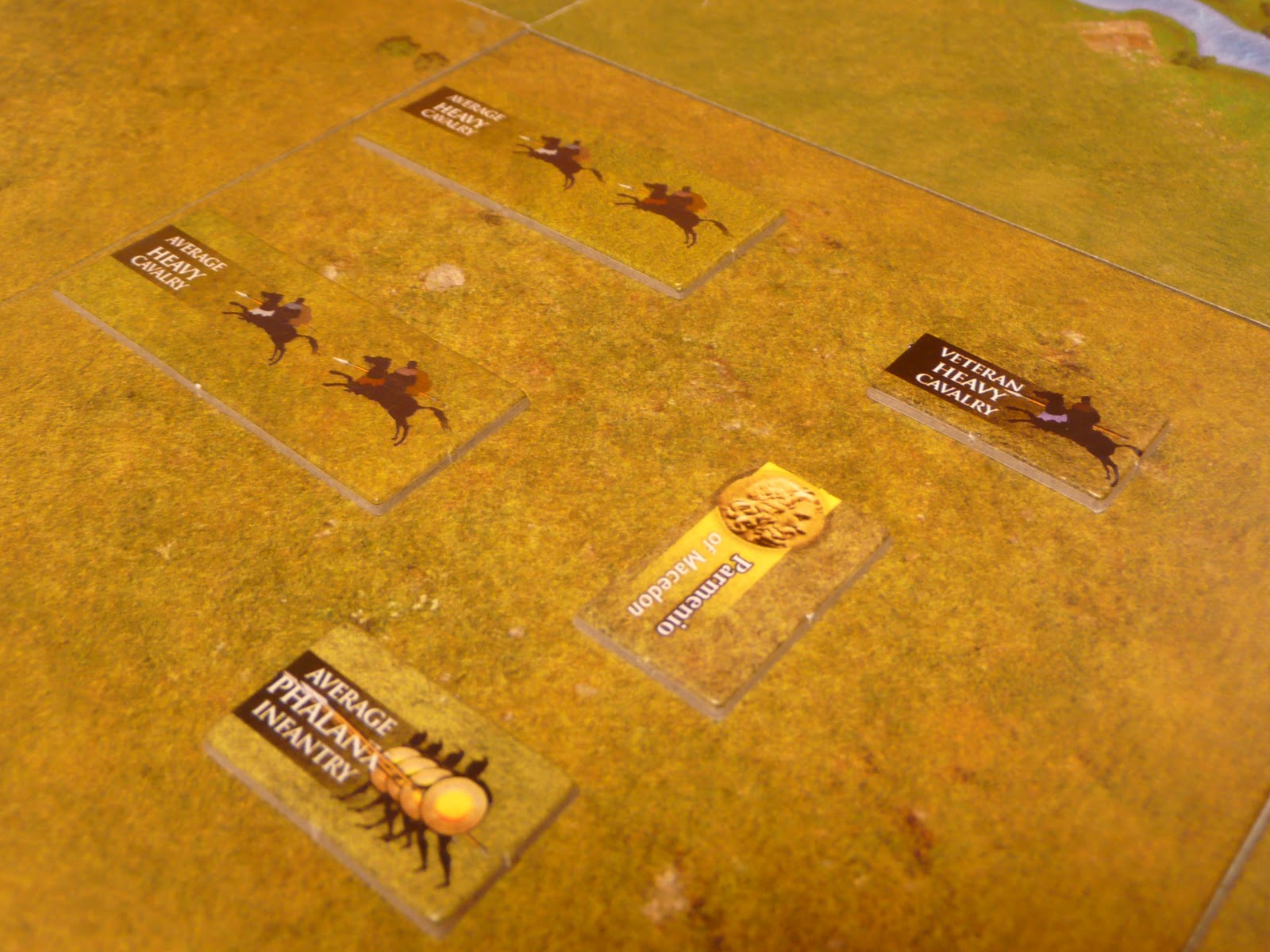
Here are a couple of pictures of the refight.


Gosh, that's a lot of pike, and is that cavalry I see to the left of us?  I wonder what old Marius would make of all this...


A report will follow as time permits.

Saturday, October 29, 2011

Ancient and Medieval Wargaming playtest

Hello again; it's been quite a while between posts...  I recently picked up Neil Thomas' Ancient and Medieval Wargaming off the shelf for something to read while backpacking the boy to sleep, and in so doing reminded myself that I still had it!  I'd played it once before with a few drinking buddies, and once or twice with Luke, but had not revisited it since then so decided to give it a shove.

I did not set up any terrain; just a Polybian Roman force (5 x hastati/principes, 1 x triarii, 1 x velites, 1 x cav) against a bunch of Gauls ( 4 x warriors, 1 x fanatics, 1 x skirmishers, 2 x cav) in the open to see how it would go.

The game lasted four turns, with the Gauls having the better of it on the wings but the Romans cleaning up in the centre.  A&MW seems to be quite a limited game, but was fun nonetheless.  The cavalry combats take a lot longer to resolve relative to the infantry ones, so it's difficult to see there being much scope for envelopments of the Hannibalic variety unless the onset of the infantry clash is delayed.  There is clearly room for tactics, but light infantry are in for a bit of a tough time as they cannot evade (though they can break off after a turn of combat if they are faster than the enemy).  The Gauls need a bit of terrain to give them a fighting chance, so perhaps I'll give it a run through again with some woods on the battlefield.

Anyway, here's a shot of the board at battle's end, with the Roman centre having disposed of its opponents and marched a heavy infantry unit off the board to complete the victory...


Nice to get a wee battle in again after a while...

Saturday, September 24, 2011

Rugby World Cup is ON!

Things will be very quiet here on the old blog for a couple more weeks as I settle down to watch the rugby world cup in earnest.  It has been a great spectacle so far, but it's going to go up a notch or two tonight as our beloved All Blacks take on the might of the French.  It should be a real battle out there, and with a cracking few weeks to come I couldn't be happier. 

So, I raise my glass to all the rugby fans out there, and let rugby be the winner on the day (as Sean Fitzpatrick might have said)!

Cheers!

Wednesday, September 21, 2011

Lost Battles (the boardgame) arrives

It's been a quiet few weeks here on the blog front.  I had a quick visit home to New Zealand to celebrate the old man's 60th, and although I was only there for a week I've been a bit of a wreck since my return.  It was great to catch up with family and have a few too many beers but it really took it out of me.  I think I must be getting old!

Anyway, on to the wargaming...

On Sunday the long-awaited boardgame version of Phil Sabin's Lost Battles arrived on my doorstep.  It really is the box of goodness I'd been hoping it would be.  The artwork is stunning and the new rulebook is superb.

Here are a few in-progress shots of the Granicus scenario to give you a taste:


The only slight complaint I have is that the grassy areas on the river tiles are rather greener than those of their normal cousins, but once the counters are down I find that I don't notice it so much.  Phil Sabin, Mark Mahaffey and the Fifth Column Games team have done a great job on this, and I'm very happy I got my pre-orders in on this one.

Well, back to the game!

Thursday, September 1, 2011

Free Ancient Naval Wargame Rules

I just came across this on boardgamegeek.com - a link to a freely available game of galley warfare that only requires a few boxes of matches!  Looks like a great concept.   Might be worth checking it out!

Wednesday, August 17, 2011

Mago's last battle scenario (following Jim Webster)

Amongst the recent influx of new members on the Lost Battles yahoo group, I recognised a name from Slingshot - Jim Webster. This reminded me that I'd been meaning to convert his recent discussion of Mago's final battle in Insubria into a Lost Battles scenario. Jim's article, "The Italian Campaign of Mago" (Slingshot 276) gives an account of Mago's expedition to Italy and the battle there that resulted in the younger Barca's defeat in 203 and the subsequent evacuation of his army from the mainland. Incidentally, I can't actually find an accepted name for this battle. Wikipedia calls it "The Po Valley Raid", but given that there appear to have been four legions involved as well as a good 20-odd thousand Carthaginians, calling it a 'raid' might be a little insulting! Has anyone an answer to this?

Anyway, this OOB relies on Jim's research and conclusions, which are themselves based on Livy's account of the battle. Livy's treatment can be found in Book XXX.18 of his "History of Rome". Here is the relevant excerpt (Canon Roberts's translation) taken from the electronic text centre, University of Virginia:

********

During this summer P. Quintilius Varus the praetor and M. Cornelius the proconsul fought a regular engagement with Mago. The praetor's legions formed the fighting line; Cornelius kept his in reserve, but rode to the front and took command of one wing, the praetor leading the other, and both of them exhorted the soldiers to make a furious charge on the enemy. When they failed to make any impression upon them, Quintilius said to Cornelius, "As you see, the battle is progressing too slowly; the enemy finding themselves offering an unhoped-for resistance have steeled themselves against fear, there is danger of this fear passing into audacity. We must let loose a hurricane of cavalry against them if we want to shake them and make them give ground. Either, then, you must keep up the fighting at the front and I will bring the cavalry into action, or I will remain here and direct the operations of the first line while you launch the cavalry of the four legions against the enemy." The proconsul left it to the praetor to decide what he would do. Quintilius, accordingly, accompanied by his son Marcus, an enterprising and energetic youth, rode off to the cavalry, ordered them to mount and sent them at once against the enemy. The effect of their charge was heightened by the battle-shout of the legions, and the hostile lines would not have stood their ground, had not Mago, at the first movement of the cavalry, promptly brought his elephants into action. The appearance of these animals, their trumpeting and smell so terrified the horses as to render the assistance of the cavalry futile. When engaged at close quarters and able to use sword and lance the Roman cavalryman was the better fighter, but when carried away by a frightened horse, he was a better target for the Numidian darts. As for the infantry, the twelfth legion had lost a large proportion of their men and were holding their ground more to avoid the disgrace of retreat than from any hope of offering effectual resistance. Nor would they have held it any longer if the thirteenth legion which was in reserve had not been brought up and taken part in the doubtful conflict. To oppose this fresh legion Mago brought up his reserves also. These were Gauls, and the hastati of the eleventh legion had not much trouble in putting them to rout. They then closed up and attacked the elephants who were creating confusion in the Roman infantry ranks. Showering their darts upon them as they crowded together, and hardly ever failing to hit, they drove them all back upon the Carthaginian lines, after four had fallen, severely wounded.

At last the enemy began to give ground, and the whole of the Roman infantry, when they saw the elephants turning against their own side, rushed forward to increase the confusion and panic. As long as Mago kept his station in front, his men retreated slowly and in good order, but when they saw him fall, seriously wounded and carried almost fainting from the field, there was a general flight. The losses of the enemy amounted to 5000 men, and 22 standards were taken. The victory was a far from bloodless one for the Romans, they lost 2300 men in the praetor's army, mostly from the twelfth legion, and amongst them two military tribunes, M. Cosconius and M. Maevius. The thirteenth legion, the last to take part in the action, also had its losses; C. Helvius, a military tribune, fell whilst restoring the battle, and twenty-two members of the cavalry corps, belonging to distinguished families, together with some of the centurions were trampled to death by the elephants. The battle would have lasted longer had not Mago's wound given the Romans the victory.

********

Returning now to Jim's take on this, the reference point is a Roman army under P. Quintilius Varus and M. Cornelius Cethegus consisting of 4 legions plus allies. At a Lost Battles troop multiple of 4, this force could come out like this:

24,000 heavy infantry - 12 units of average legionaries.

c.10,000 velities - 2 levy and 1 average light infantry units.

c.5,000 cavalry - 5 average heavy cavalry units.

Quintilius Varus (uninspired commander; perhaps even uninspired leader) with the cavalry and Cornelius Cethegus (average leader) for a total fighting value of 79.

Mago's force could look something like this (again, these are Jim's numbers and my guestimates are just to fit them into the LB scheme):

12,000 veterans from Spain - perhaps 4 units of average heavy infantry and 4 units of veteran heavy infantry.

4,000 Africans - 2 units of average heavy infantry or 1 heavy and 1 light.

7 elephants and 2,000 light infantry - 1 African elephant unit with accompanying skirmishers.

8,000 Ligurians & 4,000 Gauls - mixing these contingents together we could say 2 average heavy infantry, 1 levy heavy infantry and one levy light infantry.

1,000 Spanish cavalry - 1 average heavy cavalry unit.

1,600 Numidian cavalry and c.400 Gallic cavalry - 2 average light cavalry units.

With Mago as an average commander (though I would perhaps think about making him an inspired commander to account for the positive morale influence Livy attributes to him in this battle) this would give a fighting value of 62 (or 68 if Mago is an IC).

So far so good. This OOB can be tweaked easily enough, but is hopefully a reasonable start given what is known of the forces involved and the way Livy reports the salient features of the battle. It would be possible to use a troop multiple of five and allow both sides more veteran units, but I'm not sure that the account warrants that (though playtesting might).
The terrain is, as Jim intimates, one of the the most difficult elements of the battle to attempt a reconstruction of, as there is not very much to go on. He suggests that Mago picked a site with restricted frontage so as to negate the Roman advantage in numbers, and posits terrain on the flanks to effect this. Regarding the reserve lines, no special considerations need to be made here, as Lost Battles already effectively accounts for reserves through the zone attack limits and the gradual attrition caused by units becoming spent and rotating out of the lead position.

As two legions with ala deployed side by side might take up around 1500-1600 metres frontage, we could probably go with 600m zones, giving us a battlefield 3kms across, an attack limit of three, and ample space for the other two legions to wait for their turn on the front line. To further restrict things as per Jim's vision we could add an impassable hill on one flank and perhaps another (normal) hill in the Roman wing zone of the opposing flank to interfere with the Roman cavalry deployment and give Mago time to bring the elephants in to support the cavalry on that flank if he so desired.

Alternatively, we could make the zones 500 across, do away with the impassable hill altogether, and consider the attack limit of three to be an adequate enough representation of a constricted battlefield as it is.

There does not seem any call for weather, fatigue, or surprise to have any special impact on the battle. Key zones should probably be in the centre as usual, though if the impassable hill battlefield is used the key zones could be shifted one zone farther away from that. Mago should certainly have the first move, and if he were classed as an inspired commander would have enough commands available to set up a strong defensive position with either battlefield configuration. Even as an average commander he would be able to do a fair bit with a deployment turn of 12 commands.

Well, there we go for a start. Thanks very much to Jim for an interesting article on such an overlooked battle.
This has also been posted on the yahoo group, though in an insufficiently proof-read form, I regret to say!
Related Posts Plugin for WordPress, Blogger...