Prufrock's Wargaming Blog

Prufrock's Wargaming Blog

Wednesday, June 15, 2022

Legion: Chaeronea with Phil Sabin

A couple of months ago I was fortunate enough to have Phil Sabin offer me another game using his Legion II rules. The battle was Chaeronea, and the victory was Phil's - playing the Greek coalition! 

Yes, I managed to charge Alexander into danger, get him killed almost immediately, and then attack in uncoordinated fashion with my phalanx until, being put to the sword, I was forced to retreat what I could of the army. Phil won the battle convincingly, and a rather rueful Prufrock was left to absorb the lessons of the day!

It was a great experience, and an excellent opportunity to try out Legion using the VASSAL module that has been put together to allow online and distance play.

For those interested, the module is downloadable here from the vassalengine.org site. You need the Legion rules to play, and they are available from the Society of Ancients. 

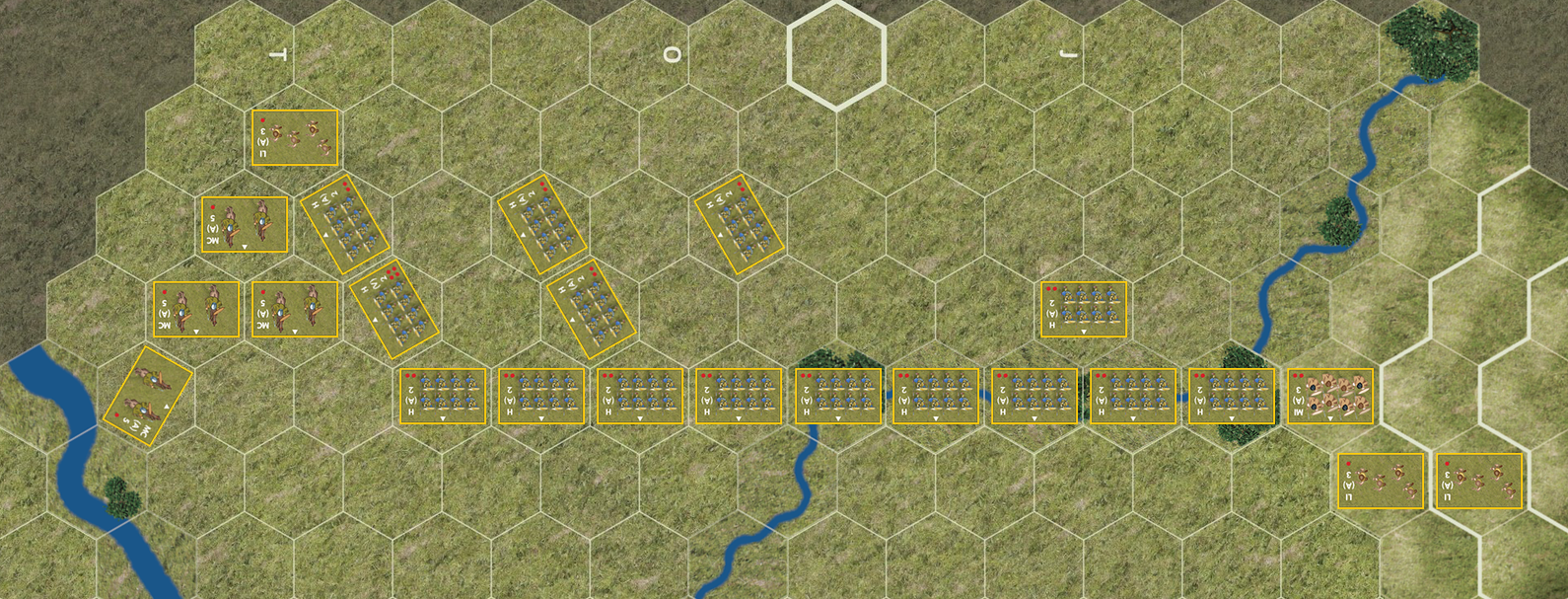
Here are some screenshots from the game.

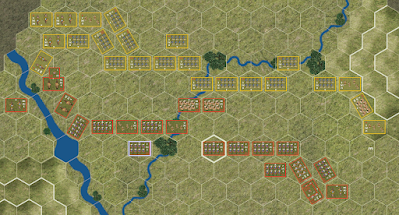
My Macedonians, with Alex on the left, full of confidence.

Phil's Greeks, waiting for us.

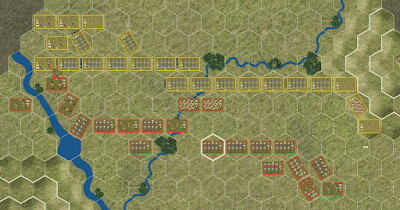
My initial attack didn't look too bad to my untutored eye...

But the Greek response showed me what a mess I'd made!

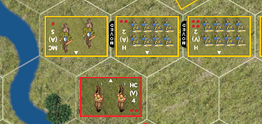
The place where Alexander was killed.

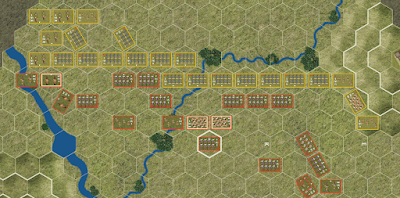
And here we are, getting in our own way, while the Greeks create superior attacks.

And our battle line only degenerated from there as Phil pressed on. 

As I hope readers can see, the VASSAL module makes Legion easily playable, even for people on opposite sides of the globe.

Highly recommended. 


Sunday, June 5, 2022

Short reviews: Undaunted Normandy

I had the chance to play through the first two scenarios of Undaunted Normandy with an opponent last night and (as promised) thought I would share some observations. See here for initial thoughts. Note that we have not used all troop options yet - only scouts, riflemen, machine gunners. There are still mortars and snipers to come.

1) Deck building. When opportunites arise you can add cards to the deck. It seems like quite a good way of stacking future options in your favour. In your turn you draw a random limited number of cards out of the deck you've built and play with what you draw. Once you know what's in your drawn hand you (obviously!) can plan and play accordingly. 

2) Card activation. Both games were won against the board position by runs of cards which gave the opposition no ability to interfere with the winning outcome. With no real time 'opportunity fire' deterrent, it gives certainty to actions which perhaps real life wouldn't.

3) Card removal. An interesting way to simulate casualties by removing activation cards.

4) Bidding for initiative. As per 1, 2 and 3, you can calculate odds, decide whether it's an action or holding turn, and bid based on that.

5) Line of sight. There is always line of sight, no matter the terrain. Rolling a ten is always a hit on the enemy, no matter how skewed the shooting odds. Intervening terrain matters only for range, and cover is only for the terrain the target is in: i.e., it is not cumulative.

6) Victory points. VPs are gained by controlling certain areas on the board. Scenarios and sides have differing objectives, but winning on VPs only takes into account the territorial objectives, not casualties sustained in achieving them.

So far it is proving to be an interesting light war-game. We are both keen to play more, but the game has its problems as does every other tactical game of its type. So far the fact that both games were won against the run of play by good immediate card hands which the opposition was powerless to interfere with once initiative was determined is a potential negative (but may turn out to be a strength). 

It certainly has something. Again, I came away with an urge to pick up the expansions but am still resisting until I see whether I really like it or not. At this stage I would rate it a 7 out of 10. More to follow once we get further through the scenarios.


Tuesday, May 17, 2022

Pharsalus - the return match

To continue the game series started last week SP and I got together Saturday for round two of Pharsalus. You can read about the first battle on the link above, but to recap, while Caesar won the battlefield victory after surrounding and routing the Pompeians, SP did enough damage to Caesar's veterans to win the game 106 to 101.

For round two we swapped sides - this time SP would take Caesar. Pompey's cavalry wing again commenced the fight with a successful charge, and again Pompey refused his right. Caesar advanced judiciously, took the flip flop on turn three, but failed to make much headway in the initial exchanges. 

The initial clash of cavalry (Caesar's to the left; Pompey's to the right). The prize, the Washbourn Trophy, sits in all its glory in the background. 

This changed on turn four, where a succession of successful attacks against Pompey's wing and centre caused nervous flutters on the other side of the table. Pompey's men replied in kind and by the end of the turn both sides had lost a unit in the cavalry fight. 

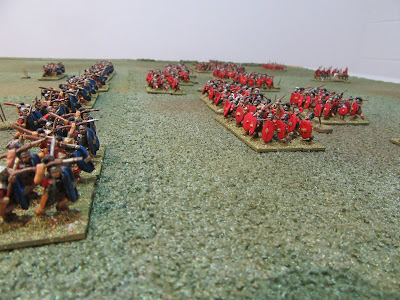
The lines meet.

From turn five onwards Caesar's veterans began to exert their dominance. Pompey's troops suffered mounting attrition, but were able to manage to inflict some damage of their own. 

Pompey's wing gave way on turn 6, allowing Caesar to get in behind the Pompeian line and lower the morale rating of Pompey's own zone, which routed soon after. Elsewhere, Antony struggled to make much of an impact against the determined resistance and ferocious attacks of the Pompeian right. 

Pompey's zone about to rout in the foreground.

With time almost up, the Pompeian centre routed, leaving just the right on the field. But they were still largely untouched, and fighting a wholly spent Antony. 

The end is near for the Pompeian centre.

Antony lost a unit shattered and was only saved for further embarrassment by a determined attack on the part of the veteran cavalry into the flank of the Pompeian legionaries on the final turn of the game.

The fighting by the river is vicious.

At this the remaining Pompeians routed and it was time to check the scores.

Caesar had done 96 points of damage to 72 by Pompey. When the handicap was added on, it was found that Pompey had won the game by 102 points to 96. 

When the scores of the two games were summed, it turned out that SP had managed 202 across the two battles to yours truly's 203, meaning that the Washbourn Trophy came back to its rightful home by the closest of margins. 

I was a little surprised to win a game victory here. We only shattered two units, but the difference was that we routed after eight units were shattered, whereas in the first game Caesar had shattered ten units in his win. This seemingly minor difference was reflected in the points scored, and shows how tight the margins can be under the Lost Battles handicap system.

So, a fine pair of games, and a good way to introduce SP to brilliant generals. 

Sunday, May 15, 2022

Pharsalus with SP

The figure gaming drought was broken last weekend with a refight of Pharsalus using - you guessed it - Lost Battles. The family has gone back to Japan for a visit now that the borders have reopened somewhat so with the house to myself it has been a bit easier to use the hobby space (i.e., I can set up the computer on the dining room table rather than on one of the hobby ones!).

SP is still learning the rules, so I thought it was time to bring in a brilliant general so that he can see the affect of a 'flip-flop' on the tactics of the game. In a flip-flop, the brilliant general once per game can reverse the turn order, effectively allowing him to position himself for a more lethal attack, reinforce a zone, or else to exploit a breakthrough.

Pharsalus, when using the historical deployments, is a fairly straightforward affair in Lost Battles. The main choice is about when and how Caesar is to reinforce his right wing cavalry, and then it's about rolling dice and intervening with attack bonuses at appropriate times. Crucially, there is also the matter of when to employ 'favour of the gods' (essentially a re-roll for either an attack you've flunked or one that the enemy has prosecuted a little too vigorously for one's liking). With favour of the gods, once one side has used it, they cannot use it again until their opponent has. As you can imagine, it leads to some difficult decisions in-game and, during the post-mortems, moments for reflection when you consider the coulda, woulda, shouldas. 

SP wanted to take up the cudgel for Pompey, so we started the action on turn two (turn one being taken up by the historical deployments).

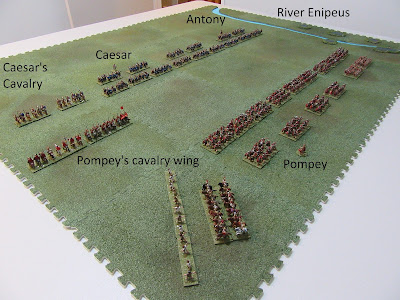
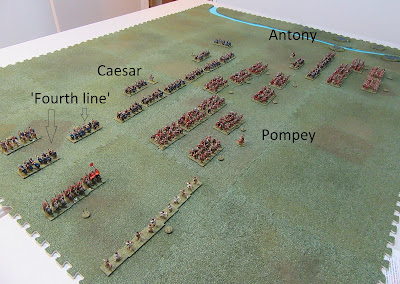
As I'm sure most readers are aware, Pompey and the Optimates have numerical superiority in both horse and foot, and have concentrated the cavalry on the left under Caesar's old Gallic War lieutenant Labienus. To counter this cavalry supremacy, Caesar used a 'fourth line' - veteran legionaries supposedly re-armed with long spears and tasked with reinforcing the wing once the cavalry battle had commenced. To reflect Caesar's qualitative superiority, all his troop units are rated veteran, which gives them high morale, better manoeuvrability, and cheaper access to attack bonuses (i.e., +1s to attacks which are paid for with excess command points). 

Pompey's army has a fighting value of 77, and Caesar's 92. 


The battlefield at start.

Pompey began with a powerful cavalry attack. He scored three hits across two attacks, spending one unit of Caesar's cavalry and shattering the other. Caesar elected not to use FotG to call for a re-roll. Elsewhere, Pompey advanced in his own zone and the centre, leaving his right refused.

Caesar employed the flip-flop immediately to reinforce the cavalry with the fourth line, and advanced Antony into contact on his left.

The serious fighting now commenced. 

Mid battle, with the cavalry fight still undecided.

Both sides experienced rising attrition in in the infantry fight. As units became spent they were recycled from the front line to avoid being shattered. Caesar eventually won the cavalry battle (but not without another fright or two) and got in behind the Pompeian line to reduce the enemy's morale. With both sides almost entirely spent and a corresponding reduced ability to recycle, units began to shatter. 

It was at this time that Caesar's veterans came into their own. Utilising their superior manoeuvrability, Caesar was able to shuffle fresh units from one zone to another to increase the overall resilience of the line. Pompey, having no such capacity, began to lose units sooner.

It was his right that came under pressure first, as Antony pressed the attack remorselessly. Before long Pompey's own zone began to falter as well.

Final moments.

At last the Pompeians, with eight units shattered and two zones surrounded, collapsed, but not before having inflicted significant damage on Caesar's own zone. 

In the final accounting we found Caesar had inflicted 101 points of damage on the Pompeians and suffered 76 himself. When the handicap was added (double the difference in fighting value between the two armies), Pompey had scored a narrow game victory of 106 vs 101. 

Caesar was left to rue a couple of moments - not using FotG to deflect the first charge of Labienus and his cavalry, and not attempting to rally a unit that shattered in his own zone being particular examples - but the result was a fair reflection of the battle. After that initial attack on the cavalry I always felt I needed to be doing more damage than I was managing to.

It was a close-fought, nerve-wracking fight, just as Pharsalus should be. SP played with his usual cool head and aversion to excessive risk-taking, both attributes serving him well in pulling off the game victory.

Round two, to decide the holder of the Washbourn Trophy, will be fought today with sides reversed.

Wednesday, April 20, 2022

Bruce Catton

I was browsing thebookdepository.com the other day looking to see if they had the new Gettysburg Solitaire book from Worthington Games. It turns out they didn't, but somehow or other (as one does) I ended up going down an internet rabbit hole. This time it led to Bruce Catton. I'd owned one of his books and loved it (I forget which one - A Stillness at Appomattox, perhaps?) but had lent it to someone and not got it back.

Since that first reading I've always checked secondhand book shops just in case they have any Catton on the shelves but I've not had any luck so far. I imagine it would be a bit different if you were shopping in the US, however!

Anyway, by roundabout means, I came across the website of a secondhand book store in Wellington called Haven Books which had a copy of the Army of the Potomac trilogy. I ordered it and it arrived today, well-thumbed, yellowed, and obviously much-read. Just how a book should be.

But my search also turned up another gem - a C-Span video of a lecture on Bruce Catton given at Gettysburg by David Blight.  I won't spoil it with an inadequate introduction, but if you have an hour and fifteen minutes to spare, you might find it worth your time.   

To close, the Gettysburg movie, Catton, Foote, and Burns have no doubt been the catalysts for many a Civil War obsession. Do readers have any other particular books, videos or lectures that got them interested in the ACW? 

Monday, April 11, 2022

Back on the horse(s)

Well, I stopped procrastinating, rearranged the garage, bought myself a lamp, and started prepping some Greeks for the Mantinea battle day project. I've jumped into cavalry and Theban hoplites first. The figures are a reminder of just how lovely the Xyston figures in this range are - beautifully sculpted, characterfully posed, and nicely proportioned; just slightly north of average for 15mm, they are not yet at the giant stage that the Hellenistics became - but also of how much of a pain it is to drill out hands for spears. 

The other problem of course it that they are intimidating. For a limited painter such as myself there is always the feeling that you won't be able to do them justice. 

Garage prep space.

But making a start is the thing. 

In other news I succumbed to an artfully placed ad while browsing TheBookDepository and ordered Undaunted Normandy. It arrived on Saturday (along with my Landmark Caesar, which is just as good as I'd hoped) and I opened it up for a wee test run on Sunday.

The first scenario in the game booklet

The first thing you notice is that the components look a lot nicer on the table than they do in photos. I was impressed enough to almost go and order the expansions on the strength of the look and feel alone. Better sense prevailed however, and I decided that I would force myself to discover whether I actually liked the game before ordering anything more (radical idea, I know!). 

How is the game? Well, I must preface my comments with the caveat that while I love the idea of squad level WWII games, in practice I mostly find them ho-hum. This one might turn out to be all right. It has a card management aspect to it that I think could be quite enjoyable with the right opponent. Solo it lacks a bit, but then that is true for most games. 

The essence of the game seems to be to build up the cards in your draw deck so as to allow you to string together move and fire sequences (or fire and move sequences, if you prefer) that will put your opponent under pressure. Interestingly, when you fire and hit an opponent's piece, you don't remove the piece, you remove one of the cards which could activate that piece. The piece is only removed when there are no accessible cards for it remaining.

So there is a natural attrition there, but it takes place in the card decks, not on the board itself. Your pieces become less able to act the more they are hit (i.e. there are fewer cards left in the deck left with which the piece can be activated), and the more pieces move, the more undesirable cards are introduced into the deck, thus making it less likely that you'll be able to pull the cards you want when you want them. This is presumably a mechanism to represent the difficulty of coordinating effectively over longer distances.

Pleasingly, Undaunted doesn't have those overpowered 'heroic leadership' pieces which seem to drive so many tactical WWII games. Leadership is abstracted into allowing you to choose cards to put in your deck, and is not the old '+2 to hit when Sergeant Skegg is stacked with your MG squad' type arrangement. 

Not an heroic NCO in sight!

I only played through about five or six turns, but will do a proper review when I've had the chance to mangle my way through a couple of games. 

A good weekend, then! I hope any readers who've got this far also had a productive Saturday and Sunday.

Cheers! 


Tuesday, April 5, 2022

Working through prep for 2nd Mantinea

As mentioned in my last post, the Society of Ancients Battle Day for 2023 has been announced as 2nd Mantinea, 362BC. This is the first time in a couple of years that the battle is one I have armies for, so I'm determined to make the most of it. Pleasingly, although I don't have all of the troops I'll need painted yet, I do have a pretty decent start made on them. 

My rules of choice will likely be Lost Battles, so it's the Lost Battles scenario I'll look to to work out how many more troops I'll need to paint up. Bearing in mind that the troop scale is 2.5, it will be 1250 men per average infantry unit, half that for veterans, double for levies, and average cavalry will represent 625 actual horsemen per unit.

Allies: 

2 x Veteran Hoplites (Spartan)

8 figures per unit - 16 figures total 

13 x Average Hoplites (5 x Athenian, 2 x Mantinean, 2 x Elean, 2 x Achaean, 1 Arcadian, 1 Allied

16 figures per unit - 208 figures total

1 x Average Light Infantry (Mercenary)

16 figures per unit

3 x Average Heavy Cavalry (1 Spartan, 1 Athenian, 1 Elean Achaean and Arcadian)

9 figures per unit - 27 figures total

Total figures needed: 224 hoplites, 16 light infantry, 27 heavy cavalry


Thebans:

Average Leader plus Veteran Hoplites (Epaminondas and the Sacred Band)

8 figures per unit, plus Epaminondas and companion - 10 figures total

8 x Average Hoplites (2 x Theban, 3 x Boeotian,  2 x Tegian, 1 Megapolitan, Asean and Pallantian)

16 figures per unit - 128 figures total

5 x Levy Hoplites (2 x Argive, 1 Euboean, 1 Thessalian, 1 Messenian and Sicyonian)

32 figures per unit - 160 figures total

3 x Average Light Infantry ( 1 x Locrian, Malian and Aenianian, 1 Thessalian, 1 Euboean and Mercenary)

16 figures per unit - 48 figures total

4 x Average Heavy Cavalry (2 x Thessalian, 1 Theban, 1 Boeotian)

9 figures per unit - 36 figures total

Total figures needed: 2 leaders, 296 hoplites, 48 light infantry, 36 heavy cavalry


Grand total: 2 leaders, 524 hoplites, 64 light infantry, 63 heavy cavalry

Next step will be to work out how many figures I have already painted, and how many are in the lead mountain. Hopefully I will not need to buy any more, but if I do, it won't be the biggest disaster in the world. There is a little flexibility, too: if I end up being short I could use 12 figure units for light infantry and 24 figure units for the levy hoplites without losing too much in the look of it all.


Painted: 

64 Thebans (Xyston), 64 Generic hoplites (Black Hat) / 8 unpainted (unknown make), 88 unpainted (Xyston) - 224. (300 if Italians are added) - enough for Thebans

64 Spartans, 96 Generic hoplites (Xyston) / 64 unpainted (Xyston) - enough for Allies.

48 Levy hoplites (Old Glory Italians, but they could pass at a pinch)

28 Hoplites (Chariot Italians which could pass at a pinch).

48 Light Infantry with javelin and small shield (old Glory) / 32 unpainted (Xyston)

48 light infantry with bow or sling.

Oodles of peltasts.


Unpainted (all Xyston):

8 Mounted Generals

8 Cavalry with petasos and pilos in chitons

12 Cavalry with Boiotian helmets

8 Cavalry armoured with Boiotian helmets

12 Thessalian Cavalry with cloaks and chitons

20 Cavalry with petasos and pilos in metal and linen armour

12 Spartan Cavalry

19 foot command


To paint: 

64 Spartan hoplites, 88 Theban hoplites, 19 foot command

80 cavalry, though I can get away with a few less.


To buy:

Ideally, I would purchase and paint up another 72 generic hoplites (and about 120 more so I don't have to use Spartans for Athenians etc.!) I will think about this...

Related Posts Plugin for WordPress, Blogger...