Here's no great matter
A wargamer in Japan.
Thursday, May 9, 2013
Book review: Matterhorn, a Vietnam War novel
Amongst a stack of books I recently got for the Kindle was Matterhorn, by Karl Marlantes. Vietnam is not one of those wars that I tend to read about - mainly because it's still raw - but as this was a novel I thought I would give it a shot and see what it was like.
I finished the book last night, and have to say that I was impressed. Marlantes may not be a literary master, but there are moments when you might almost think he was. Some of the passages display lovely lyrical qualities, and the hard-won wisdom that underpins his descriptions and observations gives the novel authenticity, power and a relevance that can evoke unexpectedly emotional responses.
Some of the characters and scenes verge upon the stereotypical, but the sense that the the author has known these people, seen these places and lived these experiences prevents any slip into terminal cliche.
Themes the book touches upon include innocence lost, the nature of friendship, race relations and the psychology of war. The relationship I developed with the protagonist was complex, and the author immerses the reader in the blood, dirt and drink of Vietnam so thoroughly that we can begin to understand some of the damage that the ordinary man must do to himself to participate in warfare, and what things will enable him to accept the cost to self.
I have not gone into any plot details here, but if you are interested in a fictionalized account of a young man coping with his experiences as a Marine lieutenant in Vietnam, you could do worse than read this book.
Labels:
book review
Wednesday, May 8, 2013
Wargame in Kobe
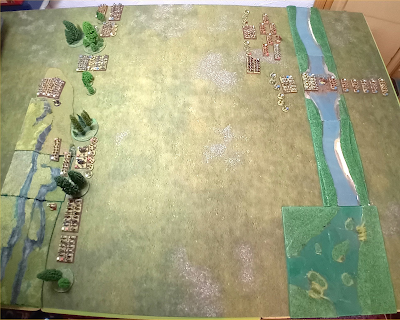
On Saturday I trotted up to Kobe for a game of The Perfect Captain's Spanish Fury with Pat and Luke. After our last game day Pat had kindly offered to umpire a renaissance game for Luke and myself, and although it took five months to find a free afternoon, I think we were all agreed that it was a case of better late than never.
The battle was Mookerheyde (1574), which pitted a Dutch force under Count Louis of Nassau (Luke) against a Spanish force under Sancho de Avila (me).
The Spanish (red) were superior in quality, but the Dutch (blue) and their mercenaries had a slight edge in numbers, especially cavalry.
In our game the Spanish had twenty turns to crush Nassau and his men. Anything less would be a loss, so the burden of attack lay on me - just how I like it!
The heart of Spanish Fury is the orders system, which meant that how I brigaded the troops together was important. I split my cavalry into two commands, put the Spanish tercios together (S6 and S7) and left the Walloons on their own. This was not perhaps the wisest choice.
Luke had all his cavalry in one command and an arrangement I wasn't sure of for his infantry.
I put all my brigades under assault orders, so we immediately went racing across the turf towards the enemy. Nassau's cavalry seemed to have similar plans, but all his infantry bar one unit of landsknechts (R6) held in place.
As my infantry advanced it began accumulating disorder points from the enemy sakers, so I decided to march as quickly as possible and hope to rally the disorder before charging home. On my left the cavalry fight was likely to be over swiftly and I hoped I could get the better of it. Unfortunately, I didn't really pay attention to what Luke was doing (always a dangerous oversight!) and started rather poorly.
At the first onrush I managed to cleverly advance my unit of reiters within range of the guns of the advancing German foot, so we were a pretty ragged bunch by the time the melee combat with the intended enemy - the cavalry - actually began.
Elsewhere, the cavalry battle was reasonably evenly matched, with me winning one combat decisively, getting the worst of another and drawing the third. But it was the fourth that was crucial: my reiters routed after the gun work of the landsknechts (and I couldn't blame them!) leading to a furious pursuit which carried the enemy cavalry behind my infantry lines. My reiters kept running, but his did not: they rallied on the flank of my advancing tercio, just as it was about to confront the landsknechts.
At this point I was confronted with a stark choice: halt my infantry advance and go into hedgehog to see off the enemy or continue advancing towards the Germans and try to break them fast. I chose the second option.
Naturally, it was the wrong one: my tercio became horribly disordered in the charge, which negated its superior stats, and the landsknechts held without breaking sweat. In the meantime, the reiters had reformed and prepared to charge. I now realised that if they hit me I would break automatically, so all depended on them passing their waver check to charge.
And they did, without a care in the world!
They then hit my poor mismanaged tercio on the flank, breaking it in one fell swoop. With my other two tercios badly disordered by enemy fire and the cavalry battle not going well, I conceded the game and slunk off to my side of the table with tail between legs and beer in hand.
So, how was the game?
Firstly, the result seemed to me to be perfectly reasonable. I did not plan my assault well, my cavalry advance was poorly executed and I failed to take into account Luke's intentions or counter them effectively.
There were a few things that did not seem entirely polished in the way that the various sub-systems of the game fitted together, but as I know very little about the subtleties of renaissance warfare I say that cautiously.
All in all it was a very enjoyable game and an excellent day. Next time I will work more on tactics and rely less on dumb luck, but the early finish allowed us to chew the fat, have a glass of something nice and put together some plans for our next meeting.
To finish, here are a few shots of the game from Pat's perspective.
The battle was Mookerheyde (1574), which pitted a Dutch force under Count Louis of Nassau (Luke) against a Spanish force under Sancho de Avila (me).
The Spanish (red) were superior in quality, but the Dutch (blue) and their mercenaries had a slight edge in numbers, especially cavalry.
| (Image captured from this Perfect Captain PDF here) |
In our game the Spanish had twenty turns to crush Nassau and his men. Anything less would be a loss, so the burden of attack lay on me - just how I like it!
The heart of Spanish Fury is the orders system, which meant that how I brigaded the troops together was important. I split my cavalry into two commands, put the Spanish tercios together (S6 and S7) and left the Walloons on their own. This was not perhaps the wisest choice.
Luke had all his cavalry in one command and an arrangement I wasn't sure of for his infantry.
I put all my brigades under assault orders, so we immediately went racing across the turf towards the enemy. Nassau's cavalry seemed to have similar plans, but all his infantry bar one unit of landsknechts (R6) held in place.
![]() |
| (Initial advances) |
At the first onrush I managed to cleverly advance my unit of reiters within range of the guns of the advancing German foot, so we were a pretty ragged bunch by the time the melee combat with the intended enemy - the cavalry - actually began.
Elsewhere, the cavalry battle was reasonably evenly matched, with me winning one combat decisively, getting the worst of another and drawing the third. But it was the fourth that was crucial: my reiters routed after the gun work of the landsknechts (and I couldn't blame them!) leading to a furious pursuit which carried the enemy cavalry behind my infantry lines. My reiters kept running, but his did not: they rallied on the flank of my advancing tercio, just as it was about to confront the landsknechts.
![]() |
| The Count's reiters reform after their pursuit... on my tercio's flank! |
Naturally, it was the wrong one: my tercio became horribly disordered in the charge, which negated its superior stats, and the landsknechts held without breaking sweat. In the meantime, the reiters had reformed and prepared to charge. I now realised that if they hit me I would break automatically, so all depended on them passing their waver check to charge.
And they did, without a care in the world!
They then hit my poor mismanaged tercio on the flank, breaking it in one fell swoop. With my other two tercios badly disordered by enemy fire and the cavalry battle not going well, I conceded the game and slunk off to my side of the table with tail between legs and beer in hand.
So, how was the game?
Firstly, the result seemed to me to be perfectly reasonable. I did not plan my assault well, my cavalry advance was poorly executed and I failed to take into account Luke's intentions or counter them effectively.
There were a few things that did not seem entirely polished in the way that the various sub-systems of the game fitted together, but as I know very little about the subtleties of renaissance warfare I say that cautiously.
All in all it was a very enjoyable game and an excellent day. Next time I will work more on tactics and rely less on dumb luck, but the early finish allowed us to chew the fat, have a glass of something nice and put together some plans for our next meeting.
To finish, here are a few shots of the game from Pat's perspective.
![]() |
| The early going with Luke in the foreground and me over there somewhere. |
| The cavalry get into position, with a little support from the landsknechts. |
![]() |
| My tercio meets the landsknechts and is in turn met by the reiters... |
![]() |
| The end of the affair! |
Monday, April 29, 2013
More Gauls
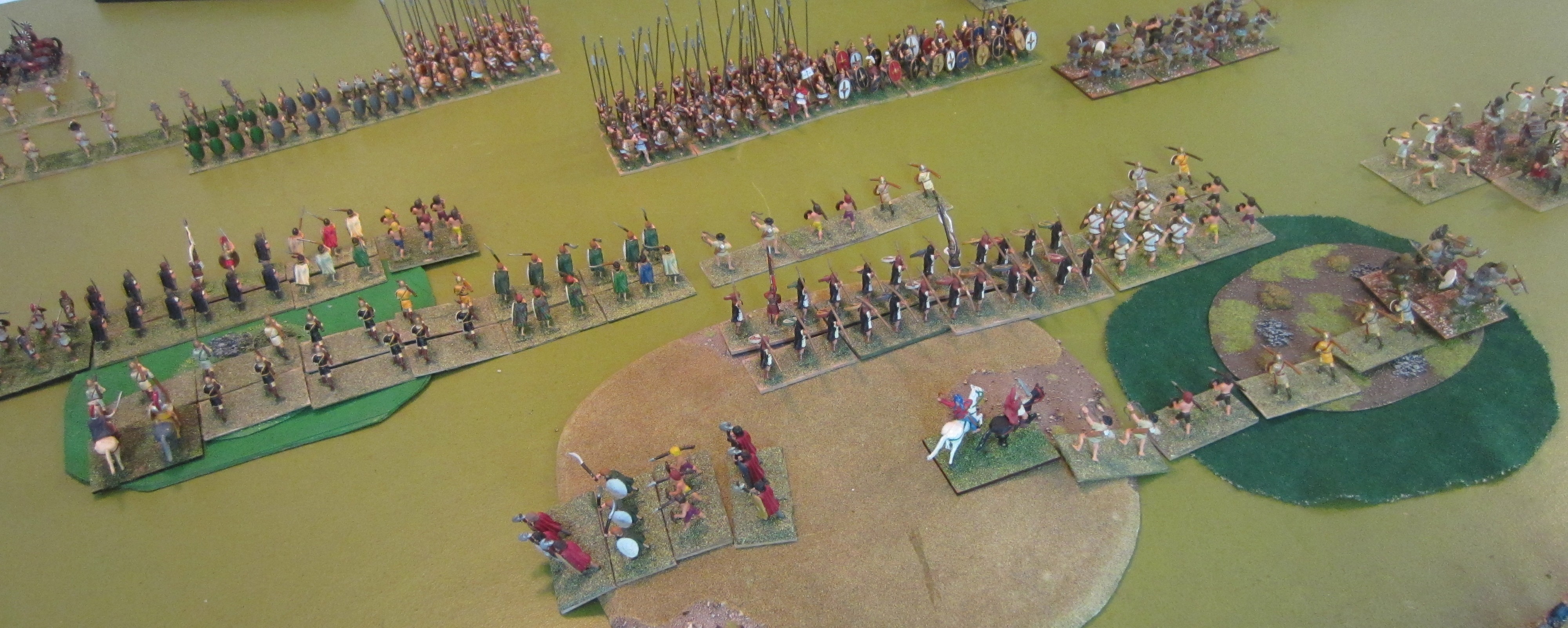
The test lot of Gauls is almost done. Here are a few shots post Klear coat but pre matt varnish (hence the shinyness). Photos are a bit ropey, but the figures look quite lively in the lead, as it were. I think the Tin Soldier / Xyston mix is going to turn out OK, but I'm going to have to clip off the stands on some of the taller TS figures to help them blend in a little better.
Labels:
15mm,
Corvus Belli,
Gauls,
painting,
tin soldier 15s,
xyston 15s
Wednesday, April 24, 2013
Prufrock's painting guides: 15mm Republican Romans.
Republican Romans.
Step one - prep figures. Remove flash using a hobby knife and / or a small round file. If the figure cannot stand properly, file the bottom of the base flat using a flat file. If the figures need spears, javelins or pila added, now is the time to drill out the hand using a dremel tool or pin vise.
Step two - wash figures in warm soapy water. Rinse well and leave to dry.
Step three - now is a good time to attach any shields, javelins, spears or pila to the figures as metal-to-metal bonds are stronger. If you are painting cavalry, you must decide whether to attach man to horse now or after the painting is done. Don't get stressed about this though; both ways work fine.
Step four - affix figures to a temporary painting stand. I use strips of cardboard and stick them on with double-sided tape. Make sure that the figures will not come off in normal handling, but don't put them on so well that you can't easily remove them later. The key word here is temporary!
Step five - spray prime the figures. I use a light primer, either white or light grey. Make sure you get decent coverage but there's no need to spray it on too thick. Be sure to cover your nose and mouth while spraying, as too much in the lungs is not a good thing. Leave to cure, preferably outside for the first couple of hours. As a rule of thumb, once the paint has cured, it will be odourless. If you can still smell the paint, wait another day before beginning to paint. If priming horses separate from their riders, a good time-saving trick is to prime the horses in their base colours, which will save you a painting step.
Step six - give the figures a brown wash all over. Use whichever wash you prefer. I like to go with a paint, water, Future / Klear mix. This is to cover up the white patches and to provide shadow for flesh areas and tunics. It is also a good colour from which to build up mail armour.
Step seven - if you think they might be tricky to get to later, it can be a good idea to do the backs of the shields now. You may have to touch them up later on to get rid of splashes, but it's better than having your splashes come the other way around.
Step eight - block in the flesh areas using a darker shade of the final flesh colour you want. Don't paint into the shaded areas; you want the earlier brown wash to show through here and give depth to eyes, mouth and sundry other bodily creases. As an aside, it's a good idea to decide before you begin how many flesh coats you want to give the figures. Two is probably enough, but I like to give three. Whatever you decide, you need to factor this in when selecting how dark to have the colour at each stage. Obviously, if you are only having two coats, you will probably have a slightly lighter first coat. If you are having three, you will have a darker first coat, a good middle coat, and a light final coat. There are also flesh washes you can use, so your technique for doing flesh will probably change as you get a better idea of what products are around, what suits your style, and how you can save on time.
Step nine - give metal areas a dark wash. I use Tamiya Smoke mixed with a little black and watered down with thinner. Experiment to get the colour and flow you like, because this will make or break the mail on your triarii and principes. Cover swords, spear / pila tips, helmets (and I do helmet crests, too), greaves and shield bosses as well as the armour. You will probably want to give another coat to the mail at some stage, but you can wait till later so that you can disguise any paint slips from later steps. The smoke dries quickly, so you might prefer to break this into two batches - weapons and helmets in batch one, armour and shield bosses in batch two.
Step ten - block in the tunics. I use two colours: red for Romans and white for allies. I will also add in the occasional buff or sand tunic for a little variety amongst the whites. You can use pretty much any colour you like for the things, but do some research beforehand just to be sure some new evidence hasn't come to light. Again, you can leave deep creases alone if the brown wash is strong, and I find you can sometimes almost drybrush the white on if your original wash was an especially good one. As with the flesh, you want to keep a lighter colour in reserve for your highlight, so my "white" here is more likely to actually be a buff, a light gray, or an off-white. Do be careful not to get excess paint on the mail areas. You can cover spills with another smoke wash, but it's much better to avoid having to do so if you can.
Step eleven - block in the shield fronts. Try not to paint over the shield bosses otherwise you'll lose that nice smoke colour.
Step twelve - do your browns. Block in the shield backs (if you didn't do them before), the spear shafts, the sandals, hair and any belts on the figure. You can also do the scabbards now, for which I usually employ a slightly different colour, reddish brown. For things which have a lot of sculpted detail such as sandals or hair, I will sometimes use a very thin coat, even a wash, to bring out the details.
Step thirteen - do your first flesh highlight. How much you cover will depend on whether you're planning on doing a second highlight or not. Try to suggest some muscle definition by putting blobs on bicep and tricep, one on elbow and hand, a line on the thumb if you can, two lines on forearm, blob on knee, two on upper leg, one on shin, two on calf, etc. Faces require a skill of their own, but I tend to hit and hope - sweep across the forehead, dab nose, dab each cheek, slash across the back of the neck; perhaps adding a touch to the ears if they are visible. I'm not a great painter of faces, so don't take my method as gospel here - check the work of others to see what works for you.
Step fourteen - do the helmet crests. I usually go for red, blue, white or black and use a base and a highlight (though I don't highlight black). Helmet crests done well are an easy way to really lend some pop to a figure, so it can be worth going for the highlight, even if you are getting a bit sick of painting by this stage.
Step fifteen - do your metallics. Slap some bronze on the helmets, the shield bosses, the greaves and the sword hilts. Leave a little bit of the smoke wash to show through at edges and joins. Some people like to further highlight their bronze but I prefer to use the smoke wash as a shade and the bronze coat as its own highlight. Use a silver for sword edges, spear tips and, if you want variety, for the odd helmet or shield boss here and there.
Step sixteen - highlight your tunics. Hit the high points, suggest folds and try to make the figure pop. A dry brush can be useful here, depending on you much sculpting detail there is on the figure.
Step seventeen - do your final flesh highlight (if there is one) and do any other highlighting that takes your fancy. You can add a touch to belts, scabbards, shields or anything, really. Highlighting really does make a difference if you have good colour matches and some patience.
Step eighteen - do a protective wash. I like to give my figures two coats of Future / Klear to protect the figure from handling damage. I don't know if it makes much difference, but I feel better for trying. The gloss coat also unites the colours and sets things up well for the final step. The Klear coat here can also have a little black or brown added to it to bring out some extra definition in the figures if you think they could use it.
Step nineteen - give everything a matt spray. The matt will bring all the colours into line, and while it may dull things down a little, overall I like the effect. If you don't like the colours to be all flat, you can do a quick highlight of the metallics to get a little shine.
Note that you can swap the order of these steps around and even skip some steps altogether, but this is my standard method of painting Romans. Note also that my results are not top notch, mainly because I paint in bulk, don't have a good method of highlighting black and can't be bothered highlighting shields or adding transfers. If you are prepared to take more care and go the extra mile with highlighting you'd be able to use this method to get better results than I got.
Labels:
15mm,
painting guide,
Romans
Monday, April 22, 2013
Painting Gauls: the colour / pattern guinea pigs.
Have been testing paint and pattern combinations for the 330 or so Gauls I have to paint. It's very slow going, but some progress has been made. I've now got about four sets of base and highlight colours that go together reasonably nicely, and another couple that I'll use base and wash with. Not very happy with the patterns so far, but hopefully I'll get better as we go along!
The idea is to have around half of the figures in drab, plain patterned articles,with every second figure having something mildly fancy (stripes of some description; rich colours; armour, etc), and every sixth or seventh figure in something a bit spiffy (in checked patterns, having a nicely striped cloak, good shield, etc).
It's very slow going, but once I get the groundwork done things should progress faster (he says with fingers crossed...).
To finish on a positive note, I pulled out the few bases of Gauls I painted six years ago and while they are too small to join this crew it's noticeable that my painting skills have improved in the interval, so that's some good news.
The idea is to have around half of the figures in drab, plain patterned articles,with every second figure having something mildly fancy (stripes of some description; rich colours; armour, etc), and every sixth or seventh figure in something a bit spiffy (in checked patterns, having a nicely striped cloak, good shield, etc).
It's very slow going, but once I get the groundwork done things should progress faster (he says with fingers crossed...).
To finish on a positive note, I pulled out the few bases of Gauls I painted six years ago and while they are too small to join this crew it's noticeable that my painting skills have improved in the interval, so that's some good news.
Labels:
15mm,
Gauls,
painting,
tin soldier 15s,
xyston 15s
Thursday, April 18, 2013
What motivates you to paint?
EDIT: poll is playing up, so sorry about that (see below).
One of the reasons I started blogging was to motivate myself to paint, and to paint better, because I would be posting pictures of the figures here.
To a certain extent this has worked, but one problem I have is that for space reasons I tend to either paint or play, and thus do not combine the two very well. I need to get on a roll to paint, and when I get out of the habit of sitting down with the brushes (and it doesn't take me long to get out of the habit!) it can be a real struggle to pick one up again.
So, my question to you, dear reader(s), is what is it that makes you pick up the paint brush and paint? I don't mean just thinking about painting, or researching painting, or - God forbid - ordering more figures to paint; I mean actually sitting down, picking up your brush, opening a paint pot and doing it.
On the top right of this blog you should now be able to see a poll, so if you feel like answering, please choose as many of the options there as you feel apply to you.
I'm fascinated by what it is that gets people from the 'hmm, I really should do some painting' to the 'look, I've just finished a unit!' stage, so if you feel that the poll does not allow you to express your experience properly, by all means add comments below. In fact, I'd be very happy for you to comment for any reason :)
Many thanks,
Aaron
EDIT: sorry all; for some reason the poll seems to be malfunctioning. It keeps shedding answers and is not remembering earlier responses. I'm not quite sure what the problem is, but it looks like it's not recording the information properly. Thanks for all your responses, and sorry for the odd behaviour of the poll widget thingy. It was looking good there for a moment :(
One of the reasons I started blogging was to motivate myself to paint, and to paint better, because I would be posting pictures of the figures here.
To a certain extent this has worked, but one problem I have is that for space reasons I tend to either paint or play, and thus do not combine the two very well. I need to get on a roll to paint, and when I get out of the habit of sitting down with the brushes (and it doesn't take me long to get out of the habit!) it can be a real struggle to pick one up again.
So, my question to you, dear reader(s), is what is it that makes you pick up the paint brush and paint? I don't mean just thinking about painting, or researching painting, or - God forbid - ordering more figures to paint; I mean actually sitting down, picking up your brush, opening a paint pot and doing it.
On the top right of this blog you should now be able to see a poll, so if you feel like answering, please choose as many of the options there as you feel apply to you.
I'm fascinated by what it is that gets people from the 'hmm, I really should do some painting' to the 'look, I've just finished a unit!' stage, so if you feel that the poll does not allow you to express your experience properly, by all means add comments below. In fact, I'd be very happy for you to comment for any reason :)
Many thanks,
Aaron
EDIT: sorry all; for some reason the poll seems to be malfunctioning. It keeps shedding answers and is not remembering earlier responses. I'm not quite sure what the problem is, but it looks like it's not recording the information properly. Thanks for all your responses, and sorry for the odd behaviour of the poll widget thingy. It was looking good there for a moment :(
Labels:
painting motivation,
poll
Saturday, April 13, 2013
A quick note on comments.
Dear readers,
The comments I get from you folks are one of the things I most enjoy about the blogging process, but I'm afraid that as I've been getting a big whack of spam recently I've reluctantly decided to reinstate the comment verification system to try and cut the spam out. I know that the extra step required to share your thoughts is a pain in the backside, but it's now become a necessary one. Sorry about that!
Apologies for the inconvenience, and I hope it will not put you off leaving a comment here now and then.
Cheers,
Aaron
The comments I get from you folks are one of the things I most enjoy about the blogging process, but I'm afraid that as I've been getting a big whack of spam recently I've reluctantly decided to reinstate the comment verification system to try and cut the spam out. I know that the extra step required to share your thoughts is a pain in the backside, but it's now become a necessary one. Sorry about that!
Apologies for the inconvenience, and I hope it will not put you off leaving a comment here now and then.
Cheers,
Aaron
Subscribe to:
Posts (Atom)