Prufrock's Wargaming Blog

Prufrock's Wargaming Blog

Tuesday, October 20, 2020

Wargaming on

It seems - looking around the blogosphere - that I am not alone in currently going through something of a down phase in the wargaming cycle. 

The aspects of wargaming I get the most enjoyment out of are (in no particular order) finishing up a painting programme, getting my teeth into a set of rules, seeing a game set up and ready to go, and writing about our little hobby.

At the moment however, none of those hold much appeal. I do set up the odd game, but blogging about it feels more like a chore than a joy right now.

Still, I am not closing up shop, and do look forward to adding to the post tally given time and rejuvenated interest.

Until then, take care all!

Saturday, August 8, 2020

Pydna, 168 BC.

When Perseus succeeded Philip V as king of Macedon in 179 BC, Macedon was already partially incorporated into the Roman sphere as a subordinate ally kingdom, and had been since Philip's defeat at Cynoscephalae in 197 BC. Macedon had been largely left to run its own affairs, but over time, resentment at having to toe the Roman line and Roman suspicions about Macedonian policy combined to raise tensions. Convinced at last that Perseus was a boil needing lancing, Rome acted, and in 171 an army was raised and sent to confront the king.

Fast forwarding to three years later, Rome still had little to show for its efforts. Against a background of mounting frustration with the conduct of the war, the republic turned to Aemilius Paullus, a 60-year-old veteran who had served successfully in Spain and Liguria and been consul before in 182, to finish the affair.

In June of the year 168, Paullus and his army came upon Perseus deployed in a strong position behind a stream near the town of Pydna. Unwilling to attack prematurely, Paullus prepared to wait Perseus out. His troops however appeared to have other ideas, and a local clash between rival water-gathering parties became general.

We pick up the action in turn one. With both armies surprised by the onset of battle, only four units can be brought on table per turn. Each side starts the contest with a unit of cavalry and three units of light infantry deployed. 

Initial deployments
Initial deployment
'Oo are you then?

For Paullus, Scipio Nasica commands the cavalry, thwarting the disruptive efforts of the Macedonian horse with exemplary personal leadership.

His initial attacks unsuccessful, Perseus brings on four more units - the maximum allowed - these being his guard phalangites, a unit of Gauls, and a unit of Thracians. 

Paullus is likewise unsuccessful in his attack, but he orders four units of veteran legionaries forward to support the light infantry.

The next round of attacks are more effective, forcing both sides to rush in additional troops. Perseus, suffering from difficulties with his signalling, can only bring on three units of phalangites; Paullus brings on four more units of legionaries, two of which are veteran.

Perseus reinforces his left; Paullus matches this while also throwing troops into the centre.

The legionaries come up.


The commanders are faced with a stark choice: do they prosecute their attacks to the full extent of their ability, or do they prioritise bringing up reinforcements? Both choose the latter. 

More troops are thrown into the fray


The clash becomes general.

With both sides fully deployed, the battle takes shape. Both sides fight in earnest on the Roman right / Macedonian left and in the centre. On the other wing the fighting is less intense: the cavalry skirmishing prevents the heavy infantry from becoming involved. 

The fighting rages on.

By turn seven, the heavy infantry of both sides are now wholly committed. The phalanx proves irresistable in the centre, but on both wings the strength of the Roman challenge is obvious.

View from the Roman right around turn 8.

With the sun setting it is clear that time is running out. Both sides still stand their ground.

The armies as darkness falls.

The battle ends with the issue undecided. Given the disparity in the forces, Perseus has done remarkably well to hold the Romans off. The day is his.

The battle proved to be very interesting, and Lost Battles yet again showed itself to be a ruleset ideally suited to the solitaire gamer who wants to revisit historical clashes. 

Monday, July 20, 2020

Quick Review: Table Battles, by Hollandspiele

Hollandspiele has gained a reputation for innovative, fast-playing board wargames with more to them than meets the eye, and Table Battles is so far proving to be the epitome of that approach.

Using just a dozen or so cards per army, coloured sticks, and six dice per side, the game allows you to recreate dozens of historical battles on your table, each playing out in somewhere between ten and thirty minutes of real time.

The rules are very succinct - just four pages - but they are flexible enough for all kinds of situations and eras to be gamed.

Take Pharsalus, for instance. Pompey begins the battle with four cards on the table representing the commands in his army, being, from left to right, Labienus, Pompey, Sulla and the Cilicians. He rolls his six dice, and can allocate these dice to his commands according to the rolls, the card limitations, and his design. Allocated dice allow him to activate his commands to attack or react to enemy attacks.

His command has two wings - Labienus and everyone else - and he can give dice to one card per wing per turn.


The oval number tell us how many blocks (hits) a division has. Labienus can be activated by doubles, Pompey by fives or sixes - but only one or the other, and only one die per turn (brackets limit number of dice placed per turn to one), Metellus Scipio by threes or fours, and the Cilicians by ones or twos. The orange headed boxes indicate which enemy the division can attack, and the damage it does. The pink headed boxes indicate reactions, which are performed when the enemy attacks.


After the dice are rolled the best choices are to load Labienus and the Cilicians so that Pompey has two good options to activate next turn.

It is now Caesar's turn to roll and allocate dice (note that the turn is just two parts: act [or react], roll and allocate dice; then the other side does the same), with his various possible actions all laid out on the cards as Pompey's were.


An an additional subtlety, Caesar has his Fourth Line in reserve, meaning they can only be activated once Caesar's horse have retired. A close look at the cards shows that the horse cannot attack, with the best they can do being to react to an attack on themselves by forming a screen (screens have the effect of negating an attack and preventing hits on either side).


In this case, Caesar elects to use the horse to screen any potential attack by Labienus and to add one die to Anthony so that he can hopefully deter an attack by the Cilicians.

The game now begins properly, with Pompey activating the Cilicians to attack, doing three hits, taking one themselves, and then another when Antony reacts with his command. Dice are rolled again and allocated, and because Caesar had to respond to Pompey's attack, Pompey is able to retain the initiative and choose where he will activate next.

And that is pretty much way things run.

The game is won when a) one side has no morale cubes left,* or b) the active side has no target remaining that they could, given the right dice, legitimately attack.

* when a division loses its last block that side must surrender a morale cube - or two if it is a 'star' division - but if both divisions - attacking and defending - lose their last block at the same time, no cube is surrendered

Game play is mandated by the rule that if a side can attack, it must [correction - I am wrong here; attacking is a may action] - though it can choose which attack to employ if there are more than one option - and if a side can react, it must [this part is correct!] - though again it can choose among multiple options.

When a side reacts, this counts as its own action, and play returns to the other side. Initiative therefore is very important. If you make a play which does not require a reaction, then the other side now takes the initiative and can choose where to attack, including planning where or how to force reactions themselves. This creates intense dynamic interplay over a number of turns as players try to set the conditions for a devastating attack or else attempt to wrest the initiative from the enemy so that they can dictate play for a period.

In our test game, Pompey's Cilicians and Antony's division cancelled each other out, losing their final blocks at the same time...

Neither side loses a morale block because the removal of the cards was simultaneous.


But Pompey was able to largely keep the initiative and defeat Domitius' division which, having a star on it, was worth two morale cubes, thereby giving Pompey the victory.


The game is short, but the interplay is dynamic and there is a nice range of options in how to approach each battle. The games I've been playing are all solo, but I can see how much fun it would be to settle down with a friend and play out a series of battles over an afternoon or evening.

Verdict: a really fun game. It all fits together so nicely you sort of feel like you could have come up with it yourself. But of course, you didn't - Tom Russell did, and he deserves a bit pat on the back for having done so. As an added bonus, it is available cheaply in a print-and-play version on Wargame Vault if things are a bit too tight to be paying for shipping, and with (at current count) four expansions available, there is a lot of play to be had.


Monday, July 6, 2020

Waterloo Revisited

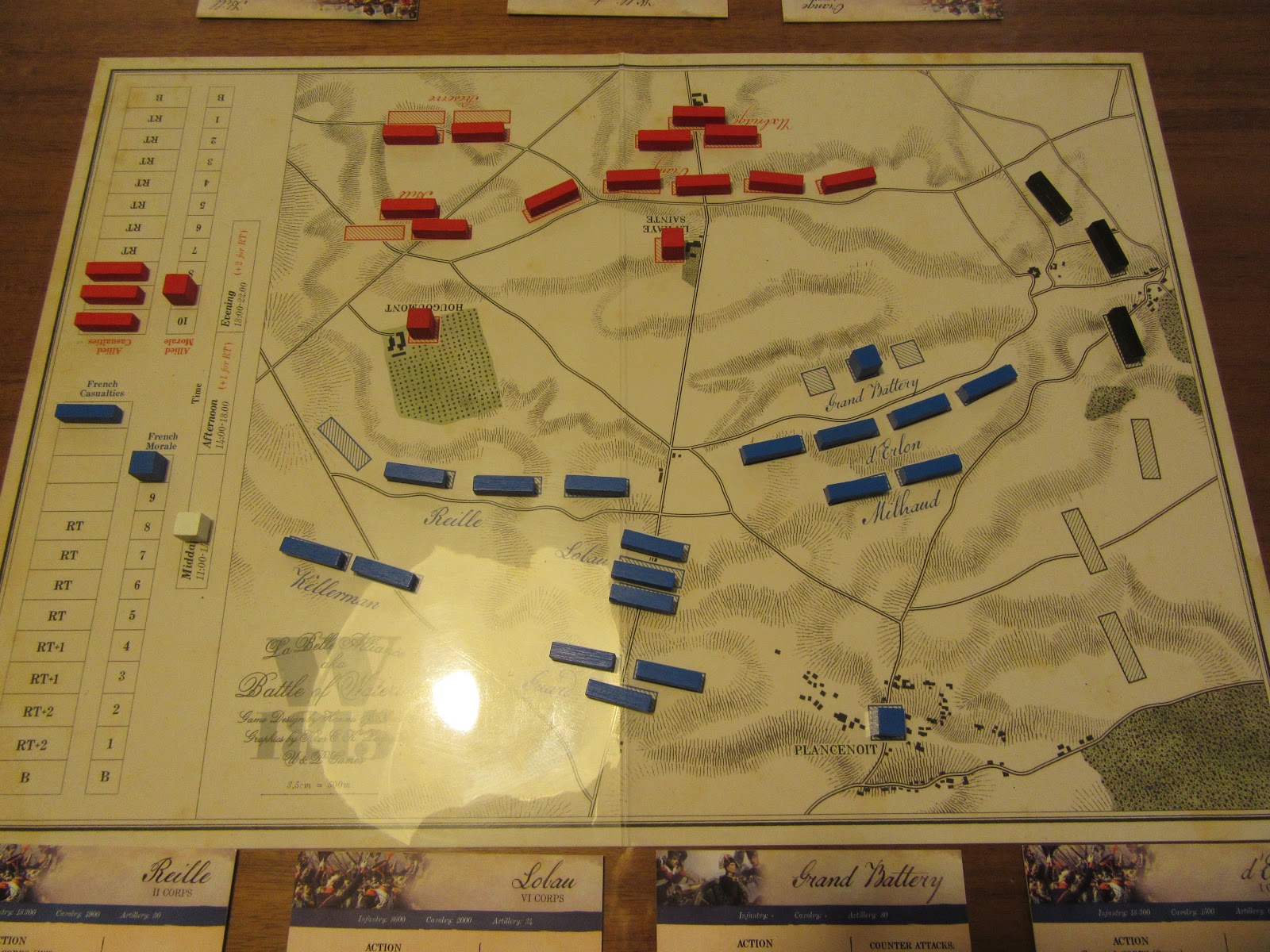
The urge struck last night for a wargame. A little fossicking brought out recent favourite W1815, and the board was set up.


Napoleon begins with a boom! - the Grand Battery roars its delight at battle commencing. Anti-climactically, the mud interferes, Orange is unaffected, and a relieved Wellington passes the baton to Blucher, who gets lost.

The Grand Battery fires again. This time Allied morale suffers. Blucher brings a division onto the field. Good man!

Once more the Grand Battery barks; again the mud interferes.


Blucher brings on another.

Napoleon changes plans. Reille is activated and Hougoumont threatened, but Wellington calls upon the Reserve, and Hougoumont holds.

Reille attacks again with casualties on both sides. Blucher brings on a third division.


Kellerman is activated to strike at Hill. Allied morale is affected, but at a cost. Hill, having formed square, orders his troops back into line.

Reille attacks again: more casualties on both sides. Blucher brings on a fourth division. Reille continues to attack, and the Reserve is called upon to reinforce Hill.  Reille attacks again with more casualties to both sides. The British cannot sustain the fight, and Hill's command is broken.

Wellington turns to Blucher, who brings on another division and is now present in considerable force.


Reille threatens Hougoumont again, and for the last time the Reserve is used to preserve the position. Milhaud attacks, but Orange goes into square and staves off damage. Blucher launches, and the Guard must activate to prevent Plancenoit falling.

Blucher moves to bring on another division. The Guard attacks Orange with Napoleon's blessing, and does good work.

Blucher launches at Plancenoit again, and this time it succumbs.

The Guard attacks once more, and the Allied army, morale test failed, routs. Victory to the French!


Game 2.

The Grand Battery fires off again, and Blucher navigates his way to the battlefield. This interplay continues for some time. Eventually Kellerman moves against Hill, who goes into and comes out of square. Reille hits Hougoumont but is repulsed. Casualties mount.


Reille throws his all into the attack on Hougoumont. The Reserve activates to hold the French off. Blucher comes as quickly as he can; so quickly that Lobau counter-attacks him.


The Guard moves and Blucher comes on in force. Casualties mount; the French push, but, just as they are about to drive Wellington off his hill, their morale breaks. An unlikely victory for the Allies!


And so W1815 provided an entertaining couple of hours play. The French were very unlucky in the second game to fail a morale test just as they were about to break Wellington on casualties alone. They rolled a six for morale, and with two plus-ones in play, just tipped over their breakpoint. It must've been the spectre of the Prussians that did it!

Overall, the game is nicely balanced, and there are different strategies to explore. It is mostly the French who drive the action, but there are moments when the Allies can apply pressure and force Napoleon into desperate choices. Well suited to solitaire play, I think.

Don't tell the missus, but I enjoy this game so much I've ordered its scion - Hollandspiele's Table Battles and all its expansions - from the US. I wonder if I can smuggle it into the house unnoticed? The chances are not good!

Saturday, June 20, 2020

In which some actual wargaming took place

I was recently lucky enough to participate in a multi-player PBEM game organised and umpired by Norm, of Battlefields and Warriors fame. The battle was Germantown, the game published by Decision Games, and the report is up on Norm's blog here.

Before I got into miniatures gaming I was involved in the PBEM Diplomacy scene. It was huge fun, though a little too demanding of time and attention to continue for very long. Norm's game - well conceived and very efficiently run - was a lovely reminder of how enjoyable multi-player PBEM play can be.

If Norm ever runs something similar again, I would advise anyone with the remotest interest in it to jump at the chance to join in.

Sunday, May 24, 2020

The Last Dice


Following on from the smash hit Michael Jordan / Chicago Bulls basketball showcase The Last Dance, Netflix is returning to its sports documentary format with a blockbuster new series due to be broadcast by the streaming giant mid summer.

The Last Dice will tell the story of monomaniacal gaming genius Gerald Maximus Bevan and his attempt to win an unprecedented third straight Commands & Colors: Late Dark Ages world title.

Accessing raw behind-the-scenes footage of Bevan gleaned from six months’ worth of unprecedented no-door-unopened filming, the documentary makers juxtapose scenes of visceral game play with unvarnished interviews featuring friends, opponents, celebrities and board gaming legends to tell the sports story of the decade.

We called him Ear Bevan because, man, he just heard about everything before anyone else, you know? Amendments, expansion tweaks, QRS adjustments, rule changes, scenario conditions, VASSAL protocols, you betta believe he would hear about it and use it before any other cat. He heard it and he brought it and that was that. Ear Bevan, m*****f******. Brian Malmouth

In the ten-part docuseries nothing will be out of bounds. From Bevan’s (in)famous eccentricity to the barely-contained controversies that threatened to cancel his historic record attempt before it even began,‘Ear Bevan’ will be exposed as he has never been exposed before.

He gave you nothing. We all know how he used to put 'Greetings' into the text box instead of 'Hi', 'Hello', or whatever, but there was more to it than than. Subtler stuff. Not many people know this, but he would type 'GG' after a game (for 'good game' - editor) win lose or draw. It was like his – I don’t quite know how to put this – sign off. He was just an intimidating presence. Dayne Kerr

Deep coverage is the intention, and early promotional material indicates that fans and viewers will be shocked by some of the revelations. You thought that Maximus was his real middle name? Not true. Watch the series to see which movie was the inspiration behind it. You thought that he probably had an interesting back story? Uh-uh. Captivating details about the dullness of his personality and numbingly ordinary suburban upbringing will emerge over the duration of the series. How this guy became what he became will surprise us all.

The thing was he thought he was the best, but I was pretty good too. The first semi in ‘08 I had his measure. I was up like four banners to one with just two needed and I thought I could rile him a little and have some fun. You know, play him a bit, get some payback. So this one game I called him 'Minimus'. Just typed it in and waited. Well, I was two banners up when I said it. I never got another banner all match. He just went to another level. That’s the kind of player he was. Now, looking back, I sort of wish I’d just called him 'Bevan', or 'Ear', or just typed ‘your turn’. Toppie Buller.

Indications are that this will be a warts-and-all treatment of its subject. His Earness’s hoarding problems will be addressed, including the rumours that this was the reason he almost walked away from the game after his breakthrough ‘07 season. 

The intense highs and lows of the period promise electrifying viewing.

Know what he said to me after that game? 'Nxt time, call me Divi Filius Minimus :) GG.'  Toppie Buller.
I didn’t have a hoarding problem; I had a storage issue. Gerald Maximus Bevan


The Last Dice: the new series documenting part of the career of a man who was so good he is almost a myth. All we can say is, 'don’t myth it'.


Friday, May 15, 2020

Book buying spree

Now that NZ has come out of full lockdown and into a 'managed' normal, it was a great relief to see that my favourite (though sadly only) secondhand bookshop in driving distance has reopened. It was only right, meet and good to go there and splurge in votive thanks as soon as I was able.

Fortunately, there were three cracking coffee-table hardcovers with Prufrock written all over them:

1) Peter Connolly's Greece and Rome at War
2) Peter McIntyre's Peter McIntyre: War Artist
3) Barry Cunliffe's Rome and Her Empire

All three have some sort of sentimental value for me, and were swiftly snaffled. The first because it's a classic that I did not have in the collection, the second because I used to read it at my grandfather's house (and he'd fought in some of the places and actions depicted), and the third because I remember looking it over admiringly at the library as a youngster.

A good lunch-break's work, I think.


Related Posts Plugin for WordPress, Blogger...