Prufrock's Wargaming Blog

Prufrock's Wargaming Blog
Showing posts with label boardgames. Show all posts

Monday, July 20, 2026

July 1st, finale.

Turns 8 and 9. 3:45 - 6:15.

With the battle in the balance (see here for part one and here for part two if so inclined) and the Union aiming to defend below the Culp/Cemetery heights while reinforcements continue to come up, Pender, Early and Rodes' divisions attempt to get to grips with the Union line. The Union left pulls back but the fighting around Gettysburg itself is intense (the victory hexes for this first day scenario are denoted by wooden cubes). 


In the first round of fighting the Union centre is blown out. 

The advantage is with the Rebels after the first round of fighting.

In the second round, the weakened Rebels are fought off and the the Union line pulls back to the heights.

Both sides take a moment to catch their breath.

The remnants of Heth's Division go in against the Iron Brigade but encounter withering fire and are shattered in the attempt. 

The Iron Brigade stands firm.

Heth's Division is no more!

The attack is pressed again.

Battle is joined all along the line.

The fighting is murderous. Both sides take high casualties but Ramseur gains the heights for the Rebels after a successful advance after combat. 

Ramseur makes it onto Cemetery Hill.

Turns 10 and 11, 6:15 - 8:45

A counter-attack is launched. There is high-stakes fighting on Cemetery Hill (so engrossing I forgot to take photos!). The Rebels will not be denied.


In the dying moments of the day the Rebels get three brigades onto Cemetery Hill, which is enough to secure a substantial victory. The cost however has been very high, and the army is spent.

Conclusion

It was a breathless end to a fascinating refight. It was not until the last turn that it seemed possible for the Confederates to achieve a win. In throwing men into attacks towards the victory objectives as night drew near it felt as if the horrendous losses would all be for nothing. The initiative rule which allowed the Rebels to chose the timing of their combat chit and some unfortunate ordering of chit pulls for the Union meant that the Confederates were able to concentrate and prosecute attacks better at the very end of the day and the brave efforts the Union troops had put in fell away at the close due to exhaustion. 

Casualties

The Union had almost three entire corps shattered. 23 points of infantry casualties (c.6900 men), 1 point of cavalry casualties, 72 points of men demoralised and shattered.

The Confederacy for its part had almost four entire divisions shattered. 26 points of infantry casualties (c.7800 men), 1 point of artillery casualties, 52 points of demoralised troops in shattered units and 6 points in demoralised men in units still on-table. 

I think it would be unlikely that the Confederates could hold the ground taken on day one on day two given the high number of units shattered, but overnight rally-attempts could alter that equation if the game were to continue (and I was wrong in my estimation of the Confederate chances to take the heights as well!).

Thoughts on the game

There is a lot to like about Battle Hymn. Apart from the combat rules, everything is pretty straightforward, and the fact that it is chit-pull is great when playing solo. Combat is dice-intensive, and there are quite a few stages to work through. This makes it difficult to predict results, but also gives the combat turns an epic atmosphere. A problem I found was that remembering who has fired and who has not became an issue in later turns. I fear that once or twice I may have fired twice for one unit and not at all for another! Oh well, I will put it down to the chaos of battle....

Next time I play I will use markers to show when a unit has fired as well as using dice to record the hits on each individual unit.

I do have a couple of reservations though - one being that it is very difficult to get rid of artillery. I wonder if there needs to be a rule that ties artillery units to their parent formations so that they will retire if the rest of their formation does. By the end of this game most of the units left on the field were artillery!

But all that aside, I really do enjoy a good Gettysburg game, and this playthrough will rank up there as  one of the most engrossing I have played. 


Sunday, December 28, 2025

Lord of the Rings: Fate of the Fellowship test game

I finally succumbed to the hype and picked up Fate of the Fellowship from Z-Man games. As a youth I loved Lord of the Rings but as this game uses the Pandemic system I was a bit leery of it at first (I have Pandemic Rome and found it to be not really my cup of tea). However, the board drew me in and as the game was on special at our FLG's Boxing Day sale, I decided to get it. 

I do have War of the Ring, but it is such an investment in time that I have never properly played it. I didn't want that to happen with this game, so set it up immediately rather than put it on the shelf for another day. 

Here are the notes on my initial run-through: 

Look at that board! Beautiful.

Turn one: Legolas uses his special power to generate a stealth token. He moves to Lorien. 

Sam and Frodo sit tight at the Shire in Eriador. With two black riders and the eye of Sauron in the region it is dangerous to move. 

The Shadow troops move; there is a battle at Palargir, but the forces from Umbar are defeated. There are orcs at the Fords of Isen. The Nazgul search for the ring, and one hope is lost. 

Turn two: Gandalf moves into Dunland to claim a friendship token, then travels to the Shire. 

Frodo and the Sam move with Merry and Pippen and Gandalf to Bree, using a stealth token to avoid a search by the black riders. 

The danger intensifies - the company loses two more hope, and the enemy musters in Southern Mirkwood. 

Nurn is reinforced and two more of the Nazgul move into Eriador. Wheels of Saruman is drawn, and the company loses two cards from its hand. 

Turn three: Eowyn moves to Helm's Deep to meet the threat from the Fords of Isen, calling up three companies of Rohirrim to her aid. 

The Shadow musters troops in all its strongholds, and orcs threaten the elves in the Woodland Realm. 

Turn four: Merry and Pippen decide it is time to move - to the Weather Downs. Sam, Frodo and Gandalf accompany them. Three search dice come up to endanger the fellowship; one is ignored by playing a friendship token, but the two others reduce the hope track further. One Nazgul is recalled to Mordor. Frodo is now down to one hope. Another friendship token is used to remove two further Nazgul to Mordor, leaving one in Eriador. 

An event card is played, placing ents in Fangorn. The forces of the Shadow attack the Woodland Realm, but it holds. Orcs attack Minas Tirith; it beats off the enemy but suffers grevious losses. 

Legolas collects stealth and resistance tokens then leads the ents to attack Isengard. He defeats the orcs there but is unable to convert Orthanc to a friendly haven because he does not have the necessary tokens. 

Eowyn at Helm's Deep; Legolas and the ents at Isengard. Orcs at the Fords of Isen.

Frodo, Sam, Pippen, Merry and Gandalf move into Rivendell using a stealth token to avoid a search by the black riders. 

The Shadow cards are drawn - orcs attack the weakened defences of Minas Tirith, and it falls. All hope is lost, and the game is over. 

Minas Tirith has fallen.

This brief summary represents about three hours of actual playing time, including set up, rules referencing, etc. 

First impressions are what a lovely board, and what an interesting set of game mechanisms. It seemed very hard to get much done: you need tokens (resources) to perform certain actions, and I just did not have enough of them. Checking boardgamegeek I realised that I had been playing the resources slightly wrong: you can also use cards as resources, not just the tokens. 

Time to set it up again!

The game has oodles of scenarios and customisable features, while also being scaleable from one to five players. It nails the Lord of the Rings atmosphere as well. It could turn out to be one of the buys of the year for me. 


Friday, August 15, 2025

Luzon Pass - Littoral Commander, Indo-Pacific

I set up scenario two of LC-IP last night to try a solo game. In this situation war has broken out between the US and the PRC. The PRC is trying to force access beyond the First Island Chain; the US is trying to deny that access. 

US marines have landed at Luzon and the islands to the north to defend against a PRC ground force aided by a naval flotilla.  


The marines have four platoons of combat infantry, six sections of long range missiles, six missile defence sections, and a logistics company.

American deployment looking west


The PRC force has four infantry platoons, a light armoured platoon, a heavy weapons platoon, two multiple rocket launch sections and two logistics platoons alongside three destroyers, a frigate and an amphibious assault vessel. 


The US has to defend the line between Luzon and Taiwan; the PRC has to breach it. There are seven turns. 

***

It is hard to do justice to how interesting this game is to play. On top of the units on table, there are also attached force packages, represented by off-table Joint Capability Cards (JCCs). These can represent anything at all, from surveillance drones to special forces troops to submarine attacks to CAP fighters to ballistic missile strikes and just about anything else you can think of. They all have a points cost, and you get to choose which JCCs you will purchase before the game starts. This means that you have a vast range of options for your game strategy.

The game pieces themselves all have a roster card as well, showing hit points, assault ammunition, long range fire ammunition, defensive missile ammunition, logistics replenishment points and so on.

Card rosters for the PLAN ground task-force, with attached JCCs, and various ratings for hits and different types of ammunition, which will be tracked in-game by coloured cubes:


Probably the best way to give a feel for the game is to go through a few turns. 

Turn 1: Initiative is with PRC. They elect to begin by activating Task Force Shanghai, their land-based force. They have three action points to use. One is used to play a JCC (AI-enabled targeting) which will be reusable each turn; and two points to activate both stacks of land units to move one hex each.

The US then activates Task Force New York. With no enemy yet revealed to fire at, they play JCCs only, to get Combat Air Patrol and their own version of AI-enabled targeting onto the table for future use.

The PRC then activates their flotilla, Task Force Beijing, to move. They move wider to try and avoid the US missile umbrella and sneak around to the west and north to exit the First Island Chain.

The US then activates their second task force, Chicago, which is deployed in the island chain offshore. They do nothing, having no revealed enemy to shoot at and no JCCs to play at present.

Turn 2:

Task Force Shanghai plays a Social Media JCC, revealing the whereabouts of the US logistics company and a HIMARS section. A second JCC is played, AI targeting, which is successful, meaning that the effects of decoys can be disregarded. The two MRL systems open fire using their full capacity, for five salvos against the logistics company and one against the HIMARS section.  Missile defence is engaged by the US, with four defensive fires for the logistics company and one for the HIMARS section. One of the PLAN missiles gets through, resulting in a hit on the logistics company. It has two hits remaining.

Task Force Chicago activates. It attempts a fighter attack on two of the PLAN ships, but is nullified by PRC Combat Air Patrol (in the form of a Joint Capability Card). An attack is launched against the missile unit. Of the six attacks initiated, one is successful. There are corresponding reductions in munitions for both sides. The logistics company is concealed so that it cannot be attacked.

Task Force Beijing moves the flotilla; Task Force New York elects to do nothing as all enemy units are either out of range or, if in range, unrevealed.


Flotilla navigates towards the gap while keeping out of range


As you can hopefully see from the samples related above, the turns are interactive. There are moments to lead, moments to wait, moments to intervene, risk-reward calculations to make.  

The pre-planning (in the form of Joint Capability Cards and positioning of on-table forces) means that there are radically different strategies to employ. 

We ended up here with the US being outgunned and out-manouevered. The PRC achieved their objective of getting through the First Island Chain with turns to spare. My assumptions about US ability proved to be overly optimistic, and the pre-battle positioning was accordingly flawed. 


US strength


Strength decimated, enemy passes by


US casualties

I highly recommend the game. It isn't cheap (not that many games are now!) but what is in the box is of excellent quality, and the decisions players are forced to make are of a most visceral quality!

Monday, August 4, 2025

New games

The last month has been a bit wargame-lite. I've gone into a different role at work which has added 75-90 minutes a day in travel / morning prep, so I've spent less time painting and playing and more time looking at boardgames online!

New purchases include:

Littoral Commander Indo-Pacific and Littoral Commander Baltic. These are going to be great additions to the collection. Have played Indo-Pacific once in person with four players and once over VASSAL with two. Plenty to go into with these near-future warfare studies but that's for another time.

Memoir 44 battle map expansions Through Jungle and Desert, Sword of Stalingrad, and Tigers in the Snow. The ready-to-play maps are just so convenient that it would have been criminal not to get them! I have plans afoot for multiplayer games so these will make that goal much simpler.

A Victory Awaits. The great Tetsuya Nakamura's version of Barbarossa on three maps using the A Victory Lost system. I decided to bite the bullet on this - A Victory Lost is still the most fun I've had with a WWII operational game, and while it's a bit tough on the wallet importing this from the States I couldn't allow it to sell out without getting a copy. Will I get to play through the whole thing? Not sure, but I hope so. Also playable one map at a time, so will be good value for solo play.

Lots here (or on the way here) to keep me busy. 

Anyway, just about time to turn in so I can get up bright and early for my commute!


Saturday, January 11, 2025

Boots on the Ground

A while ago I picked up Boots on the Ground by Worthington Games in a trade. It had been sitting in a trunk for the best part of 2024, but while I was searching for something quick-ish to play in order to test out my new plexiglass sheet, I wondered if it might be a good time to give it a try.

The rules are about six pages long, which is always a good start when you are looking for 'quick-ish'.

The game is designed to be played solitaire against a card-activated opponent, co-operatively against the same, or competitively, but I have not properly digested how the latter format works.

The system is simple: set up map of generic city; cover with your new plexiglass; populate map with markers (civilians, vehicles, items, insurgents) as per scenario instructions. Deploy your squad; activate the whole squad with limited action possibilities or activate an individual to use their special abilities; draw card for instructions on insurgent actions, perform actions. Repeat.

I chose the first scenario, requiring my squad of six to navigate their way down a long street to reach their objective, and to do so with at least four of the squad still alive. It's a 30 card (30 turns, in effect) scenario.

The first thing you notice is that the game's components are not especially appealing. The map has a sort of grainy 'satellite view' aesthetic with superimposed square grid. The counters are functional rather than artistic. But my set has already been clipped tidily by the previous owner, so that is an improvement on my own irregular clipping habits!

Game flow is similar to a first-person shooter. Insurgents suddenly appear in doors and windows to shoot at your team. You respond. You move close to a vehicle; you can't avoid it. Is it useful cover, or does it contain an IED? You approach civilians - are they harmless or insurgents in disguise? You flip the counter and see. There are lockboxes. Do you want to risk opening it? If yes, flip the counter and see.


And this one is an IED! Fortunately, our demolitions expert was able limit its effect. Can't say the same about the insurgent who appeared in the window; he has wounded the squad leader.


A wider view of the map. 

Player input is mainly about positioning your team so that they can respond to threats while also looking to work towards the objective. Combat odds favour the player - your soldiers are elite - but with opposed die rolls and situational modifiers the advantage is not certain. It is only my first game but tactics here were not particularly sophisticated. Move towards the objective, shoot anyone in the way, keep your medic close by to treat wounds. 

The card pull is the fun part. What will it be? Will it be an insurgents move and shoot card? Will it be an insurgents appear and shoot card? Will it be an insurgents take cover card? Will it be something else? 


Two thirds of the team wounded and still two blocks from the objective. Do we halt and patch wounds,  hoping for a lull in insurgent activity, or do we press on? 

In this scenario there seemed little need to use individual counter abilities. We wanted to keep everyone together and move then as a group if we could. The only one I activated individually was the medic,  who was called upon to deal with the wounded and get them back on their feet.  

At times it is brutal.


Another ambush. Our sniper killed!

At this juncture we are fortunate enough to get some air support (two card-pulls in a row) which forces the insurgents to keep their heads down long enough for our medic to get around the rest of the team.

We keep moving. We have killed or wounded the visable insurgents, but then find the civilian in front of us is not a civilian after all. Oh dear!


Insurgent revealed.  Another man wounded; we are lucky it wasn't worse. 

As we approach our objective the tension rises. Just half a block to go. We leave one of our wounded behind and press on with the four who can move as a group. Metres from safety disaster strikes.


An insurgent appears in the last doorway and shoots our demolition expert dead. 

The leader. medic and scout move to the objective; they call to the wounded heavy weapons expert to join them. He is wounded again in the sprint; the medic has to go and carry him to safety. 

They make it, but only just.


Four survivors at the objective. 

The long road travelled. 

So what of the game? It is light and a little cartoonish. But that is good for me. I prefer it to be non-specific and based on generic situations rather than real events. I don't want to play a serious game on this topic; it is still too close and too many people are still affected. 

As mentioned earlier, the play in this scenario was not sophisticated. The other scenarios will add complexity and no doubt the special abilities of the various squad members will come to the fore when there are different objectives and problems to surmount. 

On the whole, it was a nice little diversion, and a great way to start two weeks off work.

I will look to play it again and will try the next scenario and see how it goes. 

As for the plexiglass sheet, it really did the business!


Monday, December 9, 2024

300: Earth and Water

Between purchases on Amazon for Memoir '44 expansions (yes, I have gone deep down the rabbit hole - free shipping to New Zealand is a big draw!) and picking up various books and things I came across a little game on the Persian invasions of Greece called 300: Earth and Water

I have always been interested in these campaigns, right from when I was a youngster reading about Leonidas at the Hot Gates, or Themistocles at Salamis. I think I borrowed the Peter Green book from the library when I was at Intermediate school, and even wrote a poem in an 'epic' style for English class, which amusingly enough relied entirely on a (mis)pronunciation of Thermopylae (Therm-o-PY-lae) for its meter. 

It is a nice package. An attractive mounted map which extends to a little over A4 size, well-produced cards, and coloured wooden cubes and rounds representing armies and fleets make up the playing area and pieces. The rules are only a few pages long, supplemented by some historical commentary.

The cards - just sixteen of them - drive the game and are used either as events or to activate armies or fleets for movement and/or combat. 

There are five campaigns (or turns if you like) during which players purchase armies, fleets and cards to play, play them, and then score points for areas occupied at turn's end. The Persians have greater purchasing power and a larger stock of armies, but the Greeks have advantages in combat and more efficient lines of supply.

The object of the game is to occupy the two enemy home cities or else win on points at the end of the five campaigns. The rules are simple, but offer wide scope for different strategies to be employed by both sides. 

I have played one test game so far, which was won by the Persians. I was just learning the rules and the cards rather than playing optimally, so I wouldn't read anything into the result. 

Once you know what you are doing I think you could easily finish a game in half an hour. If you had the armies in miniature it could work well as a campaign game battle-generator. 


The board at end of my learning game.

I'm quite pleased with it. It is compact, clever, and will require thoughtful play. I hope that the system will be used for other campaigns as well, and it could be used to generate home-made scenarios with a bit of tweaking. 

Now I just have to convince someone to play it with me!

Thursday, September 26, 2024

The Lamps are Going Out - learning game

Earlier this year I was lucky enough to pick up a used copy of the The Lamps are Going Out, produced by Compass Games. I'd been keeping an eye out for it for a while after reading a review that struck a chord.

I set it up on Monday, have slowly worked through the sample game which takes you through the first two turns, and am carrying on from there myself to learn the rules and try to get a sense of how the game flows. It can be played solo, two-handed or four-handed. I think it will be a good one to get down: there is promise of replayability!


The map is pleasing. I like area maps for solo play, and it reminds of the Diplomacy board, which gives me the warm fuzzies. 

The game play is interesting. You have a fresh/spent model - familiar to me from Phil Sabin games - with a production model which allows replenishment of spent units, but production points are at a premium, and must also be used to do other things. 

Attacking units automatically become spent, but if they score equal or higher to the defender (with a few modifiers here and there as you would expect) the defender will also become spent. When all defenders in an area are spent, further successful attacks will either force retreats or cause casualties. 

You can probably imagine how the Western Front might go under such a system!

Alongside this you have event cards drawn each player turn which change the board situation in some way, and technology cards, which may introduce new types of units, or leave you with no advances at all, depending on what card your faction pulls.

There is 'chrome' to keep things interesting (trench rules, air rules, artillery rules, naval rules, U-boat rules, collapse-of-Russia rules, amphibious operation rules, a 'USA entry' track and so on) and allow players to put some Baldrickianly cunning plans into action.

I'm pleased with it so far and enjoying pottering around with it. It is satisfyingly large in scope, but without so many moving parts and so many decision points that you burn out playing it. 

The Schlieffen Plan - Germans in the Somme!

It has started well. Let's hope it continues that way!


Monday, May 27, 2024

A Game of Empire

 As a break from painting I got out my copy of Phil Sabin's Empire to play a solo game. Empire is a light wargame set in the ancient era covering 200 years from the time of Alexander through to the demise of an independent Macedon. The map covers Iberia to India, with areas connected by land or sea. It starts with the Achaemenid Persians pre-eminent in the east, controlling eight areas, and Carthage (three areas) dwarfing the foundling Roman Republic (which has to meet consolidation conditions before it can begin to campaign) and Macedon, both of which control just one home area to begin with.

There is a revolt phase (die rolls to find which area throws off the yoke of its oppressor) then a campaign phase in which each of the four powers look to expand their territory or reassert control over territory lost. Three 'great captains' (you can probably guess who they are!) allow five campaigns on the turn(s) they are active instead of the usual single campaign per power.  

There are two scoring rounds, turn 10 and turn 20. Carthage and Persian start with 12 VPs each; Rome and Macedon start with 0

We pick up the action in 350 BC.

350-341 BC. Bactria revolts. Carthage conquers Sicilia. Rome bickers with its Latin neighbours. The Persian Empire moves on Aegyptus but is defeated. Macedon conquers Graecia.

340-331 BC. Persia revolts. Alexander rampages through the east, taking Thracia, Asia, Pontus, Syria and Aegyptus. Rome continues to bicker. Persia takes back the province of Persia. Carthage fails to take Magna Graecia.

330-321 BC. Aegyptus revolts. Alexander continues his campaign, taking Armenia, Mesopotamia, Persia and Parthia. The Persians attempt a revolt in their home territory but fail. Carthage again fails to find a foothold in Magna Graecia. Rome is still embroiled in internecine conflicts. 

320-311 BC. Macedon fails to take Bactria. The Parthians successfully reclaim their capital. Rome consolidates Italia and now has a presence in the Mediterannean. Carthage fails to make any headway in Magna Graecia.

Alexander's conquests and Parthia reclaimed for the green team.
 

Carthage dominates the western sea as Rome emerges.


310-301 BC. Pontus revolts. The Parthians fail to take Bactria. Rome fails to take Magna Graecia, and so fails Carthage. The Successor kingdoms reassert control of Pontus.

300-291 BC. Thracia revolts. The Parthians again fail to take Bactria. Carthage takes Magna Graecia; Rome promptly takes it off Carthage. 

290-281 BC. Persia revolts. Carthage tries another futile expedition to Magna Graecia. The Successors fail to bring Aegyptus into their orbit. Parthia fails to take Bactria. Rome fails to take Cisalpina. Failure is epidemic!

280 - 271 BC. Macedon takes Thracia. Rome fails in an expedition to Sicilia, Parthia fails to take Bactria, and Carthage fails to take Magna Graecia.

270 - 261 BC. There is a revolt in Numidia. Rome takes Sicilia. Successors fail to take Aegyptus. Carthage fails to retake Numidia. Parthia takes Bactria at last. 

260 - 251 BC. Thracia revolts. Carthage brings Numidia back into the fold. The Successors again fail to take Aegyptus. Rome fails to take Cisalpina. 

Rome and Carthage with their spheres of influence (251 BC).


Rome and Macedon (251 BC)


The east (251 BC)


This is now the first scoring round. Parthia controls Parthia and Bactria for 2 points, taking them to 14. Carthage controls Africa (2), Numidia, Iberia (2) for 5 points. This takes them to 17. Rome controls Italia (3), Magna Graecia, Sicilia for 5 points, giving them 5. Macedon controls Macedonia, Graecia, Asia, Pontus, Syria, Armenia, Mesopotamia for 7 points. 

At this stage I thought that Rome looked to be in a strong position to push for a win in turn 20. 

250-241 BC. Revolt in Graecia. Rome tries to attack Africa, unsuccessfully. Carthage attempts to take Sicilia but fails. Macedon takes Graecia again.Parthia fails to take Persian. 

240-231 BC. Rome takes Cisalpina. Carthage fails to take Gallia. Greeks fail against Aegyptus; Parthians fail against Persia.

230-221. Revolt in Magna Graecia. Rome fails to retake it. Parthia fails to take India. Legacy Successors take Aegyptus. Carthage fails to take Gallia.

220-211 BC. Hannibal sweeps through Gallia, Cisalpina, Italia, bringing Rome to its knees. Macedon fails to take Thracia, Parthians succeed in taking Persia, Rome, forced to consolidate again, fails. 

After Hannibal's devastating campaigns against Rome.


210-201 BC. Revolt in Iberia. Scipio consolidates Rome and retakes Magna Graecia, but three other campaigns fail. Carthage fails to reclaim Iberia. Macedon takes Thracia. Parthia successfully conquers India. 

200-191 BC. Pontus revolts. The Roman expansion continues: they take Cisalpina, Gallia, Iberia, Numidia, and just fail to take Africa. Parthia fails to take Mesopotamia. the Successors retake Pontus. Carthage reclaims Numidia.

The Roman revenge is swift, but they do not expand east into Greece.


190-181 BC. Revolt in Syria. Carthage fails to take Iberia. Parthia fails against Mesopotamia. Successors take Syria and Rome fails to claim Sicilia.

180-171 BC. Revolt in Syria again. Parthia takes Mesopotamia. Carthage fails to take Iberia.  Successors claim Syria. Rome takes Sicilia. 

170-161 BC. Revolt in India. Macedon fails to take Illyria. Rome takes Numidia. Parthia fails to claim India. Carthage can't wrest back Numidia.

160-151 BC FINAL TURN: Revolt in Asia. Rome takes Africa. Carthage's attempt to revolt fails. Parthia is unsuccessful in India again and the Successors fail to take Asia.

Last turn scoring: 

Rome: Italia (3) Magna Graecia, Sicilia, Africa (2), Numidia, Iberia (2), Gallia, Cisalpina for 12 points, taking them to 17.
Macedon: Macedonia, Graecia, Thracia, Aegyptus (2), Syria, Pontus, Armenia for 8 points, or 15 all up.
Carthage: no territories remaining, it rests on the 17 it had at turn 10.
Parthia: Parthia, Bactria, Persia, Mesopotamia for 4 points, taking them to 18.

Parthia takes the win with 18. 17 for Rome and Carthage and 15 for Macedon.

Views of the board at game end.

Final positions. 


It was another interesting play of a Phil Sabin game, and surprisingly close. With two turns to go any of the four powers could have won mathmatically. By the last turn it was down to Carthage and Parthia, though I didn't know that until I tallied up the final score. If Carthage had held Africa on the final turn they would have taken the game.

Thoughts: Rome was fighting Carthage all game and never got a chance to expand east. Macedon could not hold Alexander's conquests, with vital revolts depriving it of a stronger result in the first scoring round. But it did manage to stay competitive. Carthage had a worthy fight with Rome and was only just short of victory. Parthia got back into the game with an early successful revolt against Macedon in its home area, and did just enough to take the win.

I wonder if Rome slightly underperforms in Empire. I don't recall a Roman victory in the times I've played it, and the need to risk a sea attack to get a foothold in Greece seems to result in a 'Carthage first' policy when an attack east earlier is probably necessary to achieve a win. 

Good, thoughtful fun anyway, as is usual with Phil Sabin's designs.


Wednesday, April 24, 2024

Chancellorsville and Glory II

If there's one thing I love about boardgames, it's setting them up. I may not get through a whole game, but I do like to get the maps on the table, weight them down for a couple of days to sit flat, leisurely put the counters in place (in consultation with appropriate reference works), and then admire the scene. 

I got Richard Berg's Glory II: Across the Rappahannock about ten years ago, I would guess, when I was in Japan. I set up a couple of one-mapper scenarios, but the whole battle of Chancellorsville is a three-mapper, and I didn't have the dedicated space over there to tackle it. 

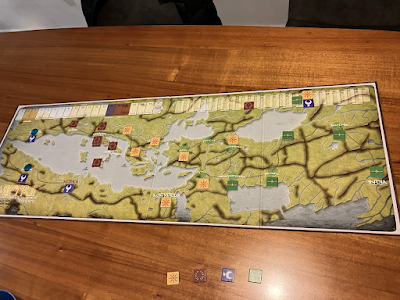
The first thing you appreciate is that three maps do the terrain justice. Here we are looking from the west towards Fredericksburg, with the Union forces in the foreground converging on Chancellorsville itself.


Moving east, we see Anderson and company digging in around Zoar Zion Church and waiting for support to come up.


On the heights overlooking Fredericksburg, McLaws stays in prepared positions (for the moment, at least).  


Further south, Early observes Sedgwick and his command across the river. 


It is 7:15am on May 1st, 1863: Hooker is at Chancellorsville, the Federals are massing, and the action is about to commence. Shelby Foote provides commentary and atmosphere; we are all set.


With the prospect of playing this out solo in front of me, I re-read the Foote account and traced it out on the map. I planned to come downstairs the next night and start the game.

But I didn't. 

And that is all we got to.

A week later, I still have not started. Back into its box it goes.

It was a nice project to a certain extent, but I'm a touch concerned, looking at the vast numbers of boardgames on my shelves, how little I actually play them. I wonder if this is what my relationship to the meatier boardgames has come to: are they now just a tool to visualise action, rather than to play it out? 

Or maybe I just need to start pulling chits and rolling dice rather than opening my phone!

Sunday, February 18, 2024

On wargames campaigns (after Polemarch)

The excellent blogger Polemarch has recently put up a couple of thought-provoking posts on campaigns. The first talks about types of campaigns, concluding that they are often better in the idea than the execution; the second offers further reasoning about why that might be. 

In the ancients era that I usually game and with the types of large set-piece battles I most enjoy, campaigns tend to not have much value. In this era, campaigning was (with one or two notable exceptions) essentially about bringing one's enemy to battle in circumstances least advantageous to them. The battle was had. If the winner was the home team, the invaders were dispersed and the game, so to speak, was up; if the invader was victorious, terms would be reached and the thing was over (unless of course you were fighting the Achaemenid Persians or the Romans, who would [eventually, or fairly immediately, respectively] raise another army and make you do it all again).  

The interest then in this era is to try to get battlefield advantage. That is not usually best expressed by manoeuvrings over a campaign map, but by some sort of pre-battle system which modifies morale, numbers, terrain, deployment or leadership to the benefit of one or the other side.

If one is to do this, it is quite useful (as indeed it is for just about any circumstance!) to read Caesar to see the kinds of things he considered important when choosing if or when to give battle. 

To me it seems that ancients campaigns work best at either the grand strategic or the tactical level. You can follow the fortunes of nations over years or decades, where competing powers look to prise provinces or regions from one another, or you can follow the fortunes of smaller entities raiding or subduing neighbours in lower intensity local conflicts.

I tried a solo campaign of the latter type set in tribal Iberia. I put quite a bit of time into it, but it simply wasn't exciting enough. It turned out I'd rather refight Zama for the tenth time than try to sustain interest in endless minor encounters between similarly equipped neighbours over local concerns.

For the former type, you can't beat boardgames. If you want to replay the Punic and Macedonian wars, it's far better to do it in a boardgame in one sitting than to stretch it out with questionable bespoke rules to take up three months' worth of miniatures battles, trying to involve players whose chance of winning was, after the first week, only slightly better than nil.

I remember that the time I was most excited about campaigns was back in the Warhammer Fantasy Battle days, when I was young, had oodles of time, and thought that defending a pass against a tidal wave of Orcs was the perfect way to spend a Sunday (and the week before it mulling over army choices!).

The difference here is the difference: you could have Orcs, Goblins, Elves, Dwarves, various humans, all with different characteristics and fighting styles, and all within a realm's distance of one another without doing violence to backstory. Celtiberian tribal dominion versus Celtiberian tribal dominion does not offer quite the same opportunites for variety.

For me, if I want to get six people involved in a game, there are two choices: a boardgame, or a multi-command set-piece battle.

But it's good to be open to being convinced otherwise!


Sunday, February 26, 2023

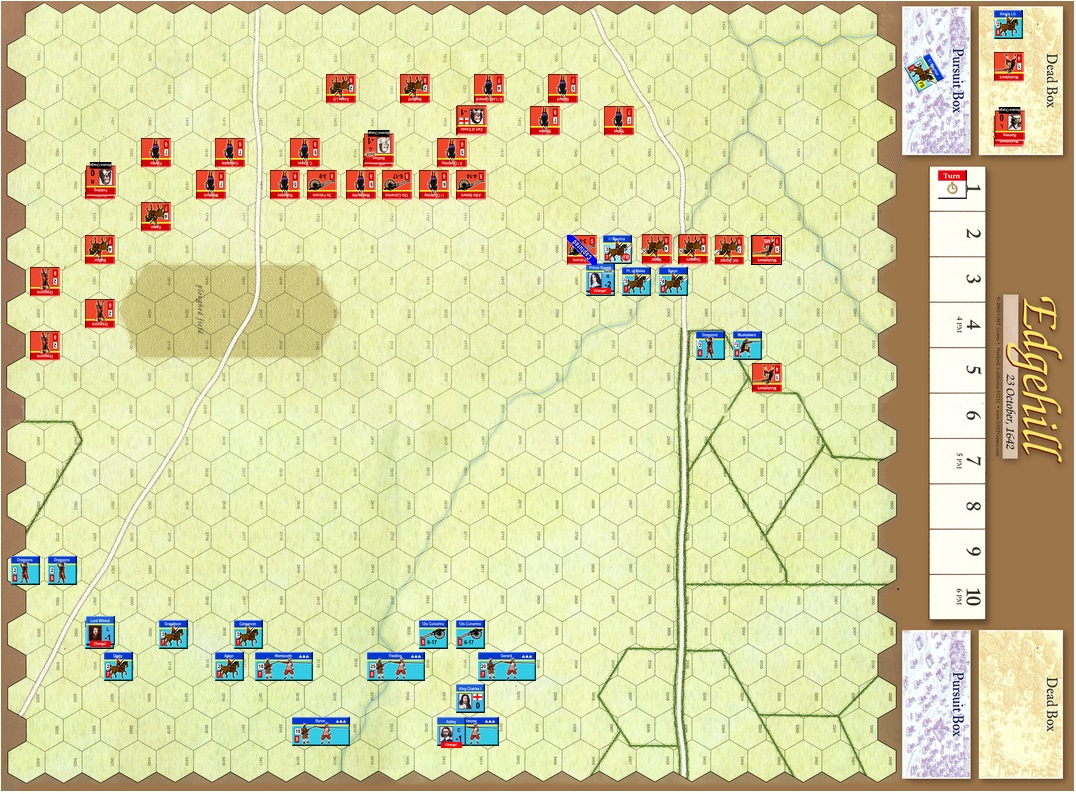
Edgehill with Pat

Following a couple of weeks of preparations, old Japan mate Pat H and myself got together online last Thursday using VASSAL for the board and Discord for chat to start a playthrough of the Musket and Pike scenario of Edgehill. 

For those that may not know Musket and Pike, it is a series of hex and counter boardgames put out by GMT focusing on battles of the English Civil War / Thirty Years War era. It was originated by Ben Hull, but has an obvious progenitor in the Berg/Herman Great Battles of History series. Like the GBoH series before it, it is a grand tactical treatment of each battle, with a specific map, named counters, and various scenario options for each battle.

The system tracks morale, attrition and formation at the unit level, while command and control rules require orders to be set at the wing level and communication traced between commanders and the commanded.

Command counters have special functions which allow units they are stacked with or in some cases are adjacent to to perform orders (rally, reform, etc) which their wing stance (charge, make ready, etc) may not ordinarily allow. 

It is one of those systems that I thought would allow a battle to be worked through over a a week or so of casual after-dinner play. Unfortunately, to this point I have not yet been motivated enough learnt the rules well enough to manage this. Hopefully this Edgehill game with Pat will change that. 

But on to the game. The scenario sees the Royalists (Pat being an inveterate Royalist I had to be very careful not to mention Harry or Megan in the course of the evening - it could have got nasty!) with charge orders itching to have at the Parliamentarian menace. As commander of the said menace, I got to sit back and watch as Rupert surged forward on my left. 

His initial activation saw all right wing cavalry, dragoons and musketeers forward. Pat then rolled for a continuation and was successful, leading to controlled carnage as his wing engaged with mine. A remarkable run of luck with my reactive shooting saw Pat's wing take considerable casualties in the charge, but ended with my commander driven off the field. 

Battle map after two activations of Rupert's wing.

It remains to be seen how we can come back from this. On the positive side, we were not routed in our entirely, and all of Rupert's units have suffered some kind of attrition. 

It has been enjoyable. It took about 90 minutes of play to get to this point in the game, but I expect things will speed up. The advatange of rules which are so procedural is that once you get those procedures down, things start to take care of themselves. The disadvantage of course it that it takes a bit of time to familiarise oneself with those procedures. 

It seems though that we are well on our way.


Tuesday, October 11, 2022

Notions of (Phil Sabin's) Empire

Faced tonight with a sudden hankering to play a game, I trotted downstairs, surveyed the shelves, and settled upon Phil Sabin's Empire. As something that takes an epic subject, could be set up without too much rules review and can be got through in an hour, it was the obvious choice.

Covering the period 350-150 BC, the game takes in the Mediterranean world (stretching as far east as India) and its Persian, Macedonian, Carthaginian and Roman inhabitants. Each of the twenty game turns starts with a rebellion roll which turns one occupied territory neutral, and then the four powers get to take a turn attempting to expand. Usually a power gets one attack per turn, but in a great captain turn they will get five (so they best make the most of it).

There is not a lot to the game tactically: you are pretty much at the mercy of the dice. To successfully conquer a territory on Empire's point-to-point game map a power needs to roll 4 or better on a d6. There are modifiers at play, and with certain territories worth more for victory point purposes, it is usually clear what the best attack is, and then you have to hope the die (or dice when attacking across a sea route) will cooperate.

It's all very straightforward - even bearing in mind a couple of special rules - and with two victory turns (VPs are counted on turns ten and twenty), everyone knows what they are aiming at.

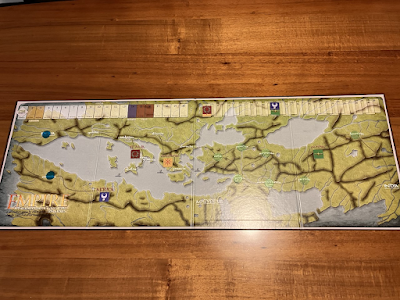
Opening situation: Carthage blue (3 territories), Rome red (1 territory), Macedon yellow (1 territory) Persia green (8 territories).


In our game Macedonia started gloriously, winning Graecia on turn one and then watching Alexander wreak absolute havoc on turns two and three, wiping out the Persians and being on the doorsteps of both India and Aegyptus.

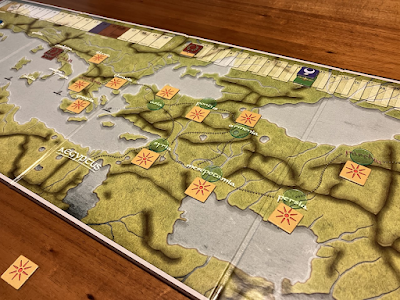
Alexander's conquests.


Neither Carthage nor Rome could make much headway in the first century of play, but Persia / Parthia reclaimed its homeland just before the first victory turn was up, and with both Carthage and Persia receiving handicap assistance, the scores at 250 BC were recorded as Rome 5, Macedon 13, Persia 14 and Carthage 16.

Carthage and Rome squabbled over Gallia until Hannibal's entrance saw Rome's influence temporarily squashed. Two turns of great captains for Rome began promisingly, but perverse sea assault rolls and some untimely revolts meant Roman expansion was stopped at Sicily, Iberia and Macedonia. 

All game Alexander's successors held on grimly to his conquests in Asia, but the Parthians (the Persian replacements) began to reclaim some of the eastern territories. 

Parthians reconquer some of the ancestral homelands.


Carthage and Rome continued to squabble ineffectually over Iberia, and at game end, the points were tallied thus: Rome 12, Persia / Parthia 20, and Carthage and Macedon tied for first place on 21. 

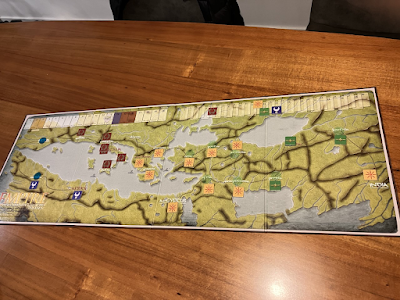
Board at game end, 150BC.


It was a nice little historical interlude, and left me with one or two ideas for future play.

Related Posts Plugin for WordPress, Blogger...