I was fortunate enough to have - for the first time - *two* gaming buddies down for a gaming session on Sunday, during which we gave Modern Spearhead a run. The battle was set c.1980, with the West Germans attempting to see off a combined Soviet / Czech assault. As the NATO player I put in a somewhat flawed performance, and my opponents were in no mood to let me off lightly. Three of my four battalions had broken by the eighth turn, and the other had only just arrived on table, too late to turn the tide. At close I controlled none of the five objectives and had only broken one weak Czech battalion in return. I think that's called a 16-1 loss!
I forgot to take any photographs, but Luke did a fantastic job with the table and apart from the fact that we were using counters instead of miniatures it really looked the part. It was Pat's first game of Modern Spearhead but he handled himself with aplomb, with his flank march in particular still giving me nightmares!
The organisation was a bit last-minute, and Luke did some sterling work getting the OOBs for the game, a task made far more difficult by our having misplaced the TO&E tables and data cards. Fortunately, the files section on the Spearhead yahoo group turned up some useful material and we were able to get things underway after all.
Despite my incompetent handling of the gallant Germans I thoroughly enjoyed the game and learned some valuable lessons from it. Hopefully I'll remember them for next time! A copy of the rules will be arriving from On Military Matters sometime this week or next, so I'll look forward to filling in some of the gaps in my knowledge and being a bit more on the ball next time we play.
Prufrock's Wargaming Blog

Tuesday, April 26, 2011


Wednesday, April 20, 2011
Lost Battles: Crimisus
I fought a half-scale battle of Crimisus using Lost Battles last night. I hadn't played a game for a while and was quite keen to do something hobby related after a recent period of too much work and too little play.
I used one stand for veteran units, two stands for average units and three stands for levy units. For chariots and cavalry I used one stand for average units and two stands for levies.
In the Lost Battles scenario Timoleon has his Syracusans deployed on the hill facing the Carthaginians who are attempting to cross the river onto the plain below the rise. The Carthaginians count as surprised, so are only able to deploy four units a turn (subject to the availability of the commands needed to do so!), which gives Timoleon and his men quite an advantage tactically. The Carthaginians have the stronger army, made up of 36,000 infantry in eighteen units, 1000 cavalry in one unit, 400 four-horse chariots in four units and two uninspired commanders (Hasdrubal and Hamilcar) for a total of 62 points of fighting value. Thirteen of the Carthaginian units are levy quality however, which means they are quite ready to cut and run.
The Syracusans have a total of 10,000 foot in eleven units, 1000 cavalry in two units, and Timoleon himself as an inspired leader for a fighting value of 53. Their lower fighting value means that the Syracusans have a victory points handicap of 27 in their favour even before the fighting starts. This is then reduced to 4 points because the Carthaginians are surprised.
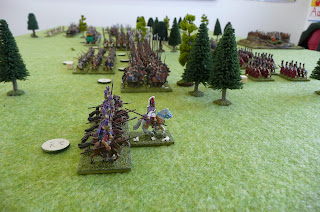
Here are a couple of shots of the deployment turn, showing the Syracusans on their hill and the Carthaginian chariots advanced across the river away from their support.


The battle went through three phases. The first phase saw the Carthaginians trying desperately to hold off the Syracusans with their chariots while reinforcements were brought up. This did not go very well...

Some heavy infantry units arrived, included elements of the Sacred Band, but they did not have the commands to get across the river, nor to attack with all of their chariot units. The Syracusans concentrated on attacking with their centre and their right, as they saw the heavy infantry beginning to form up behind the river and wanted to counter the threat before it materialised.

In the confusion (ie, a succession of very low command rolls) it proved impossible to get anyone at all across the river for the Carthaginians, and with the chariots about to break they fled back across the river to await the arrival of their infantry.
The second phase of the battle saw the Syracusans press forward towards the river and hem the Carthaginian forces in. The Carthaginian difficulties were exacerbated by a sudden burst of rain which prevented orders getting through and made the task of the fighting units that much harder.


With the Carthaginian right gone, it was only a matter of time before the collapse became total. Once the Syracusan left turned in upon the Carthaginian centre it took only two turns for the rout to become general.

I used one stand for veteran units, two stands for average units and three stands for levy units. For chariots and cavalry I used one stand for average units and two stands for levies.
In the Lost Battles scenario Timoleon has his Syracusans deployed on the hill facing the Carthaginians who are attempting to cross the river onto the plain below the rise. The Carthaginians count as surprised, so are only able to deploy four units a turn (subject to the availability of the commands needed to do so!), which gives Timoleon and his men quite an advantage tactically. The Carthaginians have the stronger army, made up of 36,000 infantry in eighteen units, 1000 cavalry in one unit, 400 four-horse chariots in four units and two uninspired commanders (Hasdrubal and Hamilcar) for a total of 62 points of fighting value. Thirteen of the Carthaginian units are levy quality however, which means they are quite ready to cut and run.
The Syracusans have a total of 10,000 foot in eleven units, 1000 cavalry in two units, and Timoleon himself as an inspired leader for a fighting value of 53. Their lower fighting value means that the Syracusans have a victory points handicap of 27 in their favour even before the fighting starts. This is then reduced to 4 points because the Carthaginians are surprised.
Here are a couple of shots of the deployment turn, showing the Syracusans on their hill and the Carthaginian chariots advanced across the river away from their support.


The battle went through three phases. The first phase saw the Carthaginians trying desperately to hold off the Syracusans with their chariots while reinforcements were brought up. This did not go very well...

Some heavy infantry units arrived, included elements of the Sacred Band, but they did not have the commands to get across the river, nor to attack with all of their chariot units. The Syracusans concentrated on attacking with their centre and their right, as they saw the heavy infantry beginning to form up behind the river and wanted to counter the threat before it materialised.

In the confusion (ie, a succession of very low command rolls) it proved impossible to get anyone at all across the river for the Carthaginians, and with the chariots about to break they fled back across the river to await the arrival of their infantry.
The second phase of the battle saw the Syracusans press forward towards the river and hem the Carthaginian forces in. The Carthaginian difficulties were exacerbated by a sudden burst of rain which prevented orders getting through and made the task of the fighting units that much harder.

The third phase saw the Syracusan left force their way across the river, breaking the chariots opposing them and causing widespread panic amongst the levy infantry in the central zones. A number of levy units routed from the field due to this. Elsewhere, the paired Syracusan hoplites were beginning to inflict a lot of damage on the disorganised troops opposing them, and the Carthaginian reinforcements were becoming spent almost as soon as they arrived on the field.
The picture below shows the advance across the river:

With the Carthaginian right gone, it was only a matter of time before the collapse became total. Once the Syracusan left turned in upon the Carthaginian centre it took only two turns for the rout to become general.

The battle finished as a resounding win to Timoleon: the Carthaginians were surprised, panicked, forced to withdraw out of their key zone, rained upon and then broken once the enemy got onto their side of the river. It was a perfectly believable sequence of disastrous events that lead to an overwhelming victory for Timoleon and his small band of men.
The final victory points were as follows:
Carthage: 11
Syracuse: 94
It was my first time to refight Crimisus under Lost Battles, and while I had to use a few proxy troops it was a most enjoyable game and an interesting situation to play out.
Monday, April 18, 2011
Comparing Romans: Chariot 15s (Magister Militum) with Strategia e Tattica 15s (North Star)
As promised some time ago, here are some comparison shots of my Strategia e Tattica Polybian Romans matched up with some figures in the same scale from the Chariot range. Chariot are of course sold by Magister Militum, while Strategia e Tattica can be found on their home site in Italy and are also carried in the UK by North Star.
First up are the hastati. The Chariot figures are to the viewer's left, with the red shields; Strategia e Tattica figures are to the right, with the blue. The height is a very good match, but the Chariot shields are more oval and are a touch thinner. The figures are about the same level of chunkiness, though the SeT ones have slightly wider heads.

Next we have the principes. These figures are also a fairly good match height-wise, but the SeT figures are noticeably more chunky here and one of the poses is also somewhat more roughly sculpted than the others in the range. There was actually a far better selection of poses in the second batch of SeT figures I ordered, so the roughly-sculpted figures are a much smaller proportion of the total figures in the second batch than they are here.

Moving on to the triarii now, you can see that the Chariot shields are very narrow here, even by comparison to the other figures in their range, and while the figures are quite nice to my eye the moulds are aging and there was terrible flash on the figures. In the close up you can see there is still some unwanted flash on the shields and faces that I was unable to remove. It's not quite so obvious to the naked eye, but it certainly is here. The SeT triarii are again a good match in height and chunkiness. They also have good variety in their standing poses, and make an impressive group, in my opinion.

Lastly, we have the velites (the cavalry will have to be posted another time - they aren't painted yet!). These figures are a very good match, and I actually use them in the same unit. The shield are almost the same size and the height and chunk match well, as per usual.

In conclusion, the heavy infantry figures work quite well as different legions/alae in the same force, and the velites can be mixed together in the same unit to create a nice selection of compatible poses. Overall, I prefer the SeT hastati and triarii, with the Chariot principes having the edge over their SeT counterparts at this stage. That might change when the second batch, with its better overall sculpts, is painted up.
I would certainly recommend the Strategia e Tattica infantry for anyone looking for some different figures for their Polybian armies.
First up are the hastati. The Chariot figures are to the viewer's left, with the red shields; Strategia e Tattica figures are to the right, with the blue. The height is a very good match, but the Chariot shields are more oval and are a touch thinner. The figures are about the same level of chunkiness, though the SeT ones have slightly wider heads.

Next we have the principes. These figures are also a fairly good match height-wise, but the SeT figures are noticeably more chunky here and one of the poses is also somewhat more roughly sculpted than the others in the range. There was actually a far better selection of poses in the second batch of SeT figures I ordered, so the roughly-sculpted figures are a much smaller proportion of the total figures in the second batch than they are here.

Moving on to the triarii now, you can see that the Chariot shields are very narrow here, even by comparison to the other figures in their range, and while the figures are quite nice to my eye the moulds are aging and there was terrible flash on the figures. In the close up you can see there is still some unwanted flash on the shields and faces that I was unable to remove. It's not quite so obvious to the naked eye, but it certainly is here. The SeT triarii are again a good match in height and chunkiness. They also have good variety in their standing poses, and make an impressive group, in my opinion.

Lastly, we have the velites (the cavalry will have to be posted another time - they aren't painted yet!). These figures are a very good match, and I actually use them in the same unit. The shield are almost the same size and the height and chunk match well, as per usual.

In conclusion, the heavy infantry figures work quite well as different legions/alae in the same force, and the velites can be mixed together in the same unit to create a nice selection of compatible poses. Overall, I prefer the SeT hastati and triarii, with the Chariot principes having the edge over their SeT counterparts at this stage. That might change when the second batch, with its better overall sculpts, is painted up.
I would certainly recommend the Strategia e Tattica infantry for anyone looking for some different figures for their Polybian armies.
Saturday, April 9, 2011
Bits and Pieces.
Summer is just around the corner so with what little hobby time I've had recently it's been a race to get as many figures prepped and primed as possible before the humidity sets in.
I decided to get my 'odds and ends' out of the way first, mostly extra Spanish tribal types and Punic citizens for my Carthaginian army. Figures are from Chariot (Magister Militum), Corvus Belli and Old Glory. As it turns out, there were about 200 of these extras! I needed to give the Carthaginians a touch up anyway as some of the original painting I did on them was pretty rough, so this will give me a good chance to improve them as I expand the army.
Also prepped are the remainder of my Strategia e Tattica Romans, while a start has been made on the Old Glory/Xyston Persians and the Xyston Greeks. The first batch of hoplites can be seen in the top box. It's fortunate that I'm a beer drinker, or there would be nowhere to put all these fellows...

I'm also quite pleased to have picked up some bargain boardgames recently. Hopefully I'll be able to convince my wife to give them a try with me before the new baby arrives...
I decided to get my 'odds and ends' out of the way first, mostly extra Spanish tribal types and Punic citizens for my Carthaginian army. Figures are from Chariot (Magister Militum), Corvus Belli and Old Glory. As it turns out, there were about 200 of these extras! I needed to give the Carthaginians a touch up anyway as some of the original painting I did on them was pretty rough, so this will give me a good chance to improve them as I expand the army.
Also prepped are the remainder of my Strategia e Tattica Romans, while a start has been made on the Old Glory/Xyston Persians and the Xyston Greeks. The first batch of hoplites can be seen in the top box. It's fortunate that I'm a beer drinker, or there would be nowhere to put all these fellows...

I'm also quite pleased to have picked up some bargain boardgames recently. Hopefully I'll be able to convince my wife to give them a try with me before the new baby arrives...
Tuesday, March 29, 2011
The Cricket World Cup
There hasn't been much action here on the hobby front of late because the cricket World Cup - which is now on in India, Sri Lanka and Bangladesh - has been taking up quite a bit of my time. As a kiwi I follow the New Zealand team, so I was extremely pleased to see them get past one of the tournament favourites, South Africa, in a testing quarter-final the other night.
It is not always easy being a follower of New Zealand cricket. Our sides have tended to be made of up honest triers and the odd player capable of turning a game on its head. New Zealanders have attempted to make up for lack of talent with grit and nous, but a rash of premature retirements during former coach John Bracewell's time in charge set the team back a long way, and it still hasn't really recovered from that.
Still, it's moments like these that we must dare to hope that this might just be the time that they make it through to a World Cup final, and give themselves a chance of glory!
It is not always easy being a follower of New Zealand cricket. Our sides have tended to be made of up honest triers and the odd player capable of turning a game on its head. New Zealanders have attempted to make up for lack of talent with grit and nous, but a rash of premature retirements during former coach John Bracewell's time in charge set the team back a long way, and it still hasn't really recovered from that.
Still, it's moments like these that we must dare to hope that this might just be the time that they make it through to a World Cup final, and give themselves a chance of glory!
Tuesday, March 15, 2011
Pat's photos of our Magnesia games
Pat has very kindly sent me the photos he took of our Magnesia battle. He has taken a series of close up shots, which I'm very pleased to post here.


Our Eumenes for the day. Another Xyston figure, this time painted by myself.


Chariot equites.


Old Glory Seleucid cataphracts. I didn't do a very good job painting these and they could do with a touch up. I do like the figures though; they have a certain air of nastiness about them.


A big thank you to Pat for these photographs!
Hastati from Magister Militum's Chariot range. These were some of the first figures I painted, way back in 2005.


Xyston Antigonid phalangites, painted by Fernando in Sri Lanka.

Our Eumenes for the day. Another Xyston figure, this time painted by myself.

The Antiochus of the day. Xyston again.

Chariot equites.

Xyston peltasts, again painted by Fernando.

Old Glory Seleucid cataphracts. I didn't do a very good job painting these and they could do with a touch up. I do like the figures though; they have a certain air of nastiness about them.

Roman allies from the Strategia e Tattica range. My new favourite Romans.

Antiochus with his guard of Old Glory xystophoroi. As you might have gathered, I really like the cavalry of the Old Glory Successor range!

A jumbo from Chariot.

And lastly, the hand of doom...
Sunday, March 13, 2011
Magnesia with Pat
My boardgame buddy Pat and I had been planning to get together for a game day for some time, and we decided that we would go ahead with the event today despite the horrific earthquakes, tsunamis and threatened nuclear meltdowns up north. It turned out that it was a good way to take our minds off the horror, and I certainly feel a lot better after a chance to chew the fat and let off a bit of steam.
I'd had a few ideas for games, but with the disruption of the past week we ended up settling on the tried and true - Magnesia with Lost Battles - and the simple and classic - the Quatre Bras scenario from SPI's 1976 quadrigame 'Napoleon's Last Battles'.
We got through two games of Magnesia, with Pat cleaning up both times as the Romans on the back of aggressive cavalry attacks on Eumenes' flank and canny use of all-out attacks in the centres.
The first game ended early with Antiochus' death in a rally attempt leading to a general rout. The second game was much closer, with the Seleucid line being rolled up from its left while the phalanx tried desperately to break the legions opposite them. In neither game did I manage to shatter a Roman unit, which shows how well Pat managed his forces. It was good to see the Romans perform well, as the last time I played the scenario some ridiculous dice saw Scipio and friends utterly routed ( go here to see a report of that battle).
From memory, the first game was won 80-33 and the second 91-76
The Quatre Bras game was a light way to fill in the last hour of the visit, and some good dice results saw the the French beaten off.
Here are some photos of the Lost Battles action. As always, click on the images to see larger shots.


I'd had a few ideas for games, but with the disruption of the past week we ended up settling on the tried and true - Magnesia with Lost Battles - and the simple and classic - the Quatre Bras scenario from SPI's 1976 quadrigame 'Napoleon's Last Battles'.
We got through two games of Magnesia, with Pat cleaning up both times as the Romans on the back of aggressive cavalry attacks on Eumenes' flank and canny use of all-out attacks in the centres.
The first game ended early with Antiochus' death in a rally attempt leading to a general rout. The second game was much closer, with the Seleucid line being rolled up from its left while the phalanx tried desperately to break the legions opposite them. In neither game did I manage to shatter a Roman unit, which shows how well Pat managed his forces. It was good to see the Romans perform well, as the last time I played the scenario some ridiculous dice saw Scipio and friends utterly routed ( go here to see a report of that battle).
From memory, the first game was won 80-33 and the second 91-76
The Quatre Bras game was a light way to fill in the last hour of the visit, and some good dice results saw the the French beaten off.
Here are some photos of the Lost Battles action. As always, click on the images to see larger shots.

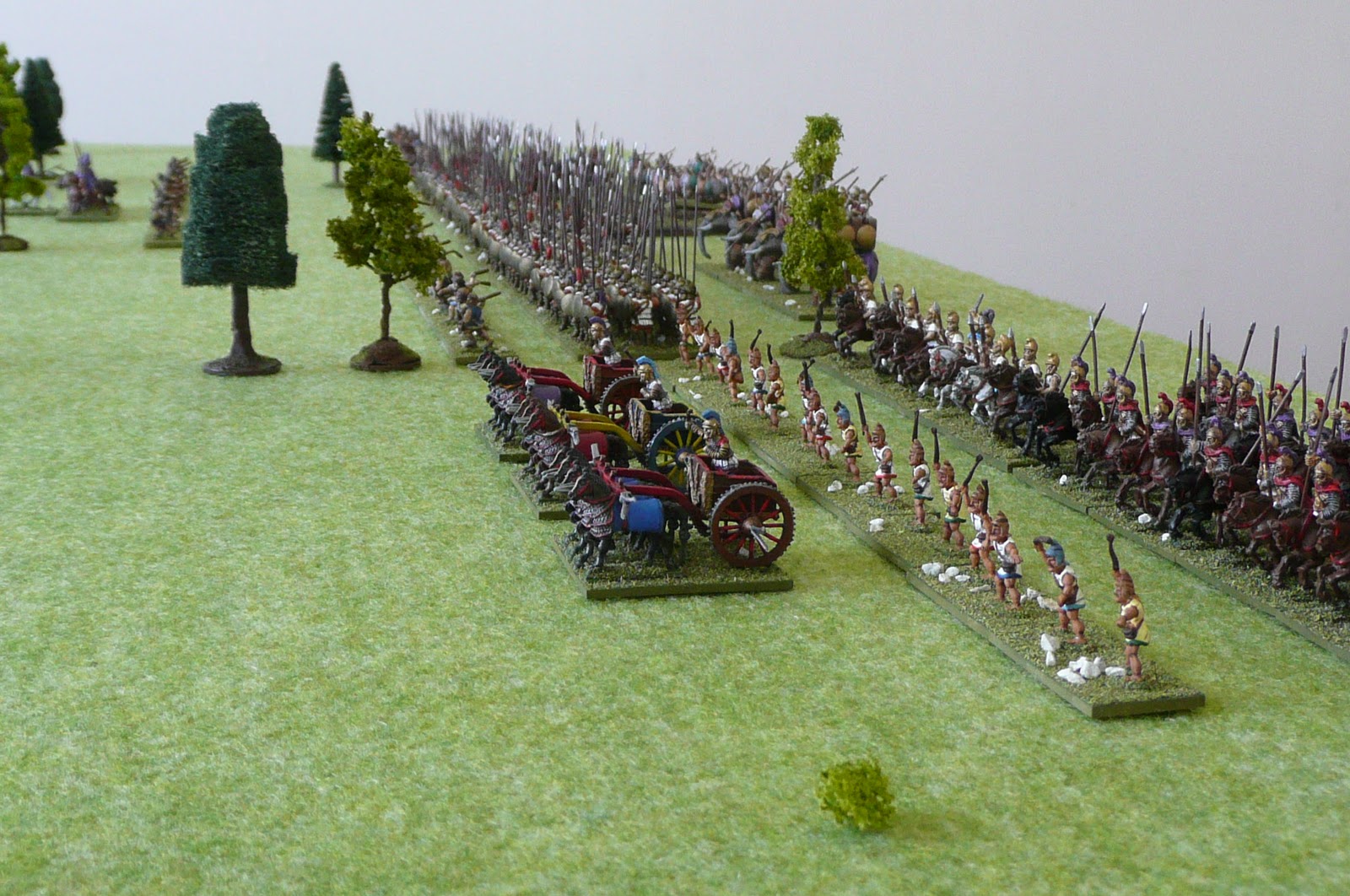


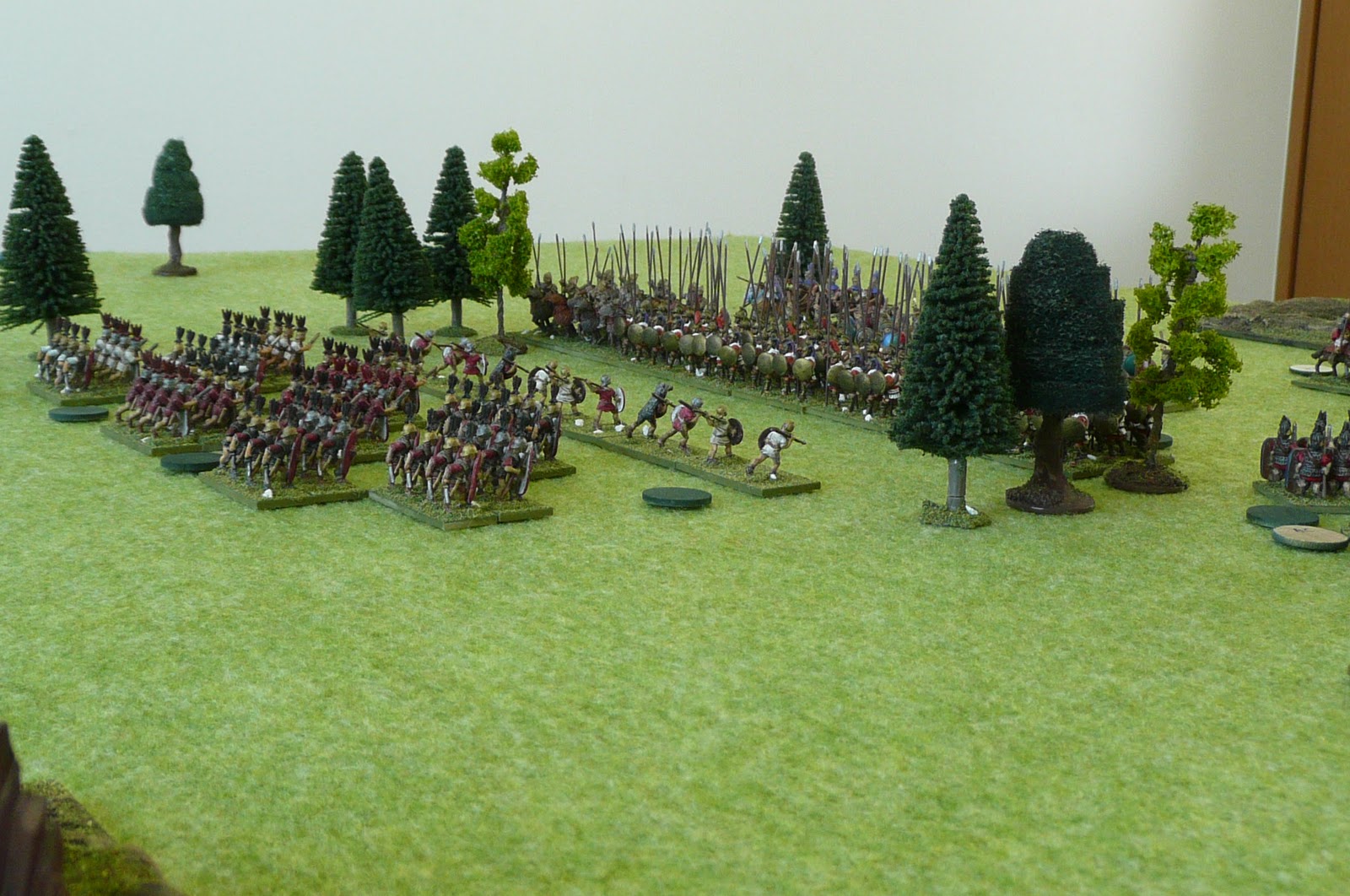


* I've got a new 1800 x 900 table (well, our school does...) which allowed us to try out my latest ground carpet and use zones 320mm (8 bases) across. On the whole I was pretty pleased with how it looked, compared to my usual set up.
Subscribe to:
Posts (Atom)
